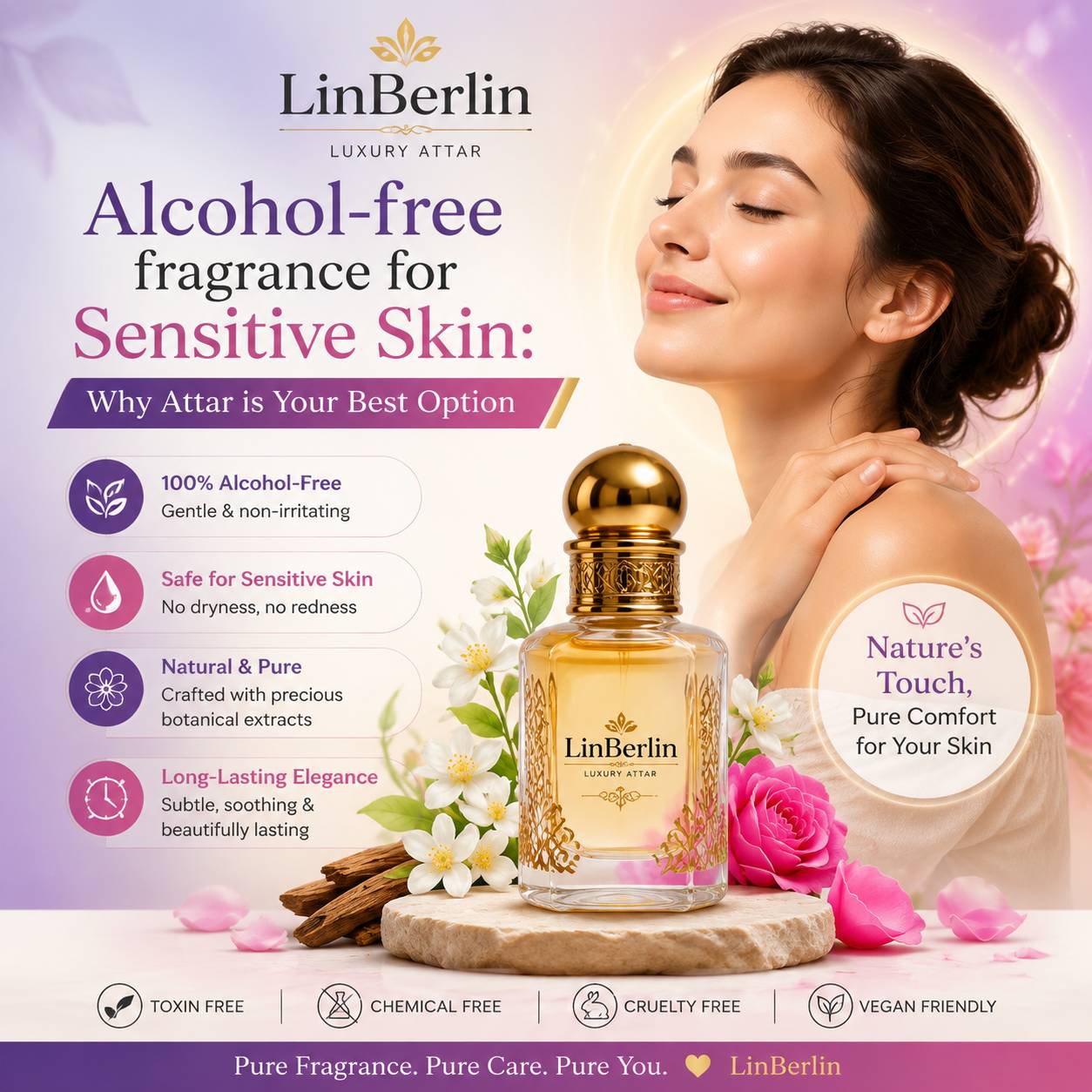
My grandmother kept a small glass bottle of ittar on her dressing table that outlived three houses, two cities, and, I'm fairly sure, one marriage. No alcohol in it, no fancy atomizer, just oil and patience. She'd dab a drop behind her ears and go about her day, and the scent would still be there faintly at dinner. I think about that bottle a lot now, because half the questions I get from readers with sensitive skin boil down to the same thing: why does my perfume burn, and why does hers never did.
The honest answer is alcohol. Not always, but often enough that it's worth taking seriously if your skin reacts to fragrance at all.
What actually happens when you spray alcohol-based perfume on reactive skin
Most commercial perfumes are built on an ethanol base, sometimes 70 to 90 percent of the bottle by volume. Ethanol is a fantastic solvent — it carries fragrance oils evenly, it evaporates fast, it gives you that initial "burst" of scent people associate with luxury perfume. But it's also drying. It strips the skin's surface lipids on contact, and for someone with eczema, rosacea, keratosis pilaris, or just skin that's naturally on the reactive side, that moment of contact can mean stinging, redness, or a rash that shows up an hour later and gets blamed on something else entirely. I've seen this play out with people who swore off fragrance for years, convinced they were simply "allergic to perfume." And in a narrow sense they were — allergic to the solvent and the synthetic fixatives riding along with it, not to fragrance itself.
So here's the thing. Attar sidesteps almost the entire problem, because it isn't built the same way to begin with.
Why oil-based attar behaves differently on skin
Attar is a fragrance suspended in a carrier oil — traditionally sandalwood oil, though today you'll also see fractionated coconut oil or jojoba used as neutral bases. There's no ethanol doing the work of carrying the scent. The oil itself does that, slowly, and slowly is really the operative word here.
A few things follow from that structure. The oil sits on the skin rather than evaporating off it in the first ten minutes. It doesn't disrupt the skin barrier the way alcohol does — if anything, a good carrier oil supports it. And because the fragrance molecules are released gradually as the oil warms against your body heat, you get a much longer, much gentler unfolding of scent rather than a sharp opening blast that fades to nothing by lunch. For sensitive skin specifically, this matters less as a luxury detail and more as a practical one. Attar simply gives your skin less to react to.
But — and this is where I have to be honest — attar isn't automatically hypoallergenic
I'd be doing you a disservice if I let you walk away thinking oil-based fragrance is risk-free for everyone. It isn't. Natural doesn't mean inert. Real botanical materials contain naturally occurring allergens too — citrus oils carry limonene, which can be irritating in high concentrations; some absolutes contain trace linalool; oud and certain resins can trigger reactions in people with existing sensitivities to tree resins or balsams. The difference is one of degree and frequency, not an absolute guarantee. If you've had a reaction to a specific botanical family before — say, you know citrus peel irritates your skin in skincare products — that same caution should carry over to a citrus attar, even a natural one.
Realistically, the safest approach for anyone with genuinely reactive skin is a patch test. Apply a small amount to the inner forearm, wait 24 hours, and watch for redness or itching before you commit to wearing it on pulse points daily.
How skin type changes the way attar performs
People assume fragrance longevity is only about the product. It isn't. Your own skin is half the equation. Dry skin holds scent poorly because there's less surface oil for fragrance compounds to bind to — the scent molecules have nothing to cling to and dissipate faster, which is part of why dry-skinned people often feel like their perfume "disappears" within an hour. Oily skin, on the other hand, tends to amplify and extend scent, sometimes to the point of feeling too strong by afternoon. Combination skin lands somewhere in between and can behave unpredictably zone to zone — attar applied to an oily T-zone-adjacent area like the neck may read differently than the same drop on a drier wrist. This is actually one of attar's quiet advantages. Because it's oil-based already, it doesn't need your skin's own oils to carry it the way alcohol-based spray does. Even dry-skinned wearers get reasonable longevity from a well-made attar, since the fragrance is riding on its own carrier rather than depending on your skin barrier to hold it in place.
Layering attar with your skincare routine without causing irritation
This is where most of the actual mistakes happen, and it's rarely the attar's fault. Applying fragrance oil on top of active ingredients — retinoids, AHAs, BHAs, vitamin C in higher concentrations — while the skin barrier is compromised or mid-purge is asking for trouble. Doesn't matter how gentle the attar is; if your skin is already inflamed from actives, adding any concentrated aromatic compound on the same patch of skin can tip it into irritation. I've had readers write in convinced a new attar was "too strong," when really they'd applied it straight over a fresh retinol night, on skin that was already compromised before the fragrance ever touched it. The fix is sequencing, not avoidance. Let actives fully absorb and settle — give it at least twenty to thirty minutes — before applying attar, and ideally apply the oil to a spot your actives don't reach, like behind the ears, the inner elbow, or the nape of the neck rather than directly on the face or décolletage where serums concentrate. Moisturized skin also holds scent noticeably longer than dry skin, which is a genuinely useful thing to know. A thin layer of unscented moisturizer or a natural oil like jojoba under your attar gives the fragrance molecules something to bind to and slows their evaporation. This is standard practice among perfume houses, not a LinBerlin-specific trick, but it works particularly well with oil-based attar because both layers are compatible chemically — you're not fighting an alcohol-oil mismatch.
Where extra caution is genuinely warranted
A few situations deserve more care than a casual "patch test and go":
Pregnancy changes skin sensitivity for a lot of people, and certain aromatic compounds — some concentrated essential oils in particular — are generally advised against during pregnancy, especially in the first trimester. If you're pregnant or breastfeeding, it's worth checking with your doctor before introducing a new concentrated fragrance oil, attar included, and starting with a much smaller amount than usual if you do. Broken or compromised skin — active eczema flares, sunburn, recent chemical peels — should never have fragrance applied directly to the affected area, oil-based or otherwise. Wait until the skin has visibly healed. And if you're on any photosensitizing medication or using strong retinoids, be aware that some botanical oils, particularly certain citrus-derived ones, carry a mild phototoxic risk. This is a smaller category than people assume, but it exists, and it's worth reading the ingredient list rather than guessing.
A practical way to test and wear attar if you have sensitive skin
Start with a single note rather than a complex blend — something like sandalwood or a simple rose attar rather than a layered oud composition — since fewer ingredients means fewer variables if something does react. Apply to the inner forearm first and leave it alone for a full day before moving to pulse points. Once you've confirmed it agrees with you, apply to warm areas of the body — wrists, inner elbows, behind the ears, the base of the throat — since body heat is what releases the scent gradually throughout the day. Use less than you think you need. A single drop, rubbed rather than rubbed hard, goes further with oil-based fragrance than the equivalent amount of spray perfume ever would.
The takeaway
Alcohol-free doesn't mean risk-free, and no fragrance format is universally safe for every skin type. But if your skin has a history of reacting to spray perfume, an oil-based attar removes the most common irritant from the equation entirely — the alcohol itself — while giving you a longer, warmer, more personal scent experience in return. Patch test first, apply to clean or lightly moisturized skin, keep it away from freshly actived skin, and let your own body heat do the rest of the work. That's really the whole method, and it's held up for a lot longer than most modern skincare advice has.