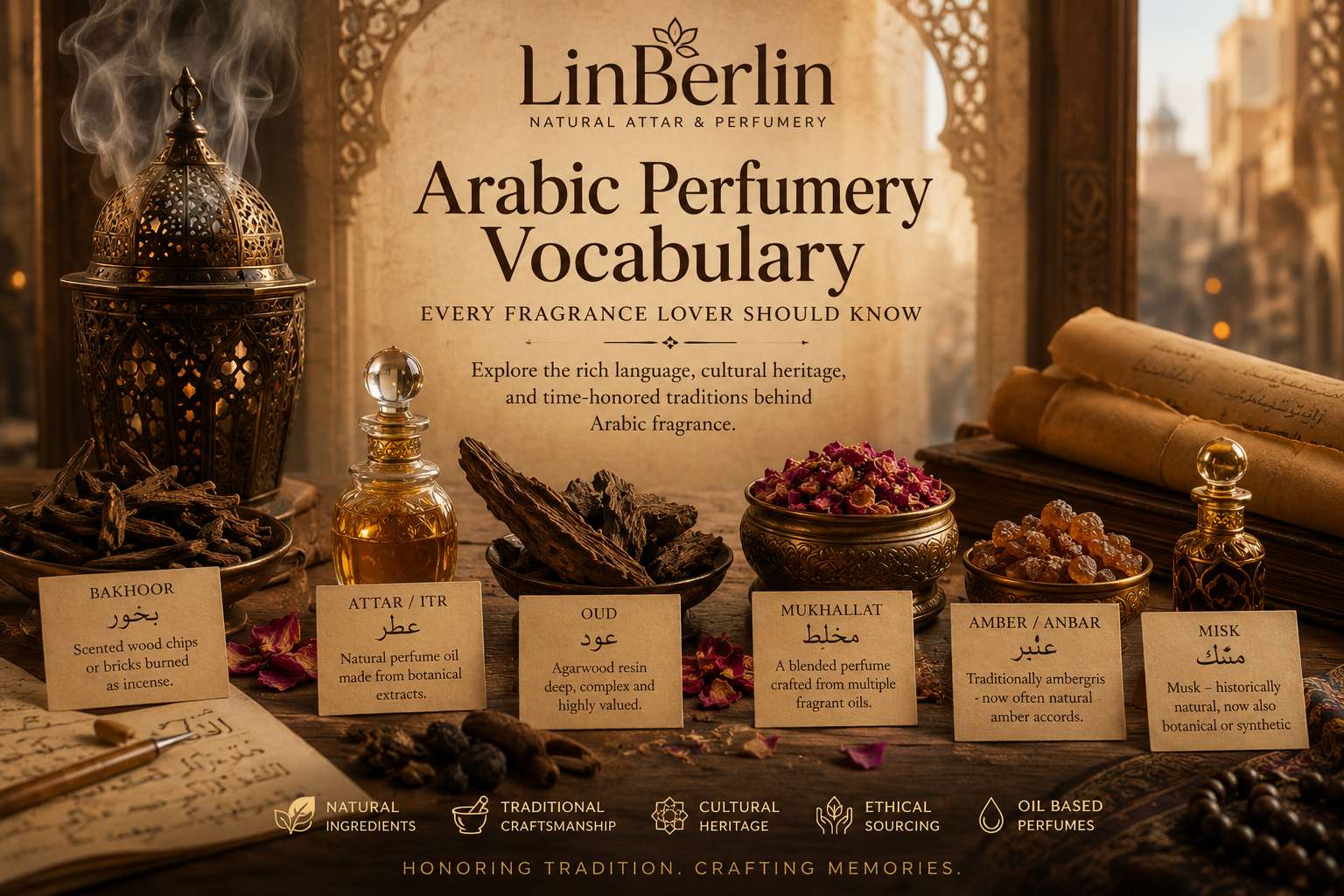
Arabic perfumery vocabulary every fragrance lover should know, from oud and mukhallat to bakhoor and attar, with real cultural depth and history. Arabic perfumery vocabulary every fragrance lover should know
Warm resin drifted through the stone corridors long before anyone entered the room. In old souks from Damascus to Muscat, scent often arrived first: oud smoke curling above folded textiles, rose oil pressed into the wrist during greetings, amber resting quietly in carved wooden boxes beside handwritten ledgers. The language surrounding these traditions carries its own texture, and Arabic perfumery vocabulary every fragrance lover should know isn't merely about terminology. Many of these words hold centuries of trade, ritual, hospitality, and memory inside them. Some travelled across oceans with merchants from Hadhramaut and Gujarat. Others stayed rooted in family customs, passed from grandparents to children during Eid gatherings or wedding preparations. Understanding these words changes the way perfume itself feels, because suddenly a bottle stops being just a product and starts sounding like history spoken aloud.
The historical roots
Across the Arabian Peninsula, fragrance occupied a practical and ceremonial place long before modern perfumery emerged in Europe. Frankincense caravans moved through southern Arabia more than two thousand years ago, linking present-day Oman and Yemen to the Mediterranean world through the Incense Route — an enormous trade network connecting ports, deserts, and royal courts. The Nabataeans, whose kingdom flourished around Petra between the 4th century BCE and 106 CE, controlled important portions of these exchanges.
And scent wasn't limited to royalty. Historical records from Abbasid Baghdad describe public markets filled with perfume sellers blending oils, woods, musk, and herbal distillations for ordinary households as well as wealthy patrons. During the Islamic Golden Age, scholars such as Al-Kindi and Ibn Sina contributed significantly to extraction techniques and aromatic chemistry (particularly distillation methods involving rose). Their writings shaped fragrance production across Persia, the Levant, North Africa, and South Asia.
Many commonly used Arabic perfume terms emerged directly from these traditions. "Oud" refers to agarwood formed when Aquilaria trees develop resin in response to infection. The material became treasured across Gulf societies for both personal use and ceremonial burning. "Bakhoor" describes wood chips or compressed fragrance bricks burned for smoke, often inside homes before guests arrive. "Attar," although deeply associated today with South Asian perfumery, comes from the Arabic word itr, meaning perfume or scent.
Trade between Arab merchants and the Indian subcontinent shaped vocabulary in both directions. Gujarati ports welcomed traders from Yemen and Oman for centuries, while Mughal courts later embraced oud, rose, saffron, and sandalwood oils with extraordinary refinement. So certain words now feel shared rather than belonging to a single region.
Another term worth understanding is "mukhallat." You’ll hear it often in Gulf perfumery, especially among traditional oil houses. It describes a blended perfume composition, usually involving multiple oils layered carefully together rather than showcasing a single note. Some mukhallats contain oud and rose; others soften heavier materials with white musk or amber accords. There isn't one fixed recipe, which explains why two perfumes carrying the same label can smell completely different.
And then there's "dehn al oud" — literally meaning "fat of oud" or pure oud oil. In older perfumery circles, the distinction matters enormously because it signals genuine distilled agarwood oil rather than a synthetic interpretation. The truth is, experienced perfume wearers in the Gulf can often identify regional oud styles within seconds: smoky Cambodian profiles, medicinal Hindi oud, softer Malaysian distillations.
The cultural significance
Inside many Arab homes, fragrance still functions as social language rather than decoration. A guest offered bakhoor-scented clothing or a wrist touched lightly with perfume oil understands they are being welcomed with care. In Gulf cultures, preparing the house with incense before visitors arrive remains deeply tied to hospitality. The smoke itself matters, but so does the gesture.
Bakhoor ceremonies vary from family to family, and that's where outside simplifications often miss the point. In some households, an incense burner moves from person to person after meals. Elsewhere, garments are lightly passed through smoke before celebrations. Weddings across parts of Saudi Arabia, Oman, and the UAE may involve elaborate fragrance rituals combining rose water, oud smoke, and musk oils.
But perfume also carries spiritual resonance. Islamic traditions contain numerous references to cleanliness, pleasant scent, and the use of fragrance. Historical narrations describe the Prophet Muhammad's appreciation for perfume, and this shaped fragrance culture across many Muslim societies over centuries. Musk, rose, and oud became associated not only with beauty but with dignity, prayer preparation, and respectability.
Some readers may wonder: are all Arabic perfumes extremely strong? Not necessarily. Modern exports sometimes exaggerate intensity because international buyers expect power from Middle Eastern fragrance houses. Yet many traditional oils are intimate and close to the skin, especially older floral attars and softer white musk blends.
The vocabulary itself reflects emotional and cultural layers. "Misk" refers to musk, historically derived from animal sources though now largely recreated synthetically or botanically. "Ward" means rose, but within perfumery discussions it often signals specific regional roses such as Taif rose from western Saudi Arabia. "Amber" or "anbar" traditionally referred to ambergris rather than the sweet lab-created amber accord common in modern western perfumery.
And language changes with geography. A perfume term used casually in Kuwait may carry slightly different associations in Morocco or Sudan. Honestly, this complexity is part of what makes Arabic fragrance traditions so alive; they were shaped across trade routes rather than within rigid borders.
One especially beautiful word is "majlis," the sitting space where guests gather for conversation and coffee. Fragrance is woven naturally into these rooms — sometimes through incense burners, sometimes through textiles carrying traces of oud smoke from previous evenings. The scent becomes part of memory architecture itself.
Or consider "mamool," small scented wood pieces soaked in oils before burning. Some families still prepare them at home using inherited recipes. These practices rarely appear in tourist descriptions of Middle Eastern perfume culture, yet they form the everyday reality behind the vocabulary.
How this tradition lives today
Walk through Dubai, Doha, or Riyadh now and you'll find fragrance traditions adapting in remarkably modern ways without fully abandoning older customs. Independent perfume houses experiment with saffron, leather, tobacco, and marine accords while still building around oud, musk, rose, and incense. Younger perfumers in the Gulf increasingly blend French-style structure with traditional Arabic materials — sometimes producing fragrances that feel suspended between Paris and Muscat.
Social media has changed the language too. Terms once familiar mainly within Arabic-speaking regions now circulate globally among fragrance communities. Collectors discuss dehn al oud on Reddit forums. TikTok reviewers debate whether a mukhallat smells more Emirati or Kuwaiti in style. Yet despite this international exposure, many traditional fragrance rituals remain private and domestic.
And oil perfumery continues to hold strong cultural relevance even as spray perfumes dominate retail shelves. Concentrated oils suit hotter climates well because they evolve slowly on skin. They're also practical for layering, which remains common across Gulf fragrance habits — a wearer might combine musk oil, rose spray, and bakhoor-treated clothing all at once.
There are changes, of course. Ethical concerns around natural musk and sustainability pressures affecting agarwood cultivation have reshaped parts of the industry. Some oud oils today come from cultivated trees rather than wild forests, especially in Southeast Asia. That doesn't automatically reduce quality, but it does alter production traditions.
Here's the thing: Arabic perfumery survives because it keeps adapting without severing itself from memory. The vocabulary remains alive not in museums but in kitchens, prayer rooms, airports, weddings, and ordinary evening gatherings.
LinBerlin's connection to this tradition
LinBerlin approaches these traditions with respect for the cultures that shaped them rather than treating Arabic fragrance vocabulary as exotic decoration. The brand's focus on natural oils, attars, and carefully sourced materials comes from genuine appreciation for slower perfumery practices where ingredients matter as much as branding.
Some of LinBerlin's blends draw quietly from traditions surrounding oud, rose, saffron, and incense — not by copying historical formulas directly, but by understanding why those materials became meaningful in the first place. That distinction matters. A traditional mukhallat created in Kuwait for family use carries cultural context that can't simply be recreated through marketing language.
And the brand recognises that fragrance traditions across the Middle East and South Asia are interconnected rather than isolated. Trade routes, migration, pilgrimage, and shared craftsmanship shaped these scent cultures together over centuries.
Closing
Learning perfume vocabulary from Arabic traditions changes more than your fragrance knowledge. Suddenly words like bakhoor, attar, and dehn al oud stop sounding ornamental and begin revealing the people behind them: merchants crossing the Red Sea, families scenting homes before gatherings, artisans distilling rose at dawn, travellers carrying oud oil between continents. The next time you encounter one of these terms on a bottle or in conversation, pause long enough to ask where it came from and how people actually lived with it. Perfume becomes richer when language keeps its history attached.