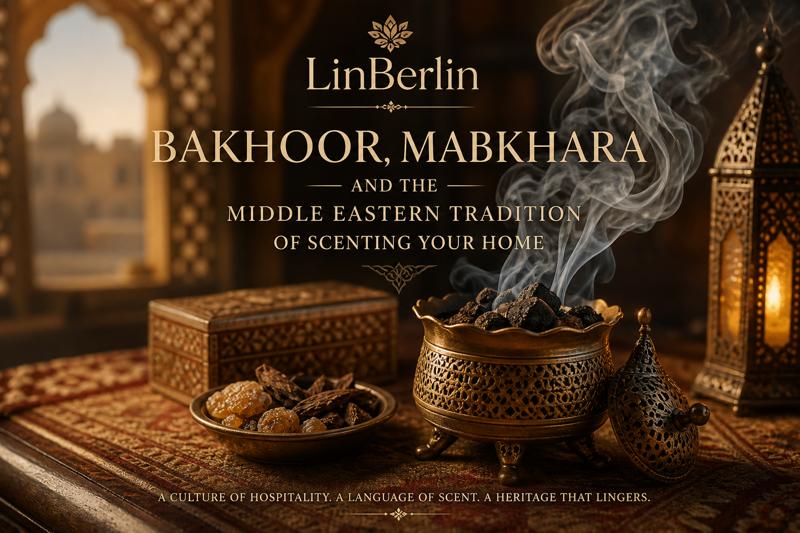
Bakhoor and mabkhara reveal a living Middle Eastern tradition of scenting homes—rooted in history, ritual, and the quiet art of sharing fragrance. Bakhoor, mabkhara and the Middle Eastern tradition of scenting your home
The first curl of smoke doesn’t announce itself loudly. It slips into a room, warm and resinous, catching in fabric, settling into wood, lingering in a way that feels almost deliberate. In homes across the Middle East, this quiet act—burning bakhoor in a mabkhara—has shaped how spaces are welcomed, shared, and remembered for generations. It’s not only about fragrance. It’s about presence.
And if you’ve ever stepped into such a space, you’ll recognise that something subtle shifts. The air feels inhabited, even before a word is spoken. Bakhoor and the mabkhara aren’t decorative traditions; they’re part of how hospitality is performed, how memory is built, and how scent becomes a form of language.
The historical roots
Long before modern perfumery found its glass bottles and atomisers, incense was moving along trade routes that connected South Asia, East Africa, and the Arabian Peninsula — routes that carried not just goods, but rituals. Frankincense and myrrh from Dhofar and Yemen were already prized in ancient Egypt and Rome, and by the early Islamic period, the Arabian Peninsula had become a centre for both trade and refinement of aromatic materials.
But bakhoor as it’s known today developed later, shaped by domestic life rather than imperial ceremony. Wood chips—often oud or other fragrant woods—were soaked in oils, resins, and sometimes ambergris, then dried and stored. When burned, they released a layered scent that felt intimate rather than monumental (and that distinction matters more than it might seem).
So how did the mabkhara enter the picture? The vessel itself reflects regional aesthetics: in the Gulf, you’ll find tall, ornate metal burners; in parts of North Africa, simpler clay forms; and in older Levantine homes, even improvised versions using what was at hand. The design isn’t incidental — it shapes how heat rises, how smoke disperses, how the ritual unfolds.
And the truth is, there isn’t a single origin story that neatly explains everything. Traditions like these evolve through households, not just empires, and what survives is often what people find meaning in, not what historians record.
The cultural significance
There’s a moment in many homes where a guest crosses the threshold and the mabkhara is already lit. It’s not announced. It doesn’t need to be. The scent reaches first, and with it, a message: you’re welcome here.
But this gesture carries layers. In Gulf countries, passing the mabkhara from host to guest allows each person to gently waft the smoke into their clothing. It’s a shared act, almost conversational — and it subtly blurs the line between personal scent and environmental fragrance.
And why does that matter? Because in these traditions, scent isn’t strictly private. It’s communal, negotiated, and tied to ideas of respect and presence. A well-scented home reflects care, but it also reflects awareness of others.
There’s also a spiritual dimension that’s harder to reduce to simple explanation. In some households, bakhoor is burned before prayer, or after cleaning, or during specific occasions where scent is understood to purify the atmosphere. But it would be misleading to treat this as uniform — practices vary widely across regions, families, and even generations.
And then there’s memory. The smell of a particular bakhoor blend can anchor someone instantly to a grandmother’s home, a wedding night, or a quiet evening during Ramadan. Unlike bottled perfume, which often travels with the individual, bakhoor belongs to the space — and to everyone who has passed through it.
Or think about this: how often do we associate a home with its scent more than its appearance?
How this tradition lives today
Step into a contemporary apartment in Dubai or Doha and you’ll still find the mabkhara, though sometimes alongside electric burners and pre-mixed bakhoor blends. The ritual hasn’t disappeared; it has adapted.
And honestly, this adaptation has made the practice more accessible without necessarily stripping it of meaning. Ready-made bakhoor blends allow younger generations to participate without needing deep knowledge of preparation — though purists will argue that something is always lost in that convenience.
So where does the tradition feel most alive today? In gatherings. Weddings, Eid celebrations, and family visits still centre scent as part of hospitality. But it also lives in smaller moments — a quick burn before guests arrive, or even just for oneself at the end of a long day.
But there’s also a quiet shift happening. Outside the Middle East, people are rediscovering bakhoor not as an exotic artefact, but as a different way of thinking about fragrance altogether. Not sprayed, but released. Not worn, but shared.
LinBerlin's connection to this tradition
At LinBerlin, the influence of bakhoor isn’t approached as something to replicate directly, but something to understand deeply. The brand’s focus on oil-based perfumery naturally aligns with traditions where scent develops slowly, interacts with warmth, and settles into the skin or surroundings rather than projecting sharply.
And here’s the thing — translating a living cultural practice into modern perfumery requires restraint. It means acknowledging what can’t be carried over fully: the ritual, the shared space, the tactile experience of smoke.
Instead, LinBerlin draws from the materials and sensibilities behind bakhoor: resinous accords, wood-rich compositions, and a preference for depth over immediacy. The goal isn’t imitation, but resonance.
Closing
There’s something quietly radical about scenting a space rather than a person. It shifts attention away from self-presentation and toward shared experience.
And maybe that’s why bakhoor continues to matter. Not because it’s old, but because it offers a different way of relating to scent — one that’s slower, more communal, and more attentive.
If you ever find yourself with a mabkhara in hand, don’t rush it. Let the smoke take its time. It always does.