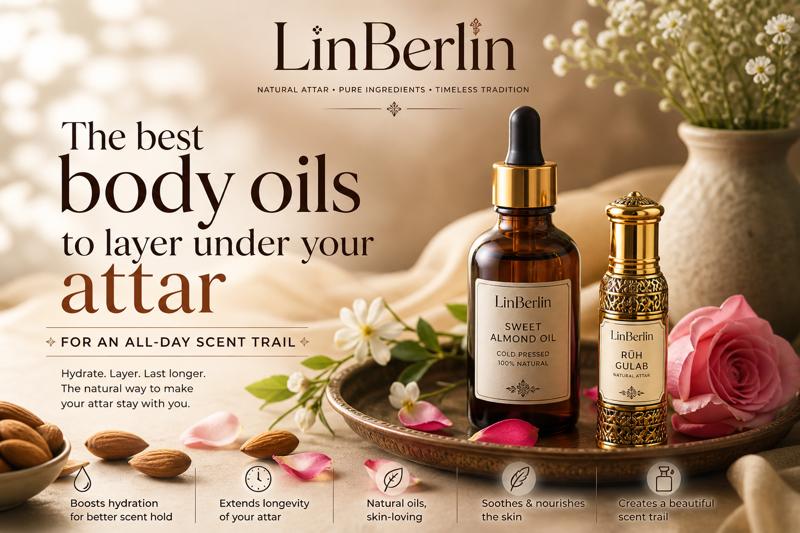
Discover the best body oils to layer under your attar for longer-lasting scent, with expert skincare insights on hydration, skin type, and safe fragrance layering. The best body oils to layer under your attar for an all-day scent trail
A faint trace of sandalwood lingers on the wrist, but by mid-afternoon it’s gone — not because the attar failed, but because the skin beneath it was quietly working against it.
Anyone who has worn natural attar long enough notices this pattern: the same fragrance behaves differently depending on what your skin feels like that day. Slightly dry, freshly exfoliated, or layered over a nourishing oil — each state changes how the scent unfolds. That’s where the idea of layering body oils under attar becomes more than a beauty trick; it becomes essential for building a scent trail that lasts.
And yet, many people either skip this step or get it wrong, ending up with a fragrance that disappears too quickly or feels oddly sharp. The right base oil doesn’t compete with your attar — it anchors it.
How skin condition affects fragrance
Skin isn’t a passive surface; it’s an active, shifting environment that shapes how fragrance behaves from the first drop to the final dry-down.
Hydrated skin holds scent better because oils and moisture slow down evaporation — the fragrance molecules have something to cling to. Dry skin, on the other hand, lets scent escape quickly, often making even rich attars feel faint within hours. And this isn’t just about applying more perfume; it’s about what’s underneath it.
But hydration isn’t the only factor. Your skin’s natural pH and oil production also influence how a scent develops. Slightly acidic skin can sharpen certain notes, while oilier skin may amplify warmth and depth (especially with oud-based attars). That’s why the same attar smells subtly different on different people.
So what happens when skin is compromised — over-exfoliated, irritated, or sensitised from actives like retinol or acids? Fragrance can feel harsher, sometimes even uncomfortable, because the barrier isn’t intact enough to handle aromatic compounds.
The truth is, most longevity issues aren’t about the quality of the attar at all; they’re about the condition of the skin wearing it.
Applying attar safely and effectively with a skincare routine
There’s a quiet rhythm to layering fragrance with skincare — and once you get it right, it becomes second nature.
Start with clean skin that still holds a bit of moisture after bathing. This is when your skin is most receptive. Applying a lightweight body oil at this stage helps seal in hydration while creating a smooth surface for the attar to sit on (not sink into too quickly).
And not all oils behave the same. A fast-absorbing oil like jojoba mimics the skin’s natural sebum, making it an ideal neutral base. Sweet almond oil offers a slightly richer feel, which works beautifully under deeper attars like oud or amber. Coconut oil can work too, but only if your skin tolerates it well — for some, it can feel heavy or even clog pores.
Wait a minute or two after applying the oil before dabbing your attar. This small pause allows the oil to settle without becoming fully dry, creating that perfect in-between layer that holds scent effectively.
But here’s where people often slip up: applying attar directly over active skincare ingredients. Retinol, AHAs, BHAs, and even strong vitamin C serums can make skin more reactive. Layering fragrance immediately after these can lead to irritation, especially on pulse points where skin is thinner.
Or you might be wondering — should you apply attar on top of moisturiser instead of oil? It can work, but creams often contain emulsifiers and water, which don’t anchor fragrance as effectively as pure oils do.
So if your routine includes actives, it’s better to keep fragrance application to areas that haven’t been treated heavily, or to wait until your skin has settled.
And honestly, less is more. Natural attars are concentrated; a small amount layered correctly will outlast heavy application on bare skin.
Ingredients to know about in natural attar
The beauty of attar lies in its ingredients — but those same ingredients interact with your skin in very real ways.
Sandalwood oil, often used as a base, has a naturally soothing quality that pairs well with most skin types. It also acts as a fixative, helping other notes last longer on the skin (which is why it’s so common in traditional attar blends).
Oud, deeper and more complex, can behave differently depending on its concentration. On well-moisturised skin, it develops slowly and richly. On dry skin, it can sometimes feel sharp at first before settling down.
Rose and jasmine, though gentle in perception, still contain natural aromatic compounds that can be reactive for highly sensitive skin. This doesn’t mean avoiding them — just applying thoughtfully.
Carrier oils used in attar, such as fractionated coconut oil or sandalwood base, also play a role. They influence absorption rate and how quickly the scent diffuses. Some sit closer to the skin, while others project slightly more.
Here’s the thing: natural doesn’t automatically mean irritation-free. Essential oils are potent, and skin that’s already stressed may respond unpredictably.
And what about layering multiple scented oils — does that improve longevity or create confusion? It depends on balance. Too many competing notes can blur the character of your attar instead of enhancing it.
LinBerlin formulations and skin compatibility
LinBerlin attars are built with skin in mind — not just scent.
The formulations lean on high-quality natural bases that sit comfortably on the skin without feeling greasy or overly volatile. This makes them particularly suitable for layering over simple body oils, where the goal is to enhance rather than mask the fragrance.
There’s also a noticeable clarity in how the notes unfold. Instead of overwhelming projection, the scent develops gradually, which works well for people who prefer a close, evolving trail rather than an immediate burst.
That said, sensitivity varies from person to person, and even well-crafted attars should be patch-tested if your skin tends to react easily.
Closing thoughts
A well-layered attar doesn’t shout; it lingers in a way that feels personal and intentional.
Start by paying attention to your skin rather than your fragrance alone. Choose a simple, compatible body oil, apply it on slightly damp skin, and give it a moment before adding your attar. That small shift changes everything — not just how long your scent lasts, but how it feels throughout the day.
And if you’ve been disappointed by fading fragrance before, this might be the step that quietly fixes it.