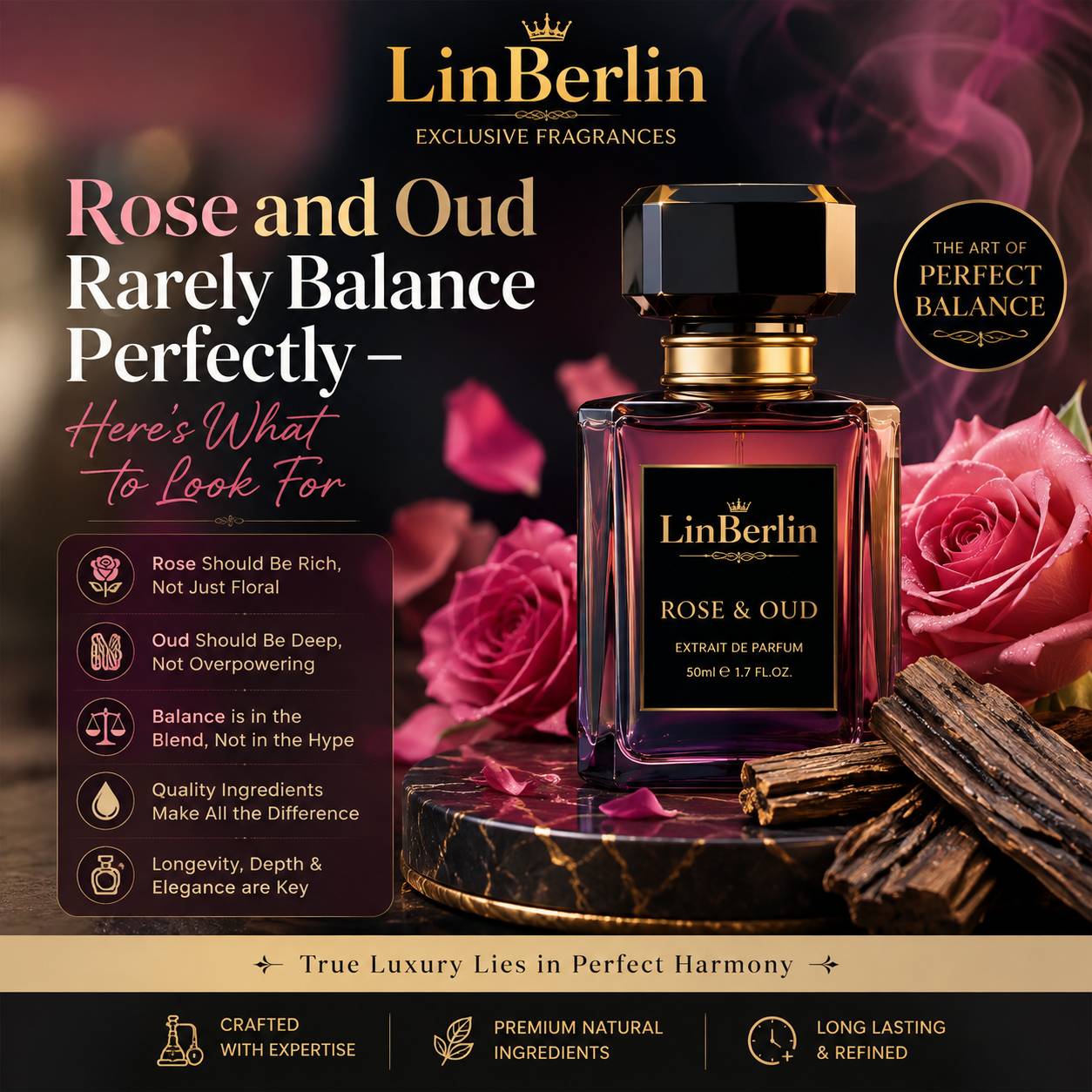
A perfumer once told me that rose and oud are like two singers who both want the solo. Put them in the same room without a plan, and one of them will always try to out-shout the other. The rose gets syrupy and shrill, or the oud turns the whole thing into a leather-and-smoke fog that swallows the flower whole within the first hour. That tension is exactly why this pairing is so hard to get right — and why, when it is done well, it becomes the kind of scent people ask you about on the street.
Why This Pairing Fights Itself
Rose is a top-to-heart note. It's bright, a little green at first, then softens into something powdery and jammy as it settles. Oud is the opposite creature entirely — deep, animalic, resinous, built to sit in the base and last for hours after everything else has faded. Blending them isn't like blending two florals or two woods. It's blending two different timelines of the same fragrance, and if the timing is off, you either get a rose that dies too fast under the oud's weight, or an oud that never gets to show its real character because the rose keeps stealing attention early on.
So the "balance" everyone talks about isn't really about equal parts. It's about sequencing. A well-made rose oud attar doesn't try to make both notes equally loud at every moment — it lets the rose lead the opening conversation, then hands the stage to the oud gradually, the way a good duet actually works.
And here's the honest part: most commercial rose-oud blends don't manage this. They either dilute the oud so much it barely registers (safe, but pointless — you're paying for oud and getting a rose with a rumor of wood behind it), or they use a synthetic oud accord that smells sharp and one-dimensional, more like burnt rubber than aged agarwood. The good ones are rarer than the marketing suggests.
What Real Balance Actually Smells Like
If you've smelled a genuinely well-composed rose oud, you know the moment. In the first ten to fifteen minutes it's mostly rose — Taif or Bulgarian, depending on the house, with that slightly wine-like, honeyed edge. Then something shifts. The oud doesn't announce itself loudly. It just... starts showing up in the gaps, a low hum underneath the petals. By the one-hour mark the rose has softened into something powdery and the oud has warmed into its full depth, and the two stop competing because they're occupying different registers now.
A few things to actually check when you're testing one:
- Does the oud smell like real aged wood — slightly medicinal, a bit barnyard, complex — or does it smell flat and singular, like one synthetic molecule doing all the work?
- Does the rose survive past the first thirty minutes, or does it vanish the second the oud kicks in? (If it vanishes, the ratio is off, not the concept.)
- On your own skin, after two hours, can you still identify both notes separately, or has it collapsed into a generic "sweet-woody" blur that could be almost anything?
This third point matters more than people think, because skin chemistry changes everything here.
How Your Skin Actually Changes This Blend
This is where the beauty-and-skincare side of things comes in, and it's genuinely underdiscussed in most fragrance content. Attars are oil-based, which means they behave completely differently depending on what's already on your skin. Dry skin tends to grab the top notes and let them fade fast — that rose you loved in the bottle can turn into "mostly oud, faintly floral" within the hour if your skin is under-moisturized, because there isn't enough surface hydration to hold the volatile rose molecules in place. Oily or well-moisturized skin does the reverse: it holds onto everything longer, rose included, and the oud tends to bloom slower and rounder rather than hitting hard and fast. That's not a flaw in the attar. It's just chemistry doing what it does.
The practical fix, if you want the blend to actually stay balanced through the day, is to moisturize the pulse points before applying — a plain, fragrance-free lotion or a light oil like jojoba works fine. This isn't about layering scents; it's about giving the attar oil a slightly damp, slightly fatty surface to bind to, which slows evaporation of the top notes without changing the composition itself. People who apply attar to bone-dry skin and then wonder why the rose "disappeared" are usually dealing with a moisture problem, not a quality problem.
A Word on Sensitive Skin and Caution
Rose oils, particularly the natural absolute or otto used in higher-end attars, can occasionally cause irritation on sensitive or compromised skin — redness, mild itching, or a warm prickling sensation, especially if applied over broken skin, recently exfoliated areas, or right after using retinoids or strong acids. Oud resin itself is generally gentler, but the alcohol-free oil base means the concentration sitting on your skin is higher than a typical spray perfume, so a patch test on the inner wrist really is worth the thirty seconds it takes. If you're pregnant, breastfeeding, or dealing with a skin condition like eczema or rosacea, it's worth checking with a dermatologist before applying concentrated florals directly to skin — some people do fine, some don't, and there's no way to predict which category you're in without testing. Realistically, most people never have an issue. But the ones who do usually wish someone had told them to test first.
Pairing Strength: Where This Sits Next to Other Oud Blends
It helps to know what you're comparing against. A rose oud is soft and romantic compared to something like a black oudh paired with musk, which leans darker and more nocturnal — a quieter, smokier story built for late evenings rather than daytime wear. If you're drawn to florals but want something even more delicate, exploring how rose behaves against a lighter white oud is worth doing before you commit — white oud tends to be gentler and less resinous, which changes the whole balance discussion in the rose's favor.
Common Mistakes People Make When Buying
The biggest one is buying based on the bottle description alone. "Rich rose and precious oud" tells you nothing about ratio, sourcing, or how it wears. Ask (or look for) whether the oud is a natural distillation or a synthetic accord — this single fact changes the price, the depth, and honestly the entire experience. Another mistake: assuming more oud means more luxury. It doesn't. A heavy-handed oud ratio without the rose to soften it just smells aggressive, not expensive. And a third — applying too much at once. Attars are concentrated. Two dabs, not a full wrist coating, is usually the right starting point, and you can always add more once you know how it develops on you specifically.
If you're buying for someone else — a partner, for a wedding, as a gift — it's worth remembering that rose oud reads differently depending on the wearer's own body chemistry, so what smelled perfect on the tester strip might shift once it's actually worn. Something worth keeping in mind if you're also exploring fragrance choices for a wedding day, where the scent needs to hold up across hours of photos, ceremony, and celebration.
The Honest Limitation Here
No rose oud attar — LinBerlin's included — will smell identical on two different people, and no amount of buying advice fully solves that. Skin pH, diet, hormonal cycles, even the climate you're wearing it in all nudge the balance one way or another. What good buying advice can do is get you close: point you toward quality ingredients, correct ratios, and honest sourcing, so that whatever your skin does with it, it's working from strong material rather than a synthetic base pretending to be something it isn't.
The best approach, if you can manage it, is to test on skin rather than paper, wait the full two hours, and pay attention to whether the rose and oud still feel like two things having a conversation — not one shouting over the other, and not one going silent too soon. When you find that, in your specific chemistry, it tends to be worth holding onto. And if you're still building your sense of what suits you day to day, it doesn't hurt to also look at how attar longevity works for everyday wear before settling on your signature blend, since a rose oud like Oud e Gulab asks for a slightly different care routine than a straightforward woody or citrus attar would.