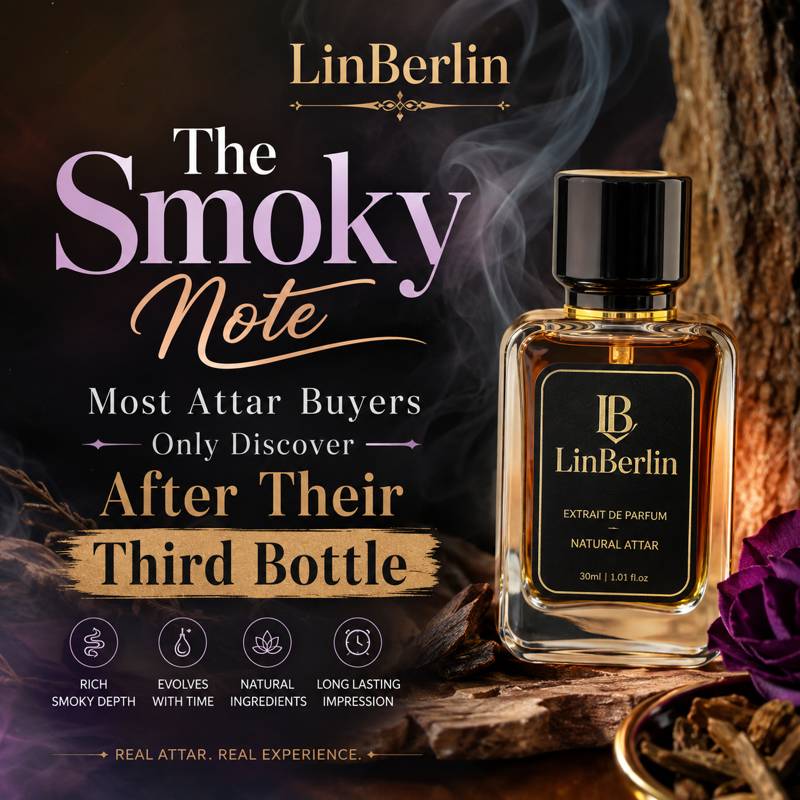
Nobody warns you about this at the counter. You buy your first attar for the rose, or the oud, or whatever soft floral got recommended for a wedding. Your second one, you buy because the first ran out faster than expected. And it's usually the third bottle — bought almost carelessly, without much research — where the smoky note finally shows up and rearranges everything you thought you knew about how attar behaves on skin, fabric, and time.
That note is tobacco. Not cigarette-smoke tobacco, not the harsh ashtray version people flinch away from — but the warm, honeyed, slightly leathery tobacco leaf note that sits underneath oud in a handful of serious compositions. It's the kind of accord that doesn't announce itself in the first ten minutes. So most beginners miss it entirely, because they're still testing attars the way they'd test a spray perfume: one quick sniff, decision made, bottle closed.
Why This Note Hides From Beginners
Tobacco doesn't open loud. Realistically, in the first application, what you'll smell is oud — resinous, a little animalic, sometimes sharp depending on the distillation. The tobacco note builds underneath it slowly, over thirty to ninety minutes, as the lighter top elements burn off and the base is left to do its work against the warmth of your skin (or, more accurately for attar, the warmth of your clothing, which we'll come back to).
Here's the thing enthusiasts eventually learn: attar isn't a "smell it once and decide" category. It's a "wear it for four hours and then judge it" category. Beginners judge too early. By bottle three, most people have figured out that the real character of a deep, oud-based attar only arrives after the initial spike has settled — and that's exactly when the smoky, tobacco-leaf facet tends to surface.
Where Tobacco Oud Actually Comes From
Genuine tobacco-oud compositions use tobacco absolute or a tobacco-leaf accord layered against agarwood oil, sometimes supported by a whisper of dried fruit or resin to round the edges. The blend isn't trying to smell like a cigar. It's aiming for something closer to a study, or an old leather chair, or a spice trader's storeroom — dry, warm, faintly sweet, never sharp.
If you want to experience this note without guessing which product actually delivers it, LinBerlin's tobacco oud attar is built around exactly this pairing. It's one of the compositions where you can genuinely track the shift — the opening leans oud-forward, and then, somewhere around the one-hour mark, Oud e Khumar settles into that dry, tobacco-leaf warmth that's genuinely hard to find in synthetic alternatives, where the smoky effect is usually one flat note instead of something that develops.
Compare that development curve to something like a musk-based attar, where the appeal is longevity and skin-hugging closeness rather than transformation. If you're the type who enjoys watching a fragrance change character over a wear, it's worth spending time with deep, mysterious musk attars as a contrast — musk holds its shape for hours, while tobacco oud is doing something closer to storytelling.
How Skin — and Fabric — Actually Hold This Note
This is where a lot of buying guides get sloppy, so let's be precise. LinBerlin attars, including tobacco oud, are fragrance oils formulated for application on clothing and fabric — not direct skin contact. That matters more than people assume, because it changes how the smoky note develops and how long it lasts.
Fabric holds fragrance oil differently than skin does. Skin has natural oils, pH variation, and warmth that cause a scent to shift and fade at different rates for different people — that's why the same attar can smell noticeably different on two people, or why one person swears an oud lasts all day while another says it fades by noon. Fabric is more consistent. It doesn't metabolize the oil the way skin chemistry does, so the tobacco-oud development you're chasing tends to show up more reliably, and for longer — LinBerlin attars are designed to last 8+ hours on fabric, which gives that slow smoky build the time it actually needs.
For anyone with sensitive skin, known fragrance allergies, or who is pregnant, this fabric-first approach is genuinely the safer route anyway — dabbing a concentrated oud-tobacco oil directly onto skin, especially skin that's compromised, irritated, or freshly exfoliated, is where reactions tend to happen, redness, tightness, sometimes a mild rash that people wrongly blame on "the attar" when it's really the application method. Apply to a collar, a scarf, a cuff, an inner jacket seam — somewhere close enough to your body heat to project, without direct contact.
One honest caveat: even fabric application isn't universally risk-free. Certain delicate fabrics (raw silk, some synthetics) can stain or react with concentrated oils, so a small hidden-spot test before full application is worth the ten seconds it takes. This is the kind of detail that gets skipped in most attar guides, and it shouldn't be.
Layering Without Losing the Note
Enthusiasts who've been through a few bottles tend to develop a habit — testing a new attar on its own, with nothing else going on, before layering it into a routine. It's a small thing but it matters, because heavily fragranced body lotions, scented deodorants, or fabric softeners with strong synthetic musk can flatten a delicate tobacco note before it's had the chance to build.
If you do want to layer, keep the surrounding products unscented or very mild — a fragrance-free moisturiser on the wrists (not where the attar goes, just generally), an unscented laundry base for the garment you're planning to wear it on. And give the attar room. Or don't layer at all for the first few wears, just to learn what the note does on its own.
Where Tobacco Oud Sits Next to Other Deep Notes
People who like tobacco oud often gravitate toward earthy, grounded notes generally — mitti, vetiver, aged sandalwood. There's a shared quality: none of these notes are trying to be pretty. They're trying to be honest, a little rough around the edges, memorable rather than merely pleasant. If tobacco oud appeals to you, it's worth reading through how mitti, sandal, and vetiver compare against each other — the overlap in appeal is real, even though the raw materials are completely different.
It's a strange category, honestly — the "notes people grow into" category. Nobody starts here. But almost everyone serious about attar ends up here eventually, which says something about how the nose adapts with exposure.
Common Buying Mistakes
A few things trip people up specifically with smoky, tobacco-forward ouds. First, judging the bottle by a single quick sniff at the point of sale, which — as covered above — completely misses the point of a note that develops over an hour or more. Second, assuming "smoky" means "strong" in the overpowering sense; a well-made tobacco oud is warm and present, not aggressive. Third, buying a large bottle before wearing a sample for a full day, since preferences around this note shift a lot once someone's actually lived with it rather than just smelled it in passing.
A Quick Word on Gifting This Note
Tobacco oud isn't the easiest gifting choice — it's a note for someone who already has some fragrance vocabulary, not a first-timer. But for the right person, someone who's clearly past their first two or three bottles, it lands as a thoughtful, slightly unexpected pick rather than a safe one. If budget is a concern and you're choosing between several ideas, browsing affordable gifting perfumes that still feel like quiet luxury alongside a smoky oud can help balance a gift set between something familiar and something more exploratory.
The Takeaway
Tobacco oud rewards patience more than almost any other attar category. It won't sell itself in the first ten minutes, and that's fine — that's not a flaw, it's how the note is built. Wear it on fabric, give it time, keep the surrounding products quiet, and do a small patch test if you're layering onto anything delicate. By the time you're reaching for your third or fourth bottle, this is usually the note that finally makes sense of everything else you've tried before it.