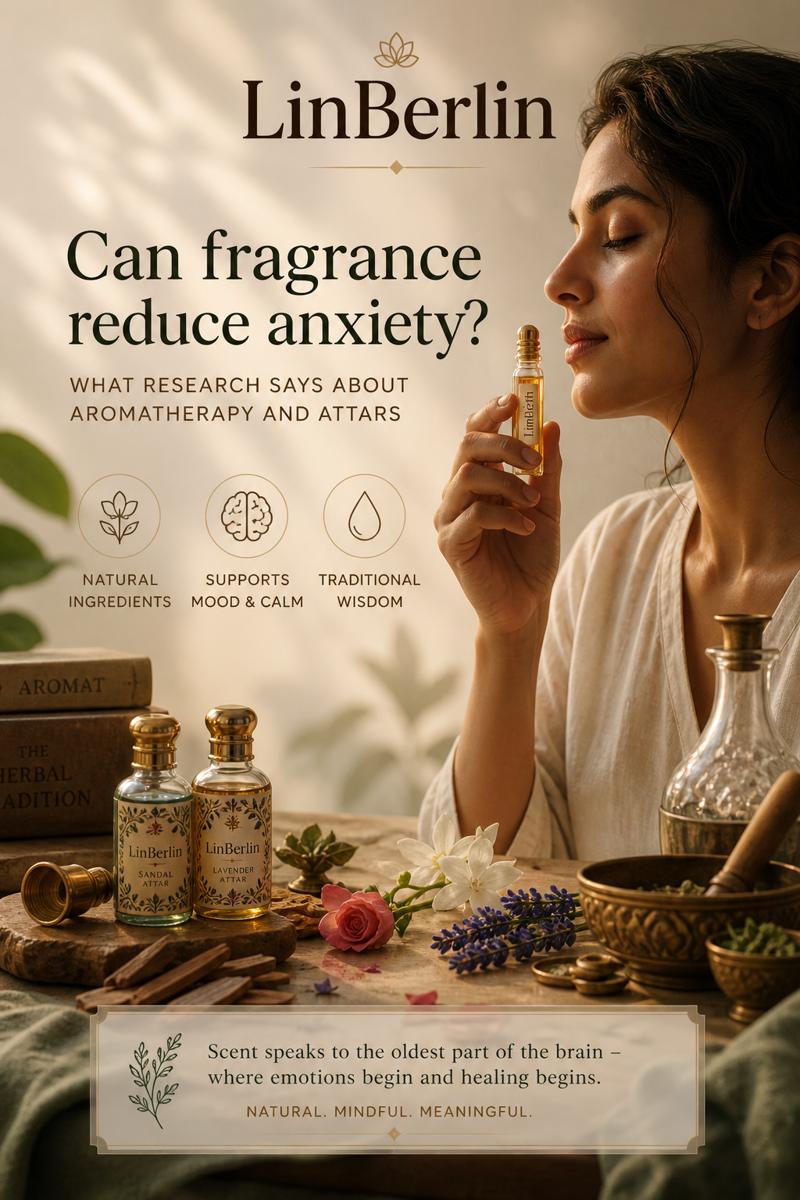
Can fragrance reduce anxiety? A grounded look at aromatherapy, attars, and how scent actually affects mood, stress, and the brain Can fragrance reduce anxiety? What research says about aromatherapy and attars
A trace of sandalwood lingering on a shawl can change the entire tone of an evening. The air feels softer, breathing slows without instruction, and something in the body loosens before the mind catches up. Moments like this are why people have quietly relied on scent for comfort across cultures. And yet, the idea that fragrance can reduce anxiety sits somewhere between lived experience and scientific debate, especially when we talk about aromatherapy and traditional attars.
Most people don’t think about why certain scents feel calming while others sharpen attention. But once you notice it, you can’t unsee how deeply scent shapes mood. The question isn’t whether fragrance affects us — it clearly does — but how far that effect actually goes.
What the science actually says
Breathing in a fragrance doesn’t just stay in the nose. Volatile molecules travel through the olfactory system and reach the limbic brain, the area tied to memory, emotion, and stress regulation. This is why scent can trigger a feeling before a thought forms.
Research around aromatherapy has focused heavily on ingredients like lavender, bergamot, and certain resins. Lavender oil, in particular, has been studied for its potential to reduce mild anxiety and improve sleep quality. Some controlled trials suggest measurable reductions in heart rate and perceived stress after exposure. But the effects are usually modest, and they vary depending on the individual.
And then there’s the psychological layer — scent is deeply tied to personal memory. A calming effect might come less from the molecule itself and more from what it represents. (A familiar scent can act like a shortcut to emotional safety.)
So does fragrance reduce anxiety in a clinical sense? Sometimes, in small ways. But more consistently, it shifts mood, which indirectly affects how stress is experienced. That distinction matters.
But here’s where nuance is important — aromatherapy research is still developing, and not every claim holds up under scrutiny. Some studies are small, others lack consistent methodology, and placebo effects can play a real role.
How to use fragrance intentionally for wellbeing
Using scent for wellbeing isn’t about spraying more perfume. It’s about timing, context, and choosing materials that behave gently on the senses.
Start by associating a specific scent with a specific moment. A soft attar applied at night can become a signal to the body that it’s time to slow down. Over time, the brain begins to connect that scent with rest itself.
And placement matters more than people expect. Applying a small amount to pulse points allows the scent to rise subtly with body heat, instead of overwhelming the senses.
Consider materials with grounding profiles — sandalwood, vetiver, and certain oud compositions tend to feel anchoring rather than stimulating. Lighter citrus notes can lift mood but may not sustain calm in the same way.
Or think about environment. A drop of attar on fabric, a handkerchief, or even a pillow can create a softer, more diffused experience than direct skin application.
One simple approach works well for most people. First, choose a scent you genuinely enjoy. Second, use it consistently in a calm setting. Third, notice how your body responds over time. That’s it.
What should you expect to feel? Not a dramatic shift, but a gentle easing — a sense that your breathing has slowed or your thoughts aren’t racing as quickly.
Here’s the thing: consistency matters more than intensity. A subtle, repeated scent experience often works better than something strong used occasionally.
Common overclaims to ignore
There’s no shortage of bold promises around fragrance and wellness. Claims that a scent can “cure anxiety” or replace medical treatment aren’t grounded in evidence.
And not every natural oil is automatically calming. Some can be stimulating, others irritating, depending on concentration and sensitivity.
Another common idea is that certain ingredients have universal effects. In reality, scent perception is highly individual. What relaxes one person might feel heavy or even unpleasant to someone else.
But perhaps the biggest misconception is that more is better. Overapplication can actually create sensory fatigue, making the experience less effective rather than more.
So if fragrance isn’t a cure, why do people still reach for it during stressful moments?
LinBerlin ingredients with genuine wellness properties
Some traditional materials used in attar making have qualities that align with what research and experience both suggest.
Sandalwood, for instance, has been associated with calming effects and is often used in meditation contexts. Its soft, creamy profile tends to settle rather than stimulate.
Vetiver offers a deeper, earthier character. Many people describe it as grounding, particularly during moments of restlessness.
And certain oud compositions, when balanced carefully, can create a sense of warmth and stillness rather than intensity.
These materials don’t act like medication. But they create conditions where the body can shift toward calm more easily.
Closing
Scent won’t solve stress on its own, but it can quietly support the way you move through it. The real value of fragrance lies in how it shapes small, repeatable moments of ease.
Choose one attar, use it at the same time each day, and pay attention. Not to dramatic change, but to subtle shifts. That’s where its effect becomes real.