My first real lesson in oud didn't come from a perfume counter. It came from a friend's wrist, three hours into a wedding reception, when the scent she'd applied that morning had settled into something completely different from what she'd sprayed on. Warmer. Rounder. Almost unrecognizable from the sharp opening note she'd worried was "too much." That's the thing nobody tells beginners about oud — it's not one smell, and it barely resembles itself an hour after application. So if you're standing at the start of your oud journey wondering which bottle to trust first, you're really asking a skin question as much as a fragrance one.
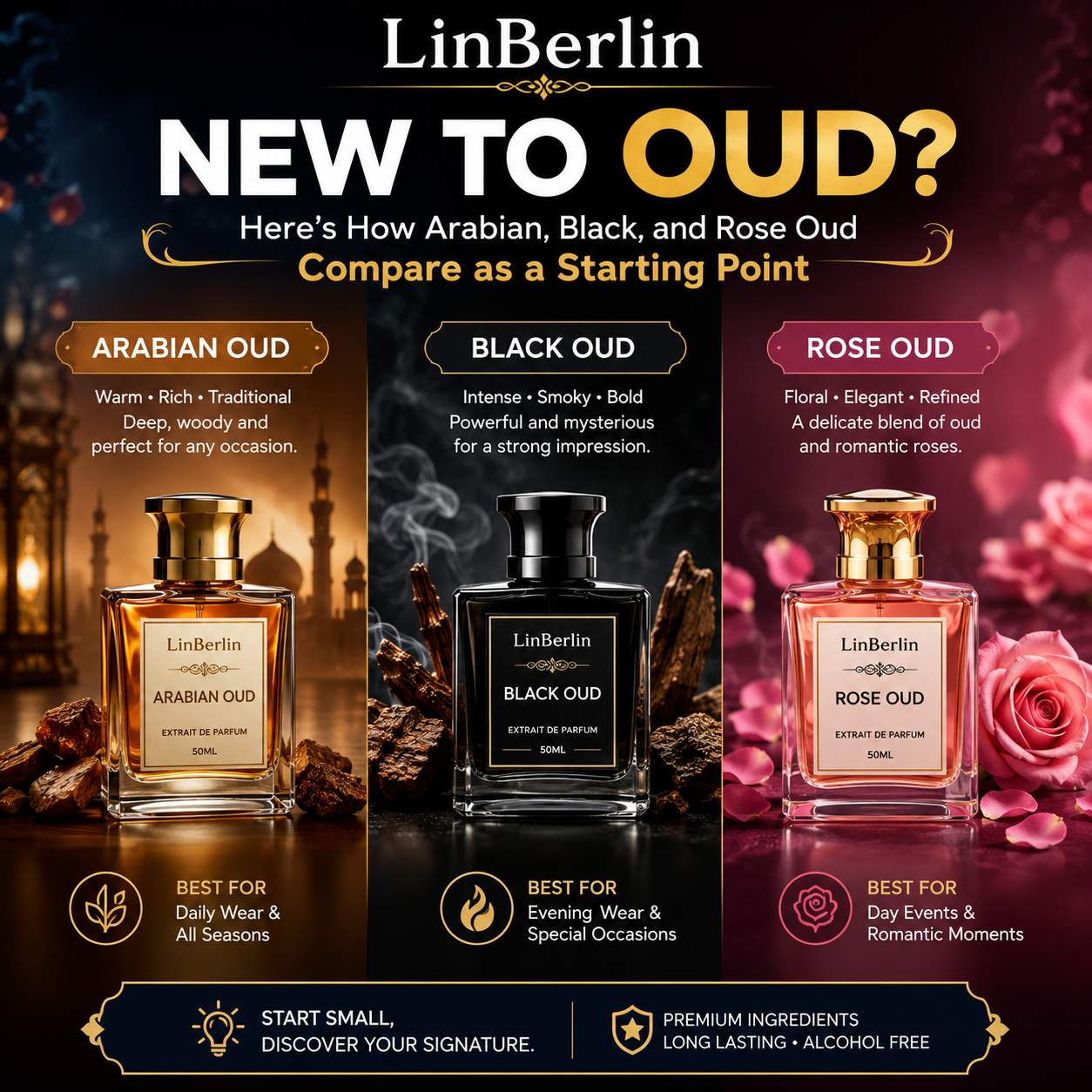
Arabian, black, and rose oud are the three doors most newcomers walk through first, and each one behaves differently once it meets actual body chemistry. This isn't a ranking. It's a guide to figuring out which door fits your skin, your climate, and honestly, your nerve — because oud does ask a little of you before it gives anything back.
Why Oud Doesn't Behave Like Regular Perfume
Most Western perfumes are built on alcohol, which evaporates fast and carries top notes to your nose within seconds. Attar-based oud works on an oil base, and oil doesn't rush. It sits in the skin's surface layer, warms with your body heat, and releases scent in slow waves rather than one loud burst. This matters more than most first-time buyers realize, because it means the same oud attar can smell noticeably different on two people standing next to each other.
Skin type plays a bigger role here than fragrance families or price points ever will. Oilier skin holds and amplifies oud beautifully — the natural lipids on the surface act almost like a fixative, letting the scent bloom for six, eight, sometimes ten hours. Drier skin, on the other hand, tends to burn through top notes faster and can make an attar feel thinner or shorter-lived than it actually is. If you've ever heard someone say "oud just doesn't last on me," there's a decent chance dry skin is the real culprit, not the oud.
And this is where skincare quietly enters the conversation. A well-moisturised arm holds scent longer than a dry one, full stop. People with dry or dehydrated skin who apply attar directly onto bare, product-free skin are often disappointed by how quickly it fades — not because the oud is weak, but because there's nothing on the surface to slow the oil down. A thin, fragrance-free moisturiser applied a few minutes before attar can genuinely change the performance of the same bottle. It's a small trick, but it works more often than not.
Arabian Oud: The Confident Starting Point
If someone asked me to hand a first-timer a single bottle with no explanation, it would probably be an Arabian-style oud. It tends to sit in a middle ground — woody, slightly smoky, warm without tipping into the medicinal sharpness that scares people away from oud in the first place. LinBerlin's Arabian oud attar, Oud e Sahara, leans into that desert-warm character — dry wood, a faint sweetness underneath, nothing that overwhelms a beginner's nose.
On skin, this style of oud tends to open a little sharp and settle within twenty to thirty minutes into something rounder. So don't judge it in the first five minutes at the counter — that's a mistake almost everyone makes once. But give it time, and it becomes the kind of scent that feels appropriate for an office, a family dinner, or a first date without announcing itself too loudly.
For readers who want the fuller picture — how oud attars are graded, sourced, and layered across different occasions — this deeper guide to oud attar and perfume covers the ground this article doesn't have room for.
Black Oud: Not for Everyone, and That's the Point
Black oud is the one people either love immediately or need a second try to appreciate. It's darker, denser, often described as smoky or leathery, with a resinous depth that Arabian ouds don't usually reach. This is where genuine oud lovers tend to end up eventually, even if they didn't start here.
Oud e Zulmat | black oud attar from LinBerlin sits firmly in this category — intense on application, and it stays intense. This isn't an oud for someone testing the waters for the first time in a crowded room. It's better suited to evenings, colder weather, and skin that can handle a strong opening without feeling suffocated by it.
Here's the thing — black oud genuinely performs better on oilier or combination skin. The density of the scent needs something to hold onto, and dry skin can make it feel almost too sharp, too soon, without the slow unfolding that makes black oud worth wearing. If your skin runs dry, a light unscented balm underneath changes this significantly. If your skin runs oily, you may need less product than you think — a single point of application, not a spray-and-hope approach.
There's also a pairing worth knowing about if black oud appeals to you: musk. The two share a strange, quiet chemistry that softens oud's intensity without diluting its character, and this piece on black oudh and musk gets into why that combination works so well for evening wear.
Rose Oud: The Gentler, More Forgiving Entry
Rose oud softens everything black oud intensifies. It's floral, slightly sweet, and considerably more approachable for people who find straight oud too heavy or too "loud" for daily wear. Oud e Gulab | rose oud attar captures this balance — rose petals doing most of the talking, oud providing a low, woody foundation underneath rather than dominating the composition.
This is realistically the safest starting point for anyone nervous about oud's reputation as an "acquired taste." It's also a strong gifting choice, particularly for someone who's never worn attar before and might find a heavier black oud overwhelming on a first try. Rose oud tends to perform consistently across skin types too, since the floral note carries even when the base oud fades a touch faster on drier skin.
One caution worth flagging here, and it applies across all three of these ouds but especially rose: natural attars can occasionally cause mild sensitivity in people with reactive or compromised skin, particularly if applied over broken skin, right after exfoliation, or alongside active skincare ingredients like retinoids or strong acids. Rose-based attars, because they're often applied more liberally due to their gentler profile, are the ones people tend to overapply — and overapplication on sensitised skin is where irritation shows up. If you're pregnant, breastfeeding, or have a known fragrance allergy, a small patch test on the inner wrist 24 hours before full use isn't overcautious. It's just sensible.
How to Choose Between the Three, Practically
Think about where you'll actually wear it before you think about which one smells "best" in isolation. Office and daytime settings usually call for something restrained — Arabian oud, or rose oud if you want warmth without weight. Evenings, colder months, or occasions where you want to be remembered call for black oud's density. And if you're buying as a gift rather than for yourself, rose oud is often the safer bet simply because it's harder to dislike.
Skin type should factor into the decision too, not as an afterthought. Oily and combination skin can handle more concentrated ouds like black oud without needing much adjustment. Dry skin benefits from a moisturised base layer regardless of which oud you choose — this single habit probably does more for longevity than switching brands ever will. Sensitive or reaction-prone skin should start with rose oud in small quantities and build up, rather than starting with the most intense option available.
A small, honest caveat: no attar performs identically across two people, no matter how carefully it's formulated. Body temperature, diet, medication, even stress levels can shift how oud reads on your skin from one day to the next. Anyone promising identical performance every single time isn't being entirely straight with you.
Layering Attar With Skincare Without Fighting It
People layer fragrance over skincare all the time without thinking about how the two interact, and it usually goes fine — until it doesn't. Strong actives like vitamin C, retinol, or benzoyl peroxide can react with certain fragrance oils and cause redness or a stinging sensation, particularly on facial or neck skin where attar is sometimes dabbed near the collarbone. The safer zones for application are pulse points that see less active skincare — inner wrists, behind the ears, the inner elbow.
Apply attar after moisturiser has fully absorbed, not while skin is still damp or tacky. Wet skin can dilute the oil unevenly, causing patchy scent development rather than the smooth bloom oud is known for. Give it a few minutes. It's a small patience test, but it pays off.
Beyond the First Bottle
Once you've settled into one of these three, the natural next step for a lot of people is exploring how ouds pair with other notes — white oud and rose is a particularly striking combination worth knowing about, and this piece on rose meeting white oud captures that pairing in more detail than a beginner's guide can. For those curious about how fragrances sit together generally, this guide on fragrance pairings is worth a read too.
Choosing your first oud isn't really about picking the "correct" one. It's about being honest with yourself regarding how bold you want to smell, how your skin actually behaves under fragrance, and what setting you're dressing for most often. Start there, and the rest tends to sort itself out.