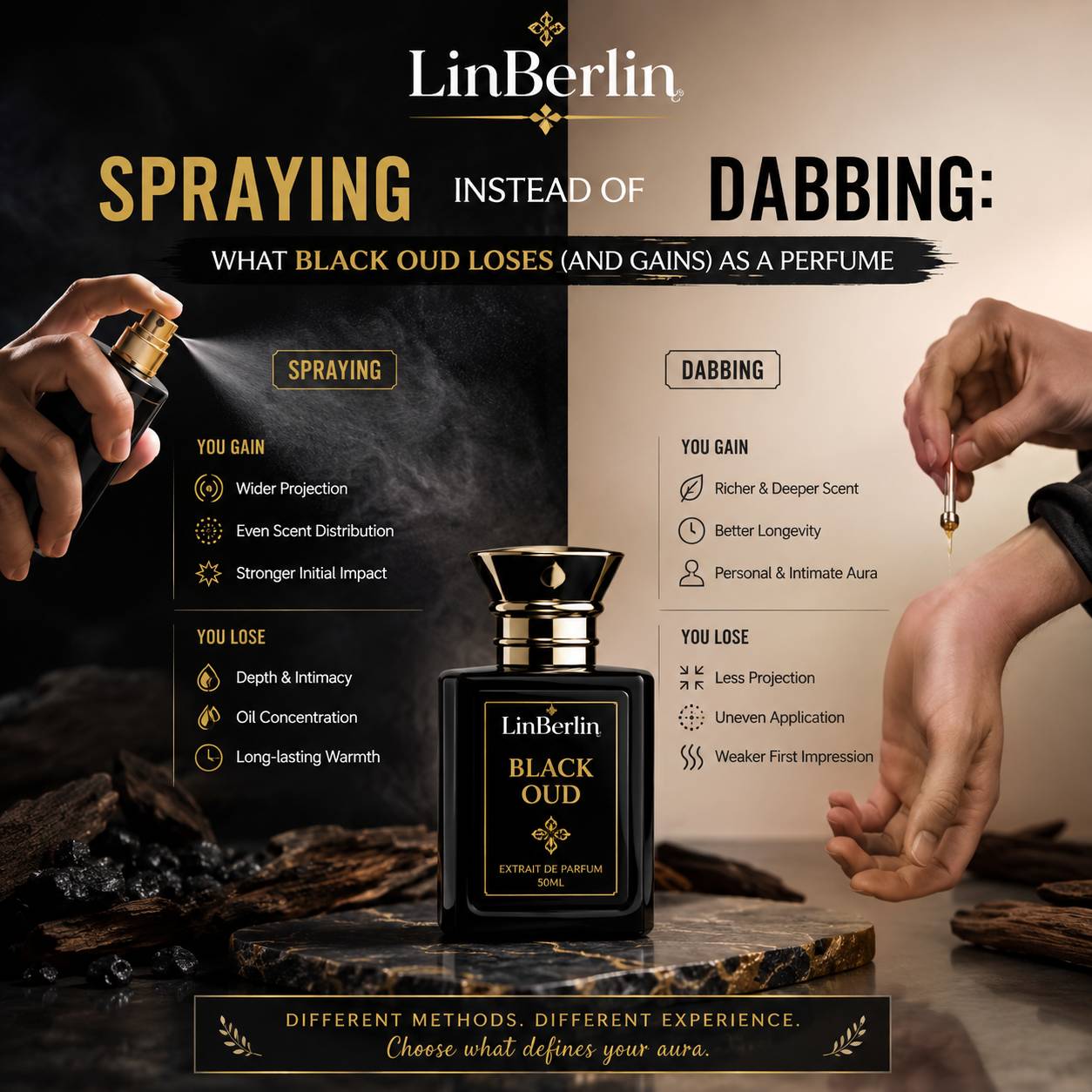
A drop of black oud on warm skin behaves like a slow-burning ember. A spray of the same oud, from an alcohol-based bottle, behaves like a match struck in a draft — bright, immediate, and gone faster than you'd like. That difference isn't marketing language. It's chemistry, and it's the reason so many attar lovers feel oddly betrayed the first time they try a spray version of a scent they already know intimately.
This piece is for the enthusiast who already owns a bottle of oud attar, has dabbed it onto pulse points more times than they can count, and is now staring at a perfume spray version wondering if it's the same fragrance wearing different clothes — or something else entirely.
Why the Application Method Isn't a Small Detail
Most people assume the delivery format — spray versus dab — is a packaging choice. It isn't. The way a fragrance touches skin changes how it evaporates, how it bonds with skin oils, and how long its individual notes stay recognisable. Dabbing places a concentrated, undiluted (or lightly diluted) oil directly onto the skin's surface, where it sits and slowly releases heat-activated molecules over hours. Spraying atomises the fragrance into a fine mist, usually carried by alcohol, which flashes off within minutes and pushes the top notes forward aggressively before retreating.
So when someone says "the spray version feels weaker," they're not imagining it. They're noticing real volatility differences. And when someone says "the dab version feels heavier," that's real too — it's oil sitting closer to the skin's natural warmth, releasing slower.
What Black Oud Actually Loses When It's Sprayed
Black oud is not a simple note. It's smoky, resinous, a little animalic if the sourcing is honest, and it carries a depth that depends heavily on slow release. Here's what tends to happen when that complexity meets an alcohol-based spray format:
- The smoky, leathery undertone — the part that makes black oud feel dangerous in a good way — often gets muted in the first twenty minutes because alcohol evaporates quickly and takes some of the heavier molecules with it before they've had a chance to settle into skin.
- Projection changes shape. A dabbed oud tends to sit close, almost private, something only someone leaning in would catch. A sprayed oud throws outward immediately, then fades faster than expected, leaving a strange gap between hour one and hour four.
- The oil's natural warmth — the way it seems to react with individual body chemistry over the course of a day — gets diluted. Alcohol doesn't carry that same slow, skin-specific evolution.
Realistically, some of this is unavoidable. Alcohol is a solvent, not a preservation medium for scent depth. That's just how it works.
What It Gains, Because It Isn't All Loss
The trade isn't one-directional, though — and pretending otherwise would be dishonest. A spray format gives black oud something dabbing genuinely can't: even, controlled distribution. No sticky fingers, no guessing whether you've applied too much to one wrist and too little to the other. For layering — say, pairing The Shadow, our black oud perfume, over a lighter musk base — a spray gives finer control than a dab ever could.
There's also the opening itself. Sprayed fragrances tend to have a sharper, more theatrical entrance. If you like that first ten minutes to feel like an event, a spray delivers it in a way oil rarely does. Oil builds slowly. Spray announces itself.
How Skin Type Changes This Entire Conversation
This is where most articles stop short, and it's the part that actually matters for longevity. Skin isn't a neutral canvas. It reacts to fragrance based on its own oil production, hydration level, and even its pH.
Oily skin holds scent longer — full stop. The natural sebum acts almost like a fixative, especially for oil-based attars, because oil binds to oil. Someone with naturally oily skin who dabs black oud attar might get six, sometimes eight hours of depth without reapplying.
Dry skin is a different story entirely. Fragrance molecules, whether from a spray or an oil, need some moisture to cling to. On dry, under-moisturised skin, even a good oud attar can feel like it disappears within two or three hours — not because the fragrance is weak, but because there's nothing on the skin's surface for it to hold onto.
Combination skin sits somewhere in between, and it's honestly the trickiest to generalise about. Someone might get strong projection near the jaw and neck where oil glands are more active, and a much fainter trail near drier areas like the forearms.
The Moisturising Trick Most People Skip
Here's something worth saying plainly, because it doesn't get repeated enough: applying an unscented, lightweight moisturiser before either a spray or a dab of oud noticeably extends how long the fragrance lasts. This isn't a myth passed around perfume forums — it's basic chemistry. Fragrance molecules bond more effectively to hydrated skin cells than to dry, flaking ones. A thin layer of moisturiser gives oud something to hold onto. But — and this matters — the moisturiser has to be fragrance-free, or close to it. Layering scented lotion under attar creates a muddled, competing scent profile, and it can genuinely mask the oud's own complexity rather than support it.
Where Caution Is Actually Warranted
This is the part that separates an honest guide from a promotional one. Black oud, whether attar or spray, is a concentrated fragrance experience, and a few groups should approach it with more care than the average enthusiast:
People with eczema, dermatitis, or generally reactive skin should patch test any new attar or spray on the inner forearm and wait 24 hours before applying it to pulse points, neck, or anywhere near the face. Oud oils, even natural ones, contain compounds that can trigger sensitivity in already-compromised skin barriers.
Pregnant readers, or anyone currently pregnant, should check with a doctor before regular use of strong resinous fragrances — not because oud is inherently unsafe, but because heightened sensitivity to smell during pregnancy is common, and some people find deep, smoky notes genuinely nauseating during that period.
Anyone using strong skincare actives — retinoids, high-percentage AHAs or BHAs, benzoyl peroxide — should avoid applying fragrance, spray or oil, directly over skin that's actively purging or peeling. The compromised barrier absorbs more, reacts faster, and the combination can cause irritation that has nothing to do with the fragrance itself being low quality.
So Which One Should You Actually Choose
Neither format is objectively better. Or, well — it depends entirely on what you're using it for. Dabbing suits people who want depth, privacy, and a scent that unfolds slowly across a workday. Spraying suits people who want even coverage, a stronger opening, or easier layering with other fragrances in a collection. If black oud specifically is the note you're chasing, and you haven't yet compared how it behaves across formats, it's worth reading how shadowed black oud interacts with golden royal oud when the two share space on skin — the contrast tells you a lot about black oud's own character in isolation.
A Small Honest Caveat
None of this is an exact science, and skin chemistry is stubborn about following rules on paper. Two people with identical skin types, using the identical bottle, applied the identical way, will still report different longevity — sometimes by hours. Diet, hydration on that particular day, even the climate humidity, all play some role that nobody's fully mapped out. So take these guidelines as a strong starting point, not a guarantee.
Layering and Pairing Notes
For enthusiasts who like to build a scent story rather than wear one note alone, black oud pairs unexpectedly well with warmer, muskier bases. There's a reason certain combinations keep showing up in perfumer conversations — the way black oudh settles alongside musk in the evening hours creates a rounder, less sharp profile than oud worn alone. If you're newer to layering, start with a single drop of the second fragrance rather than matching quantities — oud tends to dominate anything paired against it in equal measure.
The Practical Takeaway
If you're deciding between a spray and a dab-applied attar version of black oud, think about your day rather than the fragrance itself. Long meetings, close conversations, an evening where subtlety matters — oil wins. A quick errand, a first date where you want a strong first impression, layering with other scents — spray earns its place. Either way, moisturised skin will always outperform dry skin, regardless of format, and that single habit does more for longevity than switching bottles ever will.