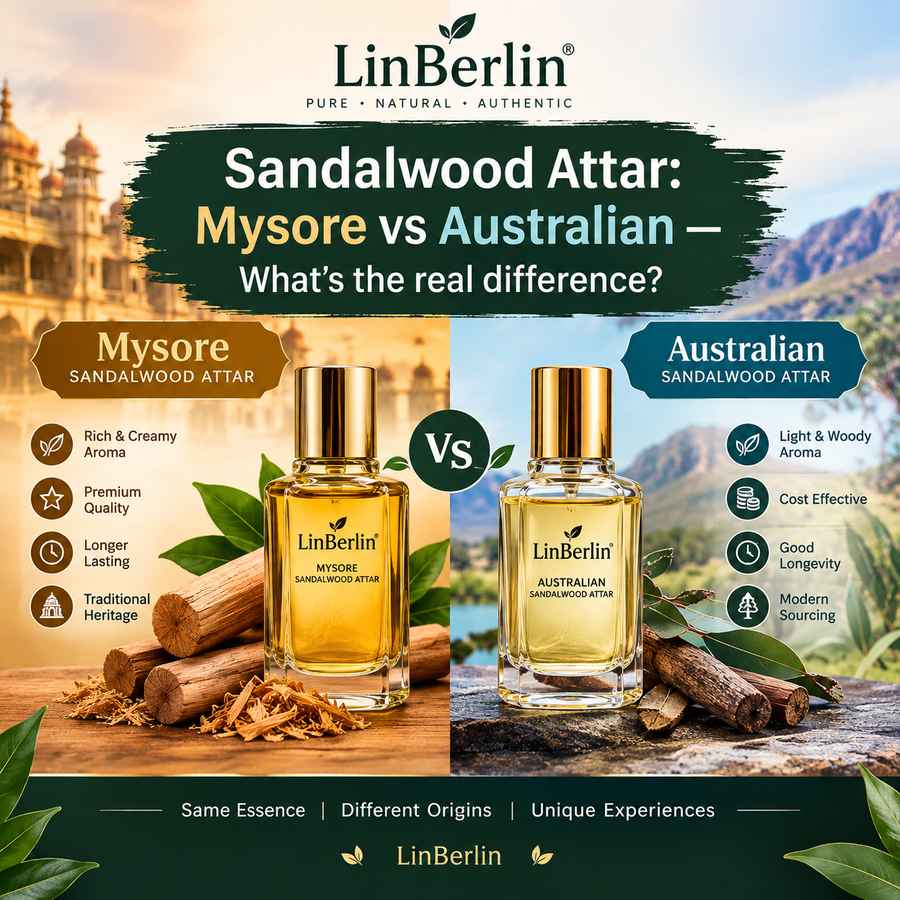
Ask five perfumers what "real sandalwood" smells like and you'll get five slightly different answers, all of them convinced they're describing the same thing. That's the strange part of this ingredient — it's one of the most talked-about materials in natural perfumery, and also one of the most misunderstood. Most people who say "sandalwood" are actually picturing a memory rather than a specific molecule, and that memory is almost always Mysore.
I've worked with both Mysore-origin and Australian sandalwood oils side by side, on skin, over full days, across different seasons. And the honest answer to "what's the real difference" is longer than most comparison charts make it look. It's not simply that one is better. It's that they're doing genuinely different jobs on skin, chemically and emotionally, and conflating them does a disservice to both.
Where Each One Actually Comes From
Mysore sandalwood grows in the forests of Karnataka, historically around the Mysore region of southern India, from the tree Santalum album. It takes decades — often 15 to 30 years — for the heartwood to develop the oil concentration that makes distillation worthwhile. That slow timeline is exactly why genuine Mysore oil has become so scarce and so expensive; India restricted commercial harvesting decades ago to protect dwindling wild stock, and what reaches the market today is a fraction of what it once was.
Australian sandalwood, by contrast, mostly comes from Santalum spicatum, a related but botanically distinct species grown commercially in Western Australia. There's also Santalum album now cultivated in plantations across northern Australia, grown specifically to fill the gap Mysore left behind. The trees mature faster there — closer to 15 years for spicatum, sometimes less — and the harvesting is regulated but far more commercially active than what's left in Karnataka.
The Actual Scent Difference, Not the Marketing One
Here's the thing most comparison articles get wrong: they treat this as a quality ranking rather than a character difference. Mysore sandalwood has a creamy, almost milky sweetness to it — soft, rounded, with a faint smokiness underneath that develops slowly over hours. It's warm in a way that feels close to skin, not projecting outward so much as settling in.
Australian spicatum tends to be drier, sharper at first application, with a more resinous, slightly green woody edge. It doesn't have quite the same milky sweetness. Some perfumers describe it as "harder" — less rounded, more angular. That's not a flaw, exactly. It's just a different structure. For certain blends, particularly ones that need a woody backbone without competing sweetness, spicatum actually performs better than Mysore would.
Album grown in Australian plantations sits somewhere between the two — closer to Mysore's creaminess since it's the same species, but usually lacking the full depth that comes from decades of tree age. Younger heartwood, thinner oil, less of that slow-building smokiness. It's a reasonable substitute. It's not a replacement, though, and anyone claiming otherwise is stretching the truth a little.
Rooh e Chandan and Why the Blend Matters More Than the Origin Alone
This is where things get interesting for LinBerlin specifically. A well-constructed sandalwood attar isn't just raw oil bottled as-is — it's usually distilled traditionally through the deg-bhapka method, sandalwood oil captured over rose or vetiver water bases, then aged. That aging process softens harsher edges and lets the sweetness fully emerge, regardless of which species the base oil came from.
LinBerlin's own Rooh e Chandan leans into that Mysore-style profile — the goal was never to chase the cheapest source, but to get as close as possible to what that creamy, temple-adjacent sandalwood smell used to be before it became commercially rare. And realistically, that's the more honest way to think about sourcing: not "is this technically Mysore," but "does this deliver the sensory experience people associate with real chandan."
How to Actually Tell Them Apart on a Test Strip
If you've got two attars in front of you and want to identify which is closer to authentic Mysore character versus a lighter substitute, there's a fairly reliable method. Apply both to skin rather than paper — paper doesn't pick up the oil's full development the way skin oils do. Wait fifteen minutes. The genuine Mysore-style oil should feel like it's warming rather than fading; the sweetness intensifies slightly before settling into a long, quiet dry-down that can last well past the eight-hour mark.
A thinner or younger sandalwood, meanwhile, tends to flatten out faster — it's pleasant in the first hour, then goes a bit one-dimensional. Not bad. Just less layered. If you want a deeper walkthrough on this, there's a solid guide on how to tell real Mysore-style sandalwood apart from a synthetic substitute, which goes into the smell-testing process in more detail than I can here.
And if you're newer to natural attars generally and just trying to build a nose for what's genuine versus what's synthetic dressed up as natural, it's worth reading up on how real sandalwood scent is becoming harder to find — it's a broader problem across the industry, not unique to any one brand or region.
What This Means for Skin — Not Just the Bottle
This is where my skincare background actually matters for this comparison, because sandalwood behaves differently depending on the skin it lands on, and that changes which version someone should reach for.
On dry skin, Mysore-style oils tend to perform beautifully — the creaminess of the scent seems to complement dry skin's slower evaporation rate, and the sweetness lingers rather than turning sharp. Oily and combination skin, though, sometimes push that same creaminess into something almost too rich by midday; the natural oils on the skin's surface amplify the sandalwood's sweetness until it can feel heavy. In that case, the drier, greener character of Australian spicatum often wears more comfortably, since it doesn't have as much sweetness to be amplified in the first place.
One caution worth stating plainly: sandalwood oil, especially in higher concentrations found in attars, can occasionally cause sensitization in people with existing fragrance allergies — this isn't common, but it's documented, and santalol (the primary aromatic compound in sandalwood) is one of the ingredients dermatologists sometimes flag for patch testing. If you're using strong actives like retinoids or exfoliating acids on the same skin, apply attar to a separate, unexposed area — wrists rather than a face that's mid-retinol-purge, for instance — since compromised skin barriers absorb fragrance oils faster and can react more intensely than intact skin would. Pregnant readers, or anyone with a known history of contact dermatitis, should do a 24-hour patch test before wearing any sandalwood-forward attar close to skin for an extended period.
Beyond the Comparison — Why Sandalwood Still Matters Culturally
Part of what makes this debate feel bigger than "which oil smells better" is how deeply chandan is woven into daily ritual across India — morning prayer, temple visits, the paste applied to the forehead before stepping outside. That's a context Australian sandalwood, however well-grown, doesn't carry the same history with. There's a lovely piece on how jasmine and sandalwood together shape the feeling of Indian mornings, which captures that emotional layer better than a technical breakdown ever could.
So which one should you actually buy? If budget allows and what you want is the closest possible echo of traditional temple chandan — creamy, warm, slow-building — a Mysore-style attar aged properly is worth the investment. If you want a woody backbone for layering, or simply prefer a drier, less sweet profile, Australian-sourced sandalwood is a legitimate, honest choice rather than a compromise. Neither one is fake. They're just different trees, different decades of growth, and different stories arriving at the same word.