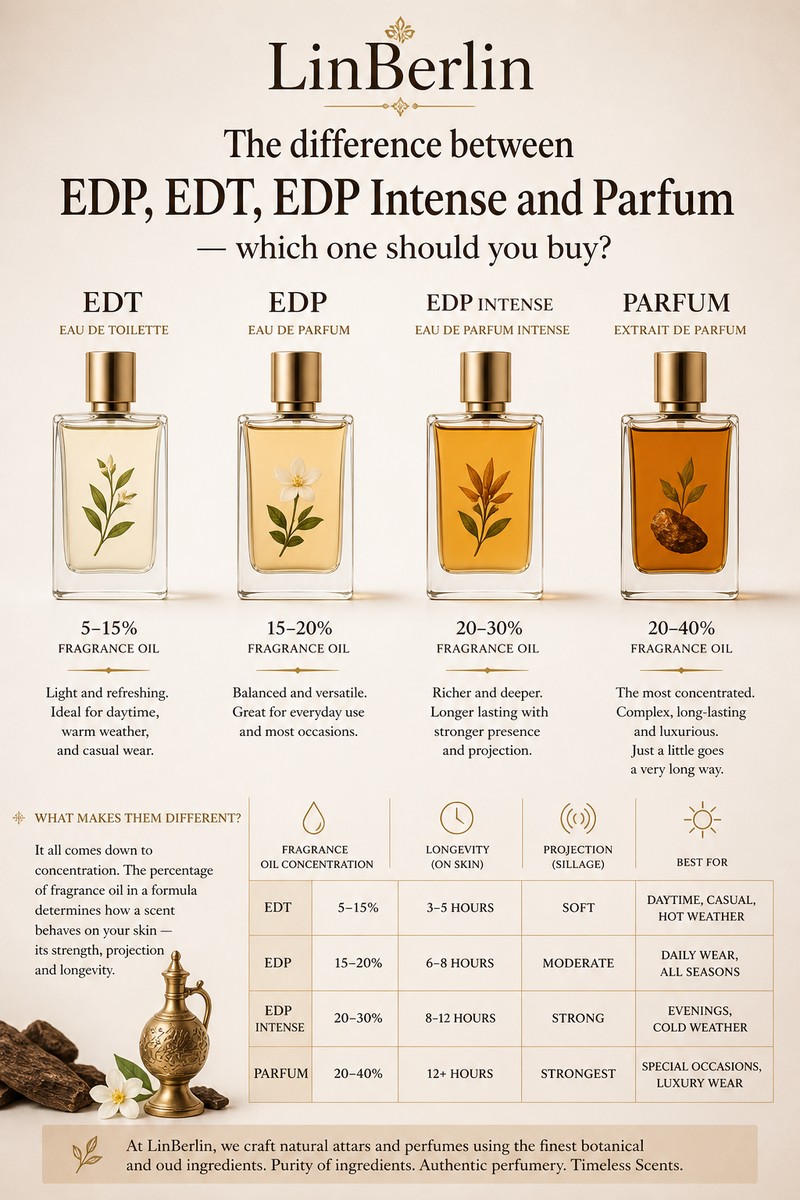
Understand the difference between EDP, EDT, EDP Intense and Parfum with real fragrance chemistry, concentration science, and how it affects performance. The difference between EDP, EDT, EDP Intense and Parfum — which one should you buy?
A drop of something dark and resinous can sit quietly on skin for twelve hours, while a brighter citrus spray disappears before your morning coffee cools. That contrast isn’t marketing magic—it’s chemistry, volatility, and how perfume is structured at a molecular level.
EDP, EDT, EDP Intense, and Parfum aren’t just labels. They reflect different balances of aromatic compounds, solvents, and evaporation behavior. And while brands often blur the lines, the underlying science still explains why one fragrance lingers and another feels like a quick shimmer.
This isn’t about choosing the “strongest” option. It’s about understanding what you’re actually wearing—and why it behaves the way it does on your skin.
The science explained
Perfume is fundamentally a solution: aromatic molecules dissolved in a carrier, usually ethanol for sprays or oil for attars. The concentration—whether it’s Eau de Toilette or Parfum—refers to how much of that solution is made up of fragrance compounds rather than solvent.
But concentration alone doesn’t tell the whole story — volatility governs perception. Molecules like limonene or bergamotene evaporate quickly because of their low molecular weight and high vapor pressure. Heavier materials such as patchoulol, ambroxan, or labdanum resins persist longer due to stronger intermolecular forces.
An EDT typically contains around 5–12% aromatic compounds, often structured to highlight top notes. That means more volatile molecules dominate the experience early on. EDPs push closer to 15–20%, increasing the proportion of mid and base notes, which slows evaporation and extends wear.
Parfum, sometimes reaching 25–30%, shifts even further toward less volatile compounds (though not always, depending on composition). This is why Parfum often feels denser, closer to the skin, and more continuous in its evolution.
And EDP Intense? It’s less standardized. Some brands increase concentration slightly, others restructure the formula entirely by amplifying base materials like iso e super or musks.
There’s also the role of ethanol itself. Alcohol evaporates rapidly, creating a cooling effect and helping disperse fragrance molecules into the air. Oils, by contrast, slow diffusion—changing not just longevity but projection.
Honestly, concentration is only part of the equation. The composition—what molecules are used and how they interact—can outweigh percentage entirely.
Why it matters for fragrance
So what does all this mean when you’re choosing between EDT, EDP, or Parfum?
An EDT tends to feel brighter, more transparent, and more immediate. It projects quickly, thanks to volatile top notes, but fades faster. This makes it ideal for environments where you don’t want a lingering scent trail.
EDPs sit in a more balanced space. They still open with brightness but transition into a noticeable heart and base. You’ll often get a fuller narrative of the fragrance over several hours.
But Parfum behaves differently. It doesn’t necessarily shout. Instead, it radiates slowly and stays close—what perfumers call a “skin scent” profile. The diffusion curve is flatter, meaning less dramatic peaks but longer persistence.
And then there’s EDP Intense, which can confuse people. Is it stronger? Sometimes. But more often, it’s richer. The emphasis shifts toward woods, resins, and musks, giving a deeper, heavier feel rather than just longer performance.
You might be wondering: why does the same fragrance smell different in EDT vs EDP? Because the ratio of materials changes, not just the strength. A citrus note might dominate in EDT but feel subdued in Parfum where amber and woods take over.
And here’s another question people rarely ask—why do some EDTs last longer than EDPs? Because longevity depends more on molecular weight and fixatives than on concentration percentage alone.
So the choice isn’t about “better.” It’s about how you want the scent to behave over time.
What this means for attar specifically
Attars operate on a completely different physical system.
Instead of ethanol, they use a base oil—often sandalwood or another stable carrier—which dramatically alters evaporation kinetics. Without rapid alcohol flash-off, top notes are softened, and transitions become more gradual.
That means an attar doesn’t map neatly onto EDT or Parfum categories. Even a small amount can last for hours because the oil anchors molecules to the skin.
But diffusion is lower (this is why attars feel more intimate). They create a personal scent field rather than projecting outward aggressively.
Natural materials also behave differently. Oud, for example, contains complex sesquiterpenes and phenolic compounds that evolve slowly. Rose attar includes components like citronellol and geraniol, which balance volatility with persistence.
So when you compare an alcohol-based EDP with a natural attar, you’re not just comparing strength—you’re comparing two fundamentally different delivery systems.
LinBerlin's approach
LinBerlin works with this reality rather than against it.
Instead of chasing arbitrary concentration labels, the focus stays on material quality and structural balance. High-grade natural extracts behave differently from synthetic blends, especially in how they evolve over time.
And that means careful sourcing—whether it’s genuine oud oils, responsibly distilled florals, or stable carrier bases that preserve integrity.
The goal isn’t to mimic EDP or Parfum categories but to create compositions that perform naturally, with depth and clarity.
Closing
Choosing between EDT, EDP, EDP Intense, and Parfum isn’t really about strength. It’s about timing, diffusion, and how a scent unfolds in the air and on your skin.
Once you understand the chemistry, the labels stop feeling confusing. You begin to notice structure—how something opens, settles, and lingers.
And that awareness changes how you wear fragrance. Not as a fixed identity, but as something alive, shifting quietly with your body and the hours around you.