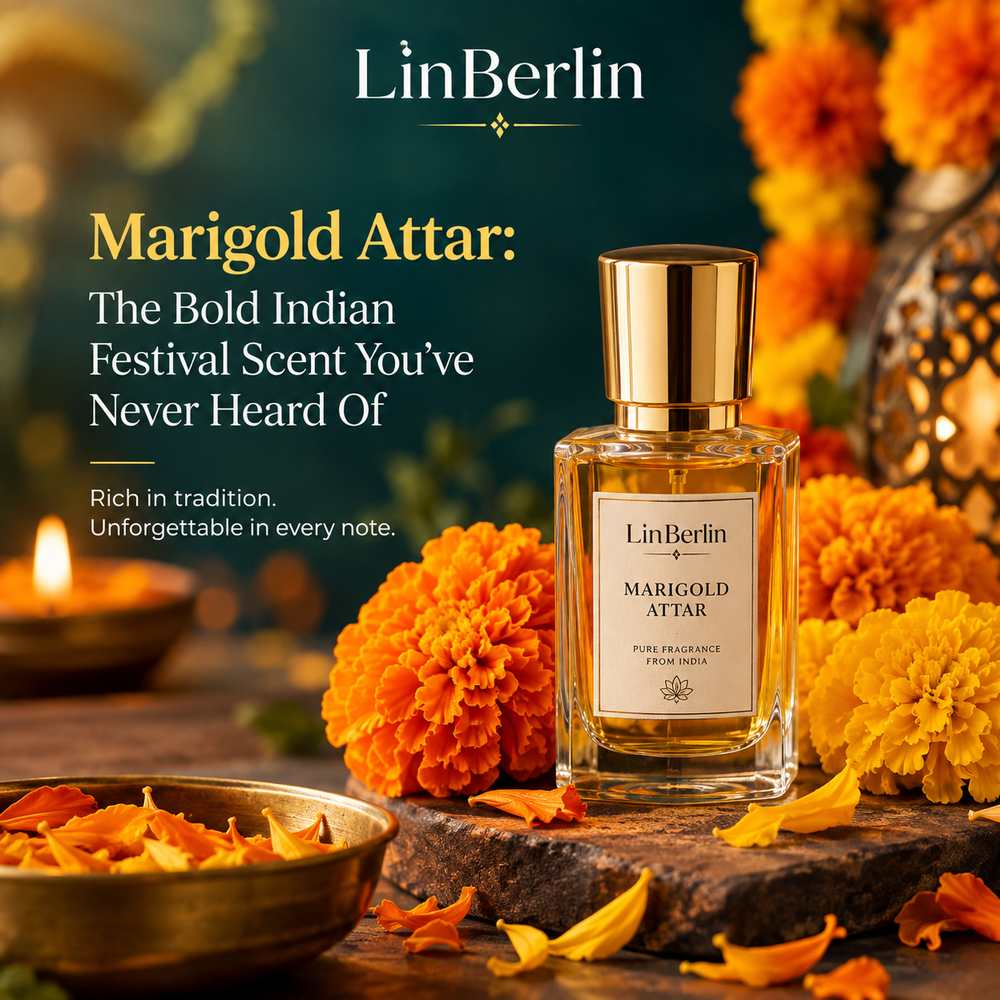
The smell reaches your fingers before it reaches your nose. Anyone who has threaded a marigold garland for a doorway at Diwali knows it: green, bitter, faintly medicinal, and then, as the petals bruise, suddenly warm and almost honeyed. You wash your hands twice. It's still there.
That smell, the real one and not the sweetened idea of "flower" that most perfume gives you, is what marigold attar tries to hold on to. And outside India's festival calendar, hardly anyone has smelled it in a bottle.
Why marigold smells nothing like a rose
Roses flatter. Marigold argues with you first. The opening is herbaceous and slightly sharp, with a dry, almost tobacco-leaf edge, and only after a few minutes on skin does a fruity, hay-like sweetness come through underneath.
The flower most Indians mean by genda is Tagetes erecta, the big orange pom-pom sold by the kilo outside every temple. It is not calendula, though the two get muddled constantly (calendula is the gentler "pot marigold" you'll see in skincare). Different plant, different chemistry, different smell.
Some people love the bitterness on sight. Others wrinkle their nose and say it smells like a garden shed. Both reactions are fair, and I'd rather you know that now than after you've bought a bottle.
How a garland becomes an attar
The traditional route is hydro-distillation in copper vessels, with the flower's vapour carried into a base of sandalwood oil rather than into alcohol. It's slow, it's fuelled by wood fires, and the yield is small. The sandalwood does two jobs: it catches the volatile top notes that would otherwise vanish, and it gives the finished attar a creamy, resinous body that softens marigold's edge.
That base matters more than people expect. It's the same warm foundation that makes jasmine and sandalwood feel so quietly holy in an Indian morning, except marigold pushes the conversation somewhere louder. Fewer prayers, more drums.
I'll be honest, I'm skipping over the finer points of how distillers judge the moment a batch is ready. It's mostly nose and experience, and it deserves its own article.
Where marigold actually belongs
Marigold is a festival scent, and I mean that literally. It hangs on Diwali doorways, drapes Ganesh idols, and threads through wedding mandaps and Durga Puja pandals. Wearing it carries all of that memory with it, which is why it feels so specific to people who grew up with it and so unfamiliar to everyone else.
If you're dressing for a celebration, it pairs beautifully with the kind of evening described in this guide to choosing fragrance for festival evenings, where silk, oil lamps and long hours on your feet all shape what smells right. Marigold doesn't whisper. It holds its own next to incense smoke and frying sweets, which most delicate florals can't.
Season plays a part, too. The warm, green-orange character is at its best in the cooler run from October into winter, when skin is a little less sweaty and the scent sits closer instead of spreading too fast. In peak heat it can turn sharp. If you're building a wardrobe around the calendar, matching fragrance to each Indian season will save you some disappointment.
What your skin does to marigold attar
Here's where the skin conversation starts, and it's the part most fragrance articles skip. Attar is oil. Oil on skin behaves according to what skin is like that day (and what you put on it an hour earlier).
Dry skin drinks fragrance and lets it go fast. You'll notice marigold vanishes within a couple of hours, the top notes especially. Skin that has been moisturised with something plain and unscented holds scent noticeably longer, because the oil has a surface to sit on rather than sinking straight in. Oily skin is the opposite problem: it can amplify the scent and push it forward, so the sharpness comes across stronger than the bottle suggested. Combination skin? Depends on the wrist, honestly. Try the inside of the elbow, where things are more even.
Normal skin has the easiest time. Sensitive skin needs the most patience, and I'd say start with clothing at the collar or a scarf edge before you go anywhere near a pulse point.
The layering mistakes people actually make
The most common one is a scented body lotion under an attar. The two fight, and what you get is muddy, a bit sour, and nothing like either product on its own. People assume the attar has gone off. It hasn't. It's just been talked over.
The second is applying straight after active skincare, and this one carries a real cost. Retinol, exfoliating acids (AHAs and BHAs), and high-strength vitamin C all leave skin temporarily more reactive. Put a concentrated botanical oil over that and the usual report is stinging or a warm, blotchy flush that lingers. Give actives a full gap, or move the attar to your clothes and hair ends on those days.
Freshly shaved skin, sunburn, eczema flare-ups, any broken patch: leave those alone entirely.
Cautions worth taking seriously
Natural doesn't mean gentle. That's the thing I wish more brands, ours included, said plainly. Plant oils are often the exact source of allergic reactions, and marigold has a few specific flags.
Tagetes oils can be phototoxic, meaning skin treated with them and then exposed to strong sunlight may react. So a heavy application on bare shoulders before an afternoon in the sun is a poor idea. Dab it where fabric or shade covers you.
Marigold also belongs to the daisy family. If you react to chrysanthemums, ragweed, or chamomile, your skin may object here as well. Pregnant? Check with your doctor before wearing concentrated botanical oils on skin, since guidance on essential-oil-based products varies and I'm not the right person to settle it for you. The same goes for anyone using fragrance around babies or very young children.
And always patch test. A small dab inside the elbow, wait a full day, and watch for redness or itching. Boring advice. It works.
How to wear it without overdoing it
- Use one small dab, not a swipe. A little goes a very long way, and marigold is not shy.
- Apply to clean, lightly moisturised skin (unscented) at the wrist, behind the ear or the base of the throat, then leave it alone. Rubbing wrists together crushes the top notes.
- For a longer evening, try layering it over something dark and musky. Black oudh and musk on warm nights gives the green edge something deep to lean on, and the drydown ends up smoky and unexpectedly soft.
Skip perfume on the same spot the same day. The alcohol thins the oil and the whole thing turns strange.
Who will and won't love this
Realistically, marigold attar is for people who like scents with a pulse. If you live in soft powdery musks, this will feel like being handed a bunch of raw herbs. If you grew up near temples, weddings, or a grandmother's puja room, it may hit you somewhere you didn't expect.
Neither is wrong. But a sample beats a leap of faith, and a patch test beats both.
Your next step
Pick a cool evening before the next festival, do the patch test the day before, and wear one small dab on clean, moisturised skin. Then pay attention to how it changes over three hours, not thirty seconds. That's where marigold shows what it is.