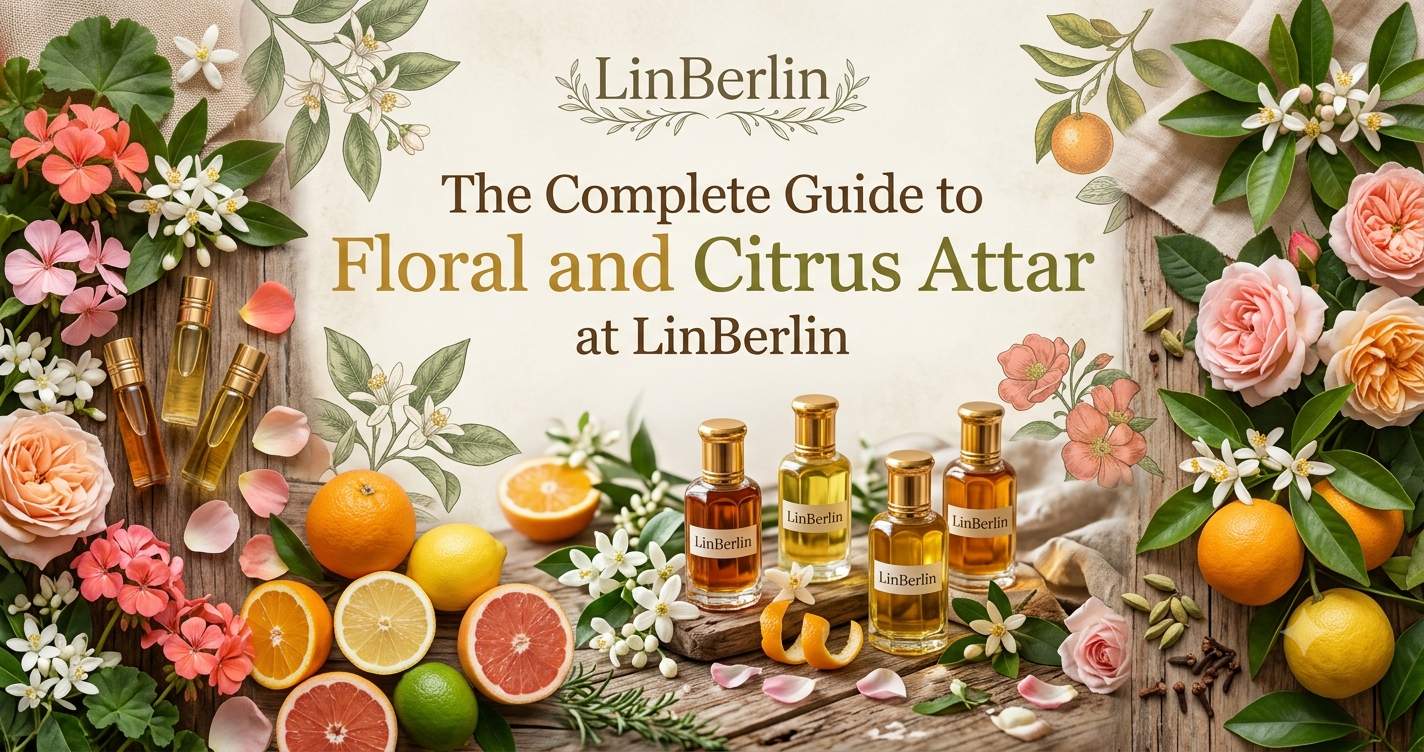
Skin remembers scent differently than fabric does. Spray a citrus attar on a cotton scarf and it will smell the same at 9am and 9pm. Spray it on your wrist and by lunchtime it's telling a completely different story — because your skin isn't a neutral surface, it's a living, oil-producing, pH-shifting thing that's constantly negotiating with whatever you put on it. That negotiation is where most people go wrong with attar, and it's also where the real craft of wearing it begins.
At LinBerlin, we spend as much time thinking about skin chemistry as we do about distillation. A jasmine attar built in a lab-perfect sense can still fall flat on a person whose skin is dry, over-exfoliated, or layered under six skincare actives. So this guide isn't just about which florals and citrus notes we make. It's about how to actually wear them — on your skin, as it really is, not as we'd like it to be.
Why skin type changes everything about how attar performs
Oily skin holds fragrance longer. That's the short version, and it's true, but it's — well, it's more complicated than that once you factor in sebum composition, skin temperature, and how often someone touches their face during the day. Sebum acts like a slow-release mechanism for oil-based perfumery. Attar is oil-based by nature, so it blends into that layer rather than sitting on top of it the way alcohol-based sprays do. This is one reason attar tends to outlast Eau de Parfum on the same person, hour for hour.
Dry skin behaves almost the opposite way. Without enough natural oil to bond with, an attar's top notes can burn off within an hour, leaving only a faint trace of the base. This isn't a flaw in the attar. It's just physics. And it's exactly why we tell people with dry skin to moisturise first — a proper, fragrance-free moisturiser, not a scented lotion that will fight with the attar for dominance.
Combination skin is the trickiest to generalise about, honestly. Some people find their T-zone amplifies citrus and green notes while their cheeks mute everything. Realistically, the only way to know is to test — apply attar to both areas on different days and pay attention to what actually happens, not what you expect to happen.
The moisture connection nobody explains properly
Here's the thing — moisturised skin isn't just softer, it's a better canvas for scent to develop on. Hyaluronic acid and ceramide-based moisturisers create a slight barrier that slows evaporation, which means the top notes of a citrus attar like our Itr e Fawakih linger a little longer instead of vanishing in the first twenty minutes. We've had customers tell us they "got a different perfume" simply by applying it after a shower on damp skin rather than dry skin later in the day. Same bottle. Different result. That's the moisture talking, not the formula.
This matters even more with delicate florals. Jasmine, in particular, is a note that unfolds in stages — indolic and slightly animalic at first, then sweeter and more honeyed as it settles. On dehydrated skin, that unfolding gets rushed or skipped entirely, and you're left smelling only the sharper opening. Our jasmine attar, Itr e Jashmin genuinely rewards a little patience and a well-moisturised wrist.
Layering attar with skincare without causing irritation
People assume layering fragrance and skincare is simple — put moisturiser on, then perfume, done. Mostly, yes. But there are a few combinations worth knowing about before you commit to a routine, especially if you're using active ingredients.
Retinol and retinoids thin the outer skin barrier temporarily, which can make skin more reactive to essential oils and aromatic compounds found in natural attar, including citrus-derived ones. If you're on a retinol routine, applying attar directly onto retinol-treated skin (rather than clothing or hair) can occasionally cause mild stinging or redness, particularly with citrus attars that carry natural limonene. Waiting a few hours, or applying to areas away from active treatment zones, usually resolves this.
AHAs and BHAs do something similar — they increase skin's sensitivity to light and to fragrance compounds for a window of several hours after application. Vitamin C serums, oddly, tend to play fine with attar, though we'd still suggest applying attar after the serum has fully absorbed rather than while it's still tacky on the skin.
And then there's the simple stuff people overlook: fragrance layered on top of a fresh chemical exfoliation, or onto skin that's just come out of a hot shower with open pores, tends to sting more and fade faster. Cooler, calmer skin holds attar better than flushed, freshly-stimulated skin. It's not dramatic. It's just something worth noticing.
Where floral attar and skin sensitivity intersect
Florals get a reputation for being "gentle" simply because they smell soft, but that's not really how sensitivity works. Some of the most reactive natural materials in perfumery are floral — rose absolute, jasmine, and certain lavender chemotypes all contain naturally occurring compounds (linalool, geraniol, citral) that can trigger contact dermatitis in a small percentage of people, even at natural concentrations.
That doesn't mean floral attar is unsafe. Most people wear rose, jasmine, and lavender attars for years without any issue. But if you have a documented fragrance allergy, eczema-prone skin, or a history of reacting to essential oils, a patch test on the inner forearm — left for 24 to 48 hours before full application — is a genuinely sensible precaution, not an overcautious one.
Our rose offerings sit at slightly different points on this spectrum depending on how they're built. Attar of Roses, Gul Nishan follows a more traditional, deg-bhapka distillation approach, while Bluma, our rose perfume is a softer, more modern rose composition designed for everyday wear on skin that might not tolerate a heavier attar concentration as well.
Lavender occupies an interesting middle ground — often recommended for sensitive skin because of its calming reputation, though the essential oil itself can still be irritating in concentrated, undiluted form. The Lavine, our lavender perfume is formulated at a wearable strength precisely with this in mind, rather than at raw essential-oil concentration.
Citrus attar, skin, and the sun question
Citrus deserves its own section, mostly because of one issue people rarely get warned about: phototoxicity. Certain citrus oils, particularly cold-pressed bergamot and some lemon extracts, contain furanocoumarins that can react with UV light and cause pigmentation or irritation on sun-exposed skin. This is genuinely worth knowing before you apply a citrus attar to your neck or wrists and head out for a beach day.
Most commercial attars, including ours, use processing methods that reduce or remove furanocoumarin content, but "reduced" isn't the same as "zero," so a little common sense goes a long way — apply to clothing instead of sun-exposed skin if you're going to be outdoors for hours, or simply apply in the evening. Our lemon attar, Rooh e Shabnam is genuinely one of our brightest, most photogenic scents on skin — and also one where this caution applies most directly, given how concentrated the lemon oil is.
Citrus also fades faster than florals on most skin types, which surprises people who expect it to behave like a heavy oud. That's just the nature of citrus terpenes — they're volatile, light, and built to lift off quickly. Layering citrus attar over an unscented moisturiser, or dabbing it onto pulse points where body heat helps sustain it, extends its life noticeably. Our citrus attar, sold under the name Itr e Fawakih, was actually built with this fading behaviour in mind — anchored with a soft floral-woody base so the citrus opening has something to land on rather than evaporating into nothing.
Pregnancy, hormonal skin, and fragrance sensitivity
Pregnancy changes skin chemistry in ways that genuinely affect how fragrance is perceived and tolerated. Heightened smell sensitivity in the first trimester is well documented, and some people who've worn the same attar for years suddenly find it overwhelming or nauseating during early pregnancy. This isn't the fragrance changing. It's the nose.
There's also a broader conversation around essential oil use during pregnancy that goes beyond scent preference — certain concentrated botanical extracts are generally advised against by midwives and obstetricians, particularly in the first trimester. We're not medical professionals, and we won't pretend otherwise here: if you're pregnant or breastfeeding and unsure whether a specific natural attar is appropriate for your skin or your situation, that's a conversation for your doctor or midwife, not a fragrance brand's blog post.
A floral built for everyday layering: Aurora
Not every floral attar needs to be worn alone. Aurora, our floral luxury perfume, was built as a multi-floral blend specifically so it could sit comfortably under a moisturiser-heavy skincare routine without getting muddled or overpowering. It's a slightly denser composition than a single-note floral, which — somewhat counterintuitively — actually makes it more forgiving on varied skin types, since no single note is doing all the work alone.
For anyone newer to jasmine specifically but hesitant about its more animalic reputation, Jasmire, our jasmine perfume, offers a gentler entry point — jasmine-forward but rounded out so it doesn't demand the same skin conditions that a pure jasmine attar might.
A few honest ground rules for wearing attar well
So, after all of this, what actually matters day to day? A handful of things, really. Moisturise before applying, especially if your skin runs dry. Give active-ingredient routines a few hours of buffer before layering fragrance directly onto treated skin. Patch test anything new if you have a history of sensitivity, and don't assume "natural" automatically means "risk-free" — it doesn't, and no honest fragrance brand should tell you otherwise.
But also — don't overthink it. Most people wear attar every day for years without a single issue, and the small precautions above are exactly that: precautions, not warnings against enjoying natural perfumery. The goal isn't to make you nervous about scent. It's to help you get more out of it, and to understand your own skin well enough that a bottle of attar performs the way it's meant to, on you specifically, rather than on some average skin type that doesn't really exist.
If there's one thing worth remembering above everything else here, it's that attar is never just about the oil in the bottle. It's about the meeting point between that oil and your particular skin, on that particular day, in that particular season. Get that relationship right, and even a small amount goes a long way.