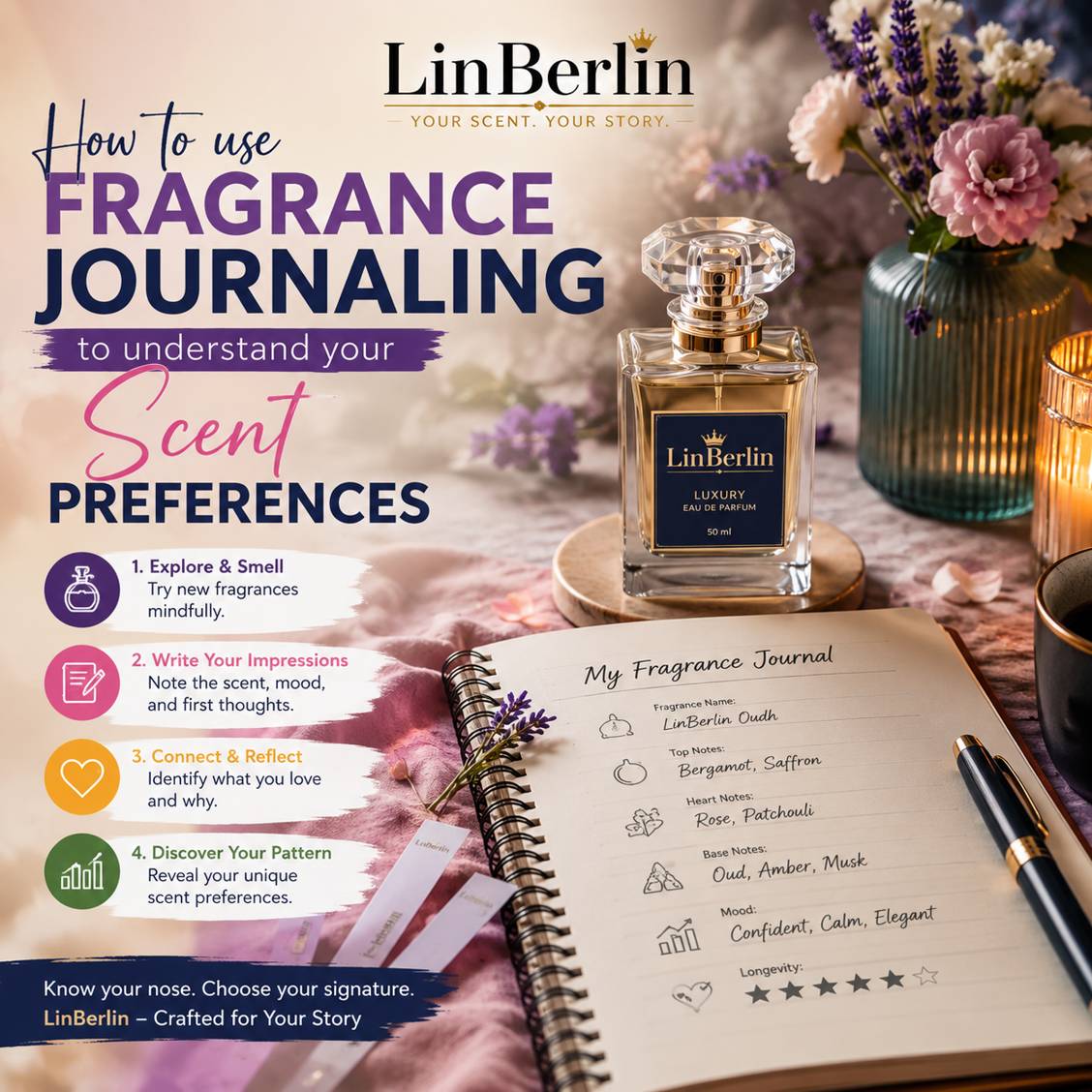
A woman walked into a fragrance consultation last year convinced her skin "rejected" attars. She'd bought three different oud blends over two years, and every single one turned sharp and medicinal on her within an hour. Her conclusion was that her body simply didn't get along with natural perfumery. It took about fifteen minutes of questions to find the real pattern — she was applying every attar right after a retinol night, on skin that was drier and more reactive than she realized, and she'd never once written any of this down. She just remembered "it didn't work" and moved on to the next bottle. That's the story that convinced us fragrance journaling isn't a nice-to-have ritual for hobbyists. It's diagnostic work, and most people are skipping it entirely.
Why your memory is lying to you about scent
Smell memory is notoriously unreliable in a specific way — it's emotionally vivid but factually thin. You'll remember that a fragrance made you feel elegant, or that it reminded you of your grandmother's dressing table, long before you remember how it actually opened, developed, and faded on your particular skin. And that gap between feeling and fact is exactly where people go wrong when they're trying to understand their own preferences. They end up buying based on a mood memory from six months ago rather than the specifics of what actually worked.
A fragrance journal closes that gap. It's not about being poetic on paper, though there's nothing wrong with that if it helps you engage. It's about capturing the boring, useful details in the moment — skin condition that day, time of application, what happened at fifteen minutes, at two hours, at six. Realistically, most people won't do this for every single wear. That's fine. Even five or six entries over a few weeks will reveal patterns you didn't know existed.
What actually changes scent on skin (and why journaling catches it)
Skin isn't a neutral surface. It's alive, it's oily or dry in ways that shift week to week, and it's chemically active in ways most fragrance buyers never consider. Moisturised skin holds scent longer — this is well established in perfumery, not folklore. Lipids and hydration act like a slow-release layer, letting the fragrance's oils evaporate gradually instead of flashing off in twenty minutes. So if you're someone whose attar "disappears too fast," the first question isn't the attar. It's whether you applied it to bare, dry skin or skin that had a light, unscented moisturiser underneath.
But skin type cuts both ways. Oilier skin tends to amplify base notes and can push a fragrance's development faster and heavier than intended — you might notice woods and resins arriving earlier and sitting longer than the same attar would on drier skin. Drier skin, meanwhile, often reads top notes more sharply at first because there's less of that lipid buffer, then loses projection sooner. Neither is better or worse. They're just different canvases, and a journal is the only real way to learn which canvas you're working with, because your skin's oil production genuinely changes with season, hormones, and even sleep.
Sensitive or compromised skin adds another layer entirely. If your skin barrier is weakened — from over-exfoliation, from a reaction, from something as simple as recent sun exposure — fragrance compounds can penetrate differently and irritation risk goes up. This is where the woman from the opening story landed. Retinol thins and sensitises skin temporarily, and layering a concentrated oil-based attar directly on top of that irritation wasn't a fragrance problem. It was a timing and skin-barrier problem that only became visible once she started writing down what she was doing before each application.
Building a journal entry that's actually useful
You don't need a beautiful notebook or a complicated template. What you need is consistency in a handful of fields, tracked the same way each time so patterns can surface. Here's what we'd suggest recording, in whatever format works for you — notes app, spreadsheet, actual paper:
The attar or fragrance name and where you applied it (wrists, inner elbow, behind ears — location matters more than people assume, since pulse points run warmer and project differently). Then skin condition that day: dry, freshly moisturised, post-shower, post-actives like retinol or acids, or normal. Then a timeline of impressions — opening scent in the first five minutes, then a check at the one-hour mark, then again around four to six hours if it lasts that long. And finally, an honest note on how it felt to wear, separate from how it smelled. Did it feel heavy? Did you forget it was there, which is often a compliment? Did it itch or feel warm on the skin, which is worth flagging immediately.
One thing to skip: rating everything on a rigid ten-point scale. It looks organized but it flattens the nuance you're actually trying to capture. A quick sentence — "opened citrusy and bright, settled into something warmer and slightly powdery by hour two, lasted well past six hours on my wrist but faded fast on my neck" — tells you more than any number could.
Reading your own patterns over time
After a few weeks of entries, most people notice something they didn't expect going in. Maybe it's that every attar with a heavy amber base turns cloying on them by hour three, regardless of brand. Or that citrus-forward oils vanish almost immediately unless applied over moisturised skin, which points to their skin running dry rather than the fragrance being poorly made. Or, and this comes up more than you'd think, that they consistently prefer how a scent smells on someone else's skin in the store versus their own — which usually isn't about the scent at all but about individual skin chemistry doing something entirely different with the same oils.
So the preferences that emerge from a journal tend to be more specific and more useful than the vague "I like woody scents" most people start with. You start to notice you like woody base notes but only when the opening is citrus or green rather than sweet. Or that you gravitate toward attars with a spice component but only in cooler months, because heat makes those same spice notes feel overwhelming on your skin. These are the kinds of preferences that actually help you choose well, rather than the broad categories that lead to another bottle sitting unused in a drawer.
Where caution matters
A few honest flags here, because trust matters more than a sale. If you're pregnant, heightened sensitivity to smell is common and some people find fragrances they used to love become nauseating or overwhelming — this isn't something to push through, and it's worth noting in your journal separately so you can revisit those attars later rather than assuming you've gone off them permanently. If you're using strong actives — retinoids, AHAs, BHAs, benzoyl peroxide — give your skin a buffer before applying concentrated oil-based fragrance directly to treated areas; the wrist and inner elbow are usually safer test zones than the neck or décolletage if you're on an active skincare routine. And if you have a history of contact dermatitis or known sensitivities to specific botanical extracts, patch test on the inner forearm and wait 24 hours before wearing anything new more broadly. Natural doesn't mean risk-free — it means the compounds are complex and plant-derived, which is worth knowing rather than assuming automatically safer.
The limitation worth naming
Journaling won't tell you everything. It won't fully explain why a scent that reads beautifully on paper sometimes just doesn't move you emotionally, and it can't replace the simple, unmeasurable fact that sometimes you just love something for reasons that don't reduce to notes and hours. There's a real limit to how much data-driven tracking can capture about what makes a fragrance feel like yours. But for the practical questions — why something fades fast, why it turns sharp, why it never quite matches what you smelled on someone else — a few weeks of honest notes will tell you more than another six months of guessing.
Start small. Pick your next two or three attar wears and just note the basics: skin condition, application point, and how it felt at the one-hour and four-hour mark. You'll likely see the shape of your own preferences faster than you expect, and it'll change how you shop — less by mood memory, more by what you actually know works on you.