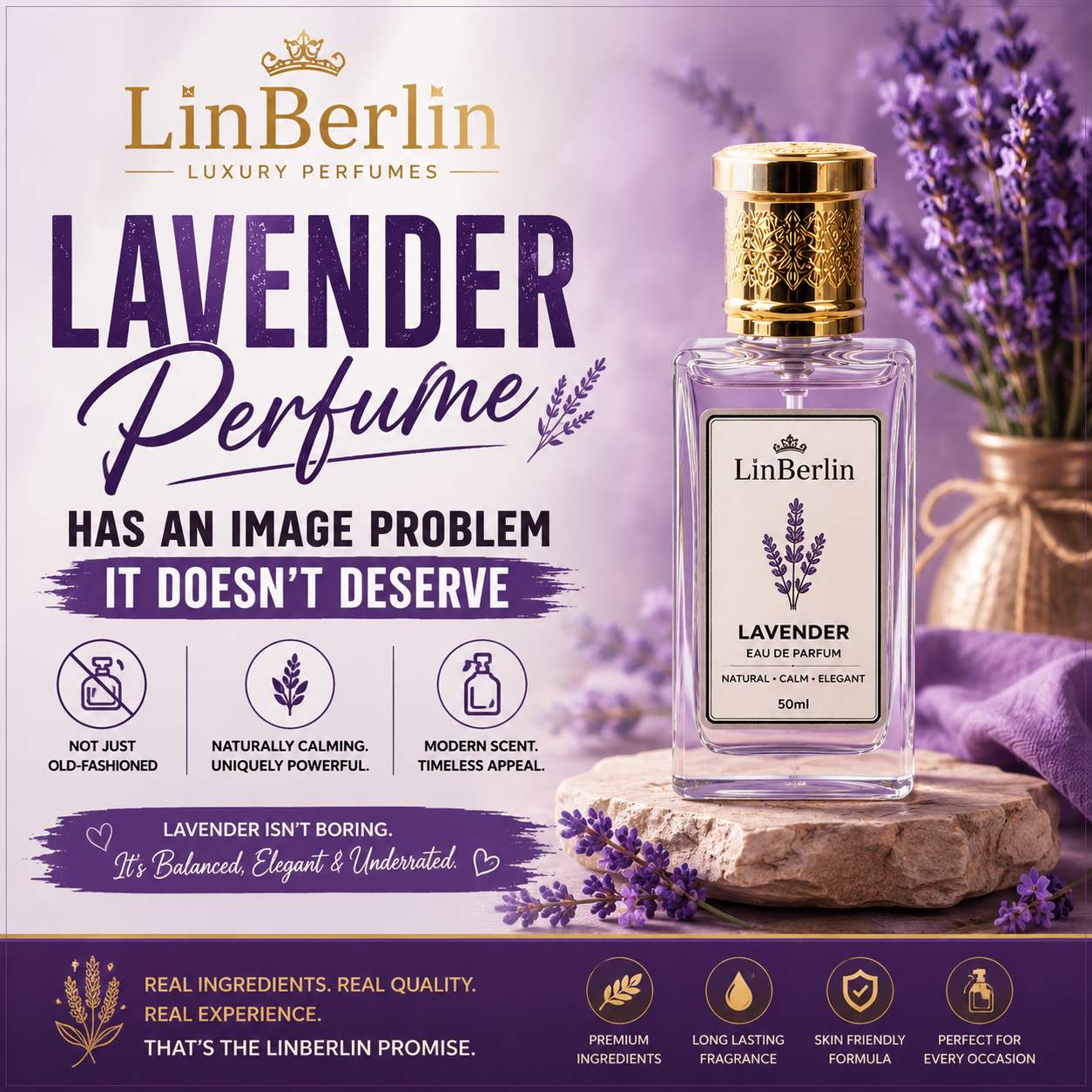
Ask most people to describe how lavender perfume smells and you'll get some version of the same answer: soap, old ladies' sachets, that purple bottle in a hospital gift shop, maybe a hint of laundry detergent if they're being generous. It's a strange fate for a note that, worn properly, is one of the more genuinely versatile things in natural perfumery — herbal, slightly sweet, capable of sitting comfortably on men and women, in daytime and evening wear alike. The reputation and the reality have drifted apart, and honestly, most of that drift comes down to decades of cheap synthetic lavender in cleaning products doing the actual damage to the note's image, not lavender itself. That distinction matters more than it sounds. Because once you separate "lavender the cleaning-product smell" from "lavender the actual essential oil," you're dealing with something considerably more interesting than its reputation suggests.
Where the image problem actually started
Synthetic lavender — usually built around isolated linalool or linalyl acetate, sometimes blended with cheaper aroma chemicals to approximate the fuller profile — has been used in laundry detergent, air freshener, and budget soap for so long that most people's first, most repeated exposure to "lavender" isn't lavender at all. It's a flattened, sharpened approximation designed to read as clean rather than to smell genuinely floral-herbal the way real Lavandula angustifolia oil does. That's the association most people are actually reacting to when they say they dislike lavender perfume. Real lavender oil is rounder, slightly sweeter, with a herbaceous depth that synthetic versions rarely bother capturing because it's more expensive and honestly less necessary for a detergent. The truth is, a lot of people who claim to dislike lavender have simply never smelled the real thing worn properly on skin — they've smelled a cleaning-aisle impression of it for thirty years and mistaken that for the whole story.
What real lavender actually does on skin
Genuine lavender attar or perfume behaves quite differently from its synthetic cousin once it's actually applied. It opens herbal and slightly camphorous, softens within the first fifteen minutes into something rounder and more floral, and settles into a warm, faintly sweet base that can carry a gentle powdery quality by the end of its wear. That evolution — sharp to soft to warm — is something synthetic lavender rarely manages, because it's usually built from one or two isolated molecules rather than the full, complex compound range naturally present in distilled lavender oil. The Lavine, our lavender perfume, is built around that fuller, evolving character rather than a flat single-note approach — which is really the whole argument for why lavender deserves better than the reputation it's stuck with. Worn properly, it reads considerably more sophisticated than the "grandmother's linen closet" stereotype suggests.
Why lavender suits more skin types than people expect
Here's something worth knowing before dismissing lavender based on how it's performed for you in the past: skin type genuinely changes how this note comes across, maybe more than most other florals. Dry skin tends to bring out lavender's softer, more powdery qualities — there's less natural oil to sharpen the initial herbal top note, so it settles into that rounder, warmer character a bit faster than it would on oilier skin. A light moisturiser underneath extends this considerably, letting lavender's base notes develop fully rather than fading before they've had the chance to soften. Oily and combination skin holds lavender's herbal brightness longer and more assertively — which some people love and others find a touch sharp if they were expecting something purely soft and calming. Neither is wrong. It's just a different read of the same oil, and worth knowing before you judge a bottle based on one wear on unrepresentative skin. Sensitive skin generally does well with lavender, actually — it sits toward the gentler end of the essential oil spectrum compared to citrus or concentrated floral absolutes, and it's one of the few oils occasionally used in skincare formulations specifically because of its relatively low irritation profile. That said, "generally gentle" still isn't the same as "universally safe" — a small percentage of people do have genuine lavender sensitivities, so a patch test on the inner arm, with a 24-hour wait before full application, remains sensible for anyone new to a specific formulation, particularly if they have a documented fragrance allergy already.
A note on pregnancy and layering
Lavender has a reputation as one of the "safer" essential oils generally, and in most contexts that reputation holds up reasonably well. But pregnancy is one area where blanket reassurance isn't quite honest enough — some sources advise caution with concentrated lavender oil during the first trimester specifically, so checking with a doctor or midwife before regular use is a reasonable precaution rather than an overreaction. Layering with skincare is mostly straightforward with lavender compared to more reactive notes, but the same general rule still applies: give strong actives like retinol or exfoliating acids twenty to thirty minutes to fully absorb before applying any concentrated fragrance oil on top, lavender included. Skin that's temporarily more permeable from active treatment is more prone to mild stinging with any oil-based fragrance, not because lavender specifically causes problems, but because the skin barrier itself is in a more reactive state right after strong actives.
Lavender isn't just for women, and it isn't just for calm
Part of lavender's image problem is gendering it — treating it as inherently feminine, soft, almost delicate in a way that pushes men away from a note that actually has a long history in men's grooming, particularly in older barbershop and aftershave traditions where lavender's herbal, slightly sharp opening paired beautifully with citrus and woody bases. There's a good piece on this exact territory in how a calm, composed fragrance identity works for men's office wear, worth reading if lavender's reputation has kept you from considering it as a genuinely wearable option for a man's everyday rotation. And the calming association isn't entirely reputation, either — there's real, if modest, research behind lavender's effect on relaxation and lowered stress markers, which is part of why it's shown up in aromatherapy for so long. That said, the calming effect from wearing it as perfume is subtler than from concentrated aromatherapy use, so it's worth enjoying lavender as a genuinely pleasant, well-constructed fragrance first, and any calming side benefit as a pleasant extra rather than the whole reason to wear it.
Where lavender pairs well, if you want more range
Worn alone, lavender is already more versatile than its reputation suggests, but it also plays beautifully alongside other notes if you want something with more depth. Vanilla softens and warms lavender's herbal edge into something almost dessert-like without losing the identity underneath — there's a lovely exploration of that specific pairing in how lavender's calm meets vanilla's warmth, worth trying if pure lavender feels a touch austere on its own. For something earthier and more grounded, vetiver rounds lavender out in the opposite direction — less sweetness, more depth. There's a good piece on that combination in how lavender settles in near vetiver's earthy calm, which covers this pairing properly rather than just gesturing at it.
Being honest about where the reputation holds a grain of truth
None of this means every lavender fragrance on the market deserves defending. A lot of cheap lavender products genuinely do smell exactly like the stereotype — thin, sharp, one-dimensional — because they're built from the same inexpensive synthetic isolates responsible for the reputation in the first place. The reputation isn't entirely undeserved when applied to that specific category of product. It's just wrongly applied to lavender as a whole, real oil included, which is the part worth correcting.
Giving lavender a fair second try
If your only experience with lavender is a linen spray or a bar of soap, you genuinely haven't smelled what this note can do yet. Try a real, properly distilled lavender oil on your own skin, give it the full twenty minutes to unfold rather than judging it in the first sniff, and see whether the stereotype actually survives contact with the real thing. Most of the time, it doesn't.