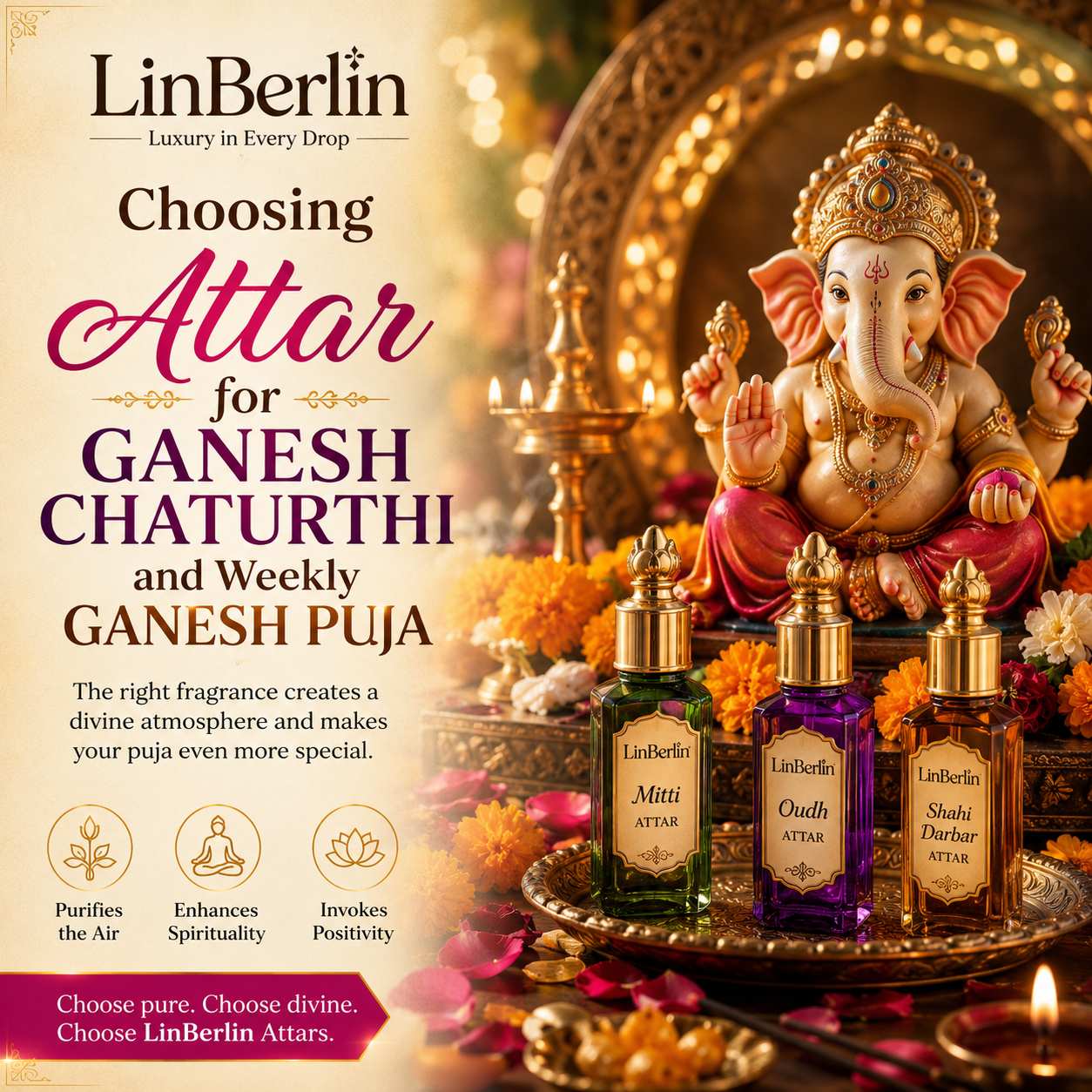
There is a specific smell that lingers in a puja room hours after the aarti has ended — not the sharp curl of camphor smoke, which fades fast, but something quieter that stays on the wrists and the collar of whoever performed the ritual. Most people never notice it until someone else does, usually a grandmother who leans in during pranam and says, without meaning to sound like a compliment, "kya laga hai tumne." That lingering note is almost never the incense. It's the attar, still sitting on warm skin long after the diya has been put away.
This is where most guidance about puja fragrance goes wrong. It treats attar selection as a matter of taste — floral versus woody, sweet versus earthy — without asking the more practical question: what actually survives an hour of standing, bowing, and moving near heat, on your particular skin, in your particular season?
Why the Right Attar Matters More During Puja Than Any Other Day
On an ordinary day, fragrance is personal. During Ganpati puja, it becomes something closer to an offering and we need special puja attar. The scent you wear is meant to sit alongside flowers, modak, durva grass, and the smoke of dhoop — not compete with them, not vanish under them either. A perfume built for nightclubs or office meetings usually collapses in that environment. Alcohol-based sprays evaporate quickly in a warm, incense-heavy room, and synthetic musks can turn sharp or slightly chemical when layered against natural dhoop and camphor.
Attar behaves differently because it isn't fighting the room. Oil-based fragrance blends into the same sensory world as the puja itself — flowers, sandalwood, ghee lamps — instead of standing apart from it. And that's really the whole argument for choosing attar over spray perfume for Ganesh Chaturthi: it was designed, historically, for exactly this kind of ritual proximity to the body and to devotion.
What Makes an Attar Feel Right for Ganpati — the Ganesh Pushp Profile
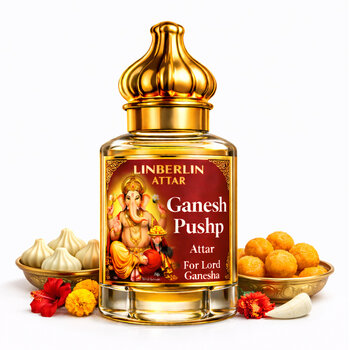
A floral-forward, temple-style attar tends to work best here, and this is where a well-formulated Ganesh Pushp attar for Ganpati Puja earns its name. It isn't built around a single loud note. It's a soft layering of marigold, jasmine, and a rounded base — the kind of composition that reads as "puja" the moment it reaches someone's nose, without anyone needing to be told what it is. There's a reason marigold and jasmine keep showing up in devotional attars across regions. Both flowers are already part of the visual and ritual language of Ganesh worship — garlands, offerings, the flowers pressed into modak thalis. A pushp attar echoes that instead of introducing something foreign to the moment.
But floral doesn't mean flat or one-note. A good Ganpati attar usually has a slightly warm undertone beneath the flowers, so it doesn't smell thin once it's been on skin for twenty minutes. That warmth is what keeps it from disappearing under incense smoke, which is a real risk with cheaper floral oils that are mostly top-note and very little else.
How Your Skin Actually Holds — or Loses — Puja Fragrance
Here's the thing nobody tells people buying attar for the first time: the bottle isn't what determines how long it lasts. Your skin is. Dry skin, especially on the wrists and inner elbows where attar is traditionally applied, doesn't hold onto oil-based fragrance the way moisturised skin does. The scent molecules need something to bind to, and bare, dehydrated skin just lets them evaporate faster.
This is basic perfumery, but it gets ignored constantly. A light, unscented moisturiser applied ten minutes before attar — enough time to actually absorb, not just sit on the surface — will noticeably extend how long a Ganesh Pushp attar stays present through a full puja. Oily skin, on the other hand, tends to hold fragrance longer naturally but can sometimes shift the character of lighter florals slightly sweeter or muskier as body heat interacts with the oil base.
So if you've ever applied attar in the morning and felt like it vanished by the time the aarti started, it probably wasn't the attar. It was dry skin pulling the fragrance off faster than it should.
Applying Attar Before Puja Without Upsetting Sensitive Skin
Realistically, most people layer attar on top of whatever skincare or festive makeup they've already applied — and that's usually where irritation shows up, not from the attar itself. Retinoids, strong AHAs, or freshly exfoliated skin make the skin barrier more permeable than usual. Applying concentrated fragrance oil directly onto that kind of compromised skin can cause redness, mild stinging, or a patchy reaction that has nothing to do with the attar being "bad" and everything to do with timing.
A safer approach: apply attar to pulse points that haven't been recently exfoliated or treated with active skincare — behind the ears, the base of the throat, the inner wrist away from any recent waxing or threading. Clothing works well too. A dot of attar on a dupatta or the inner fold of a kurta collar carries scent through the whole puja without ever touching skin directly, which sidesteps the sensitivity question altogether.
A Note on Caution
Pregnancy, known fragrance allergies, and active skin conditions like eczema near the application site all warrant a slower approach. Not avoidance necessarily — but a patch test on the inner forearm a day before Ganpati, rather than discovering a reaction mid-puja when there's no time to deal with it. Some natural attars use trace amounts of essential oils that are generally considered safe in low concentration but aren't recommended during pregnancy in larger amounts (certain woody and floral absolutes fall into this category). If in doubt, a dermatologist or your obstetrician is the better source than a blog post — this article can flag the caution, not resolve it for your specific skin.
Weekly Puja vs Ganesh Chaturthi — Adjusting the Ritual
Weekly Tuesday or Wednesday Ganpati puja at home is a quieter, shorter affair, and a single small dot of attar usually carries through it without needing reapplication. Ganesh Chaturthi is a different scale entirely — visarjan processions, hours of standing, heat, crowds, and often an outdoor element that a home puja doesn't have. Or the opposite problem: an indoor pandal packed with people, where a dozen different incense smells are already competing for space.
For the ten-day festival, it's worth carrying a small attar vial rather than expecting one morning application to survive the whole day. Reapplying lightly before visarjan, when the fragrance has already faded from the morning aarti, keeps it consistent through the parts of the ritual that matter most emotionally — the final darshan, the immersion, the moment everyone's actually paying attention to how things feel and smell around them.
A Few Honest Observations Before You Buy
Not every floral attar sold as "puja fragrance" is actually built for puja. Some are just generic rose or jasmine oils repackaged with festive labelling, and they smell noticeably thinner once you're an hour into an aarti. A properly blended attar should still smell like itself — not just top-note florals — after thirty or forty minutes on skin. That staying power, more than the price or the packaging, is usually the real signal of quality.
And one small thing worth remembering: attar is meant to be subtle in a puja setting, not loud. The goal isn't to be the strongest scent in the room. It's to sit quietly alongside the flowers and the dhoop, present enough to be part of the offering without overpowering it.
Choosing the right attar for Ganpati puja comes down to fewer decisions than it seems — a floral base that suits devotional use, a little attention to your own skin type before applying it, and enough caution around sensitive skin or pregnancy to test before you commit. Get those three right, and the fragrance takes care of the rest.