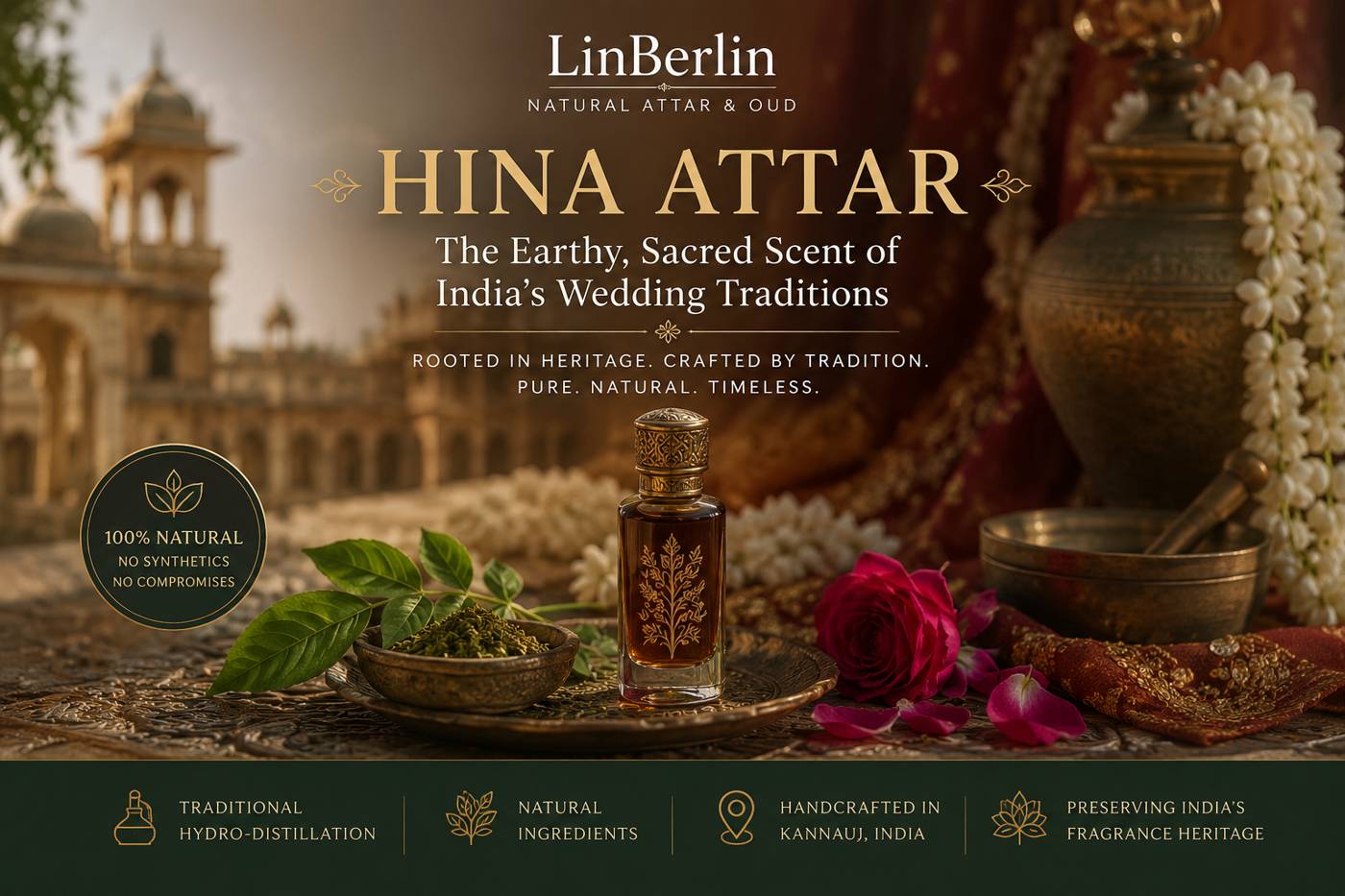
Discover the deep cultural roots, earthy aroma, and traditional craft behind hina attar, the sacred Indian perfume long linked with weddings and ritual. Hina attar: the earthy, sacred scent of India's wedding traditions
Smoke from marigold garlands, damp winter shawls, sandalwood ash, and the sweet heaviness of henna on warm skin often linger together in old North Indian wedding halls. Somewhere beneath all of that sits the unmistakable aroma of hina attar, dark and earthy with a strange warmth that doesn't behave like modern perfume at all. It clings quietly instead of announcing itself.
For many fragrance enthusiasts, hina attar becomes memorable not because it smells conventionally pretty, but because it carries atmosphere. The scent feels textured, almost tactile, with hints of spice, burnt herbs, damp earth, and aged wood moving together in ways synthetic compositions rarely manage. And despite its importance in traditional Indian perfumery, genuine hina remains deeply misunderstood outside specialist circles.
By the end of this deep dive, you'll understand where hina attar comes from, why it became tied to weddings and winter rituals across parts of India, how traditional makers build its unusually complex aroma, and what separates authentic hina from simplified commercial interpretations.
The origin and history
Cold evenings in North India shaped the cultural role of hina more than most people realise. Traditional attars were rarely created only for decoration — they were often connected to season, temperament, ritual, and even bodily comfort according to Unani and Ayurvedic thinking. Hina emerged as a warming fragrance suited especially to winter months, with its spicy and resinous profile believed to balance the body during colder weather.
Its strongest historical roots are tied to Kannauj, the historic perfume city of Uttar Pradesh where generations of deg-bhapka distillers refined attar-making techniques over centuries. Mughal influence played an enormous role here. Persian fragrance traditions merged with Indian botanical materials during the Mughal courts, and hina became associated with ceremonial gatherings, wedding preparations, and evening wear among nobles and merchant families alike.
But hina was never a single fixed formula. That's where confusion begins for modern buyers.
Some old perfumers describe hina as a blend built around dozens of herbs, roots, spices, and woods distilled into sandalwood oil. Others insist the defining feature comes from specific aromatics such as saffron, vetiver, cloves, or shamama-style accords. Regional variations exist across North India, particularly between older Kannauj houses and smaller independent distillers who guard their family formulas carefully (sometimes refusing to disclose more than two or three ingredients).
And unlike rose or jasmine attars, hina doesn't attempt to reproduce a single flower faithfully. Its identity comes from composition rather than imitation. That made it especially suited to ceremonial use because the fragrance evolved slowly through smoke-filled wedding spaces, crowded gatherings, wool clothing, incense, and skin warmth.
You'll still encounter hina during traditional Muslim weddings in parts of Uttar Pradesh, Delhi, Hyderabad, and Lucknow, where older generations associate the scent with sherwanis, prayer gatherings, and winter festivities. In some households, applying hina before evening events became as culturally expected as wearing embroidered attire.
The truth is, many younger perfume wearers first encounter hina through memories rather than direct explanation. They recognise it from a grandfather's scarf, an old prayer cap, or the scent left behind in carved wooden wardrobes after wedding season.
What makes it distinctive
Dense herbal warmth defines real hina attar immediately, yet the scent changes dramatically depending on the maker. Some versions lean smoky and leathery while others reveal sweeter spice, dry woods, or even faint green bitterness underneath. A well-made hina unfolds slowly on skin — first sharp and aromatic, then resinous, then softly woody hours later.
Traditional production methods contribute enormously to that complexity. Classical hina attars are often created through hydro-distillation using copper degs heated carefully over wood or coal fire. The vapour passes through bamboo pipes into receiving vessels containing sandalwood oil, which absorbs the aromatic compounds over repeated distillation cycles. This old process remains labour-intensive and expensive, especially now that genuine Indian sandalwood is tightly regulated and far costlier than it once was.
What actually goes into hina? That's the question most readers are already asking.
Older formulations may contain vetiver roots, cloves, saffron, cinnamon bark, patchouli, kewda elements, spikenard, sandalwood, dried herbs, and occasionally traces of floral material to soften the harsher edges. Some perfumers also incorporate baked earth notes or smoky accords that mimic the atmosphere of incense and winter air. There isn't universal agreement because many recipes evolved through oral family tradition rather than written formula books.
But high-quality hina nearly always avoids smelling flat. If the fragrance opens loudly and remains unchanged for hours, there's a good chance it relies heavily on synthetics or simplified aroma chemicals. Authentic hina tends to breathe on skin. One moment it smells dry and woody, the next surprisingly sweet or almost medicinal.
So why do some people dislike hina instantly while others become obsessed with it?
Part of the answer lies in expectation. Modern perfume buyers often search for clarity: rose should smell floral, vanilla should smell sweet, citrus should smell bright. Hina refuses that simplicity. It behaves more like an old spice cabinet beside burnt incense and damp soil after winter rain. Honestly, that unpredictability is precisely what longtime attar enthusiasts cherish about it.
There's another complication too — commercial market versions labelled as hina sometimes contain very little resemblance to traditional compositions. Mass-produced oils may amplify sweetness, add heavy synthetic musk, or strip away the darker herbal facets that give authentic hina its meditative character.
How to recognise, appreciate, or choose
The first mistake new buyers make is expecting hina to behave like Western perfume oils. Real hina often opens challenging, especially during the first ten or fifteen minutes. Sharp spice, smoky edges, medicinal herbs, or leathery dryness can appear before the scent settles properly into skin warmth.
And that's exactly why testing on paper strips tells you almost nothing.
Skin chemistry matters enormously with traditional attars because natural oils evolve through heat and absorption rather than alcohol projection. Apply a tiny amount to the back of the hand or wrist and give it time. A mature hina composition usually softens gradually into woods, spice, earth, and subtle sweetness after an hour or two.
Colour can offer clues, though not definitive proof. Many authentic hina attars appear deep brown, greenish amber, or dark golden due to natural botanical materials and ageing. Extremely bright or artificially uniform colour sometimes suggests aggressive additives or heavy processing. Still, natural variation exists between distillers, so appearance alone won't guarantee quality.
Pay attention instead to texture and movement. Does the fragrance flatten quickly into generic sweetness? Does it smell aggressively synthetic after drydown? Or does it keep revealing small shifts in spice, smoke, herb, and wood as the hours pass?
Storage matters more than many enthusiasts realise (particularly with older sandalwood-based attars). Heat and direct sunlight can damage delicate aromatic layers over time, muting the subtle transitions that make hina compelling in the first place.
One honest caveat deserves mention here. Traditional hina formulas are not standardised internationally, so even respected attar houses may produce noticeably different interpretations under the same name. That's frustrating for newcomers expecting consistency, but it's also part of the living tradition surrounding Indian attar culture.
Season matters too. Hina feels most natural during cooler weather when its earthy spice can breathe without becoming overwhelming. Many experienced wearers reserve it for evenings, religious gatherings, winter weddings, or reflective settings rather than daytime summer use.
And don't rush your judgment after one wear. Some fragrances impress instantly and disappear from memory a week later. Hina often works in reverse.
LinBerlin's approach to this
At LinBerlin, hina isn't treated as a novelty perfume category or an exotic marketing concept. The focus stays on sourcing attars that preserve the layered, grounded character traditional hina is known for rather than sanding it down into something overly sweet or commercially safe.
That means paying close attention to how the attar evolves across several hours instead of only evaluating the opening minutes — especially because natural compositions reveal quality gradually. LinBerlin also recognises that many enthusiasts discovering hina today may never have encountered older Indian wedding or ritual fragrance traditions firsthand.
So the goal isn't to modernise hina beyond recognition. It's to present the material honestly, with respect for the historical craft behind Kannauj distillation methods and the cultural memory woven into the scent itself.
Closing
Long after louder perfumes disappear, hina tends to leave fragments behind: spice trapped in wool fabric, dry woods lingering on skin, faint smoke returning unexpectedly the next morning. That's part of why it remains emotionally powerful for so many people connected to Indian wedding traditions and old attar culture.
If you've only experienced polished modern perfume oils, spending time with a carefully made hina attar can completely shift your understanding of what fragrance is capable of expressing. Start slowly, wear it in cool weather, and allow the scent enough quiet space to unfold properly.
Source reference: fileciteturn0file0