A faint trace of sandalwood on a sleeve can pull someone years back without warning, as if a memory had been quietly waiting for permission to return. That strange immediacy is where fragrance stops being decorative and starts becoming neurological. The way scent interacts with mood, memory, and focus isn’t poetic exaggeration; it’s rooted in how the brain is wired. And while people often talk about it in sweeping claims, the science tells a more precise, sometimes surprising story.
And that story begins not in the nose itself, but in the brain structures that process what we smell. What fragrance does to you depends less on the bottle and more on how your mind has learned to interpret it.
What the research actually shows
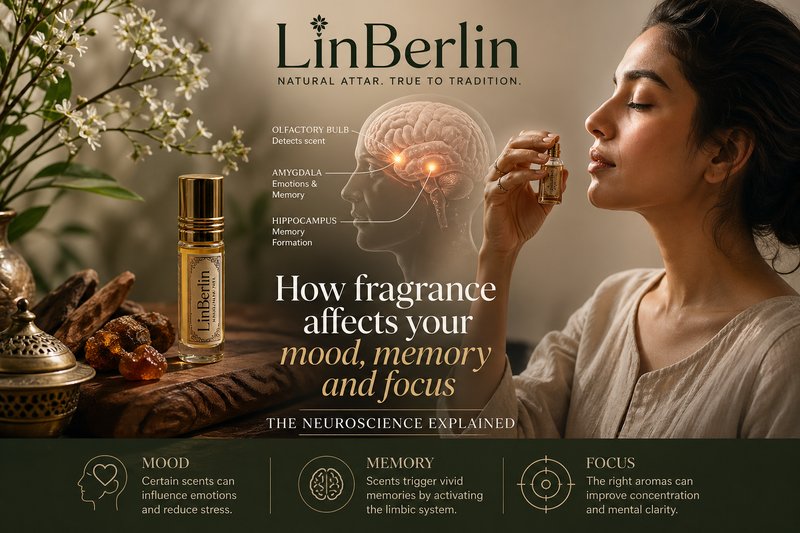
The signal from a scent doesn’t take the long route most senses do — it moves directly from the olfactory bulb into parts of the brain linked with emotion and memory, especially the amygdala and hippocampus. That shortcut is why smell can feel so immediate. Researchers like Rachel Herz, a neuroscientist known for her work on scent and memory, have shown that odours are more likely than visual or verbal cues to trigger emotionally vivid recollections.
But there’s nuance here. The brain doesn’t store smells as isolated data points; it binds them to context. A rose note might feel calming to one person and unsettling to another, depending on experience (this is why identical perfumes can feel so different across people). The emotional response isn’t built into the molecule itself — it’s learned.
So what about mood and focus? Some studies, including small controlled trials on lavender and peppermint, suggest measurable effects. Lavender has been associated with reduced anxiety markers in clinical settings, while peppermint has shown modest improvements in alertness during repetitive tasks. But these effects tend to be subtle and context-dependent, not dramatic shifts.
And here’s the thing — much of the evidence is still limited by small sample sizes or short-term observation. You’ll see headlines claiming scent can “boost productivity” or “reduce stress instantly,” but the data rarely supports such broad claims.
What does hold up consistently is this: scent is a powerful cue for memory retrieval and emotional association. That’s not speculation; it’s one of the more stable findings in sensory neuroscience.
The practical reality
In everyday life, this doesn’t play out as dramatic mood control. It’s quieter than that. A particular attar worn during focused work can, over time, become linked with concentration — not because the oil itself forces focus, but because the brain starts to associate that scent with a specific mental state.
So if you reach for the same fragrance every time you sit down to work, something interesting happens. Eventually, just catching that scent can make it easier to settle into the task.
But it’s not automatic.
And it won’t override stress, fatigue, or distraction on its own. Fragrance works more like a cue than a solution. Think of it as a mental bookmark rather than a switch.
People often wonder, can a scent really calm anxiety in a meaningful way? The answer is: sometimes, but not reliably for everyone. If you already associate a smell with safety or comfort, it can help reinforce that feeling. If you don’t, the effect may be minimal.
Or consider memory. Why do certain scents bring back childhood so vividly while others don’t register at all? Because repetition and emotional context matter. A smell experienced during meaningful moments becomes anchored in memory. Without that, it’s just another sensory input.
Honestly, expecting fragrance to change your mental state instantly is where most people get disappointed. The strength of scent lies in consistency and association over time.
How to apply this with attar
Using attar in this context is less about choosing a “correct” note and more about creating intentional patterns. Natural attars, especially those based on sandalwood, vetiver, or soft florals, tend to evolve slowly on the skin, which makes them well suited for this kind of repeated use.
Start with one scent for one purpose. For example, a grounding woody attar for work or study. Apply it lightly at the same time each day. Over weeks, your brain begins to link that aroma with the mental state you’re in during those moments.
And keep it simple — layering too many fragrances breaks that association.
You might also use a different attar in the evening, something softer or warmer, to signal a shift away from activity. This isn’t about forcing relaxation (the effect is usually gentle), but about creating a consistent sensory marker that your body can learn.
So the question becomes: what do you want a scent to represent in your life?
LinBerlin’s perspective
LinBerlin approaches fragrance with a respect for both tradition and evidence. Natural attars have long been used in cultural practices for grounding and reflection, but that doesn’t mean every claim attached to them is scientifically proven.
The focus remains on quality of raw materials and authenticity of composition, not exaggerated promises about mood transformation. A well-made attar can support a personal ritual or habit, but it isn’t positioned as a shortcut to emotional change.
And that distinction matters, because it keeps expectations realistic while still leaving space for meaningful personal experience.
Closing
A scent won’t reorganise your mind overnight, but it can quietly shape how you return to certain states over time. The link between fragrance, memory, and mood is real, just not as dramatic as it’s often presented.
Pick one attar. Use it with intention. Give it time. And notice what begins to shift — not suddenly, but gradually, in the background of your daily life.