I still remember walking into a quiet room once, catching a faint sandalwood scent, and suddenly feeling calmer than I had all day. Nothing else changed — same room, same stress, same thoughts. Just the smell. That moment stuck with me because it felt almost... too quick to be real.
And honestly, that’s where fragrance wellness becomes fascinating. We often think of scent as something decorative — a nice extra. But the truth is, scent mood and attar mental health connections run much deeper than most people realize. Your brain doesn’t treat fragrance like background noise. It reacts to it instantly, emotionally, and sometimes even physically.
So what’s really happening inside your brain when you smell something? Why does one scent relax you while another makes you restless? And can you actually use fragrance to improve focus or emotional balance?
Let’s break it down — not in a complicated way, but in a way that actually makes sense in real life.
Your brain doesn’t “think” about scent — it feels it first
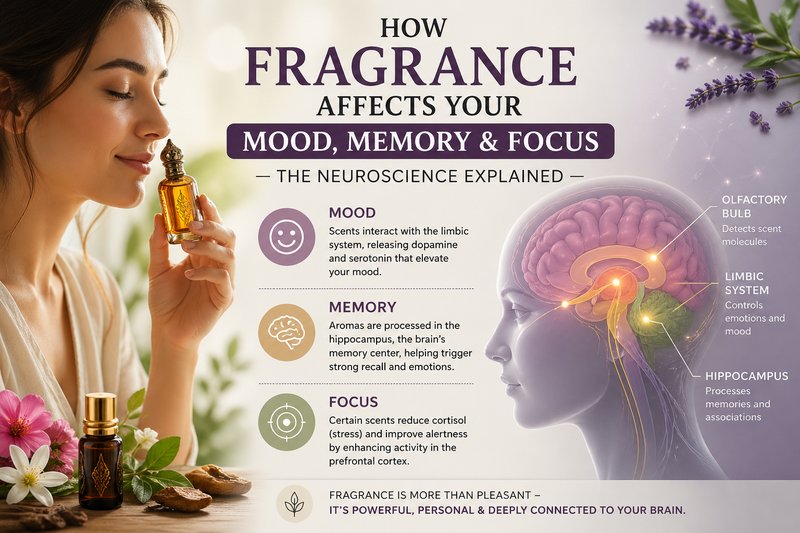
Here’s something most people don’t realize: smell is the only sense that bypasses the brain’s usual logical filtering system. When you see or hear something, your brain processes it, analyzes it, then reacts.
But scent? It goes straight to the emotional center — the limbic system — almost instantly.
I’ve seen this play out so many times. Someone smells a particular attar, and within seconds they either relax, smile, or sometimes even feel uneasy. No explanation. No conscious reasoning.
That’s because scent mood is directly tied to areas of the brain responsible for emotions and survival responses. It’s fast. Almost primal. And honestly, a little underestimated.
This is also why fragrance wellness isn’t just about “feeling nice.” It can genuinely shift your emotional state without needing effort or awareness.
Why certain scents unlock memories you forgot existed
You know that strange moment when a smell suddenly pulls you back years — like a childhood room, a temple, or even a random street?
That’s not coincidence.
The olfactory system (your smell system) is closely linked to the hippocampus — the part of your brain responsible for memory. Which means scent doesn’t just remind you of things. It can reactivate entire emotional experiences.
In my experience, traditional attars do this more strongly than synthetic perfumes. Maybe it’s the natural composition, maybe it’s the depth — but they tend to feel more “connected” to memory.
And this is where attar mental health becomes interesting. If certain scents can trigger positive memories, they can also help regulate emotional states — especially stress or anxiety.
But it’s not universal. One person’s calming scent might feel heavy to someone else. That’s something people often overlook.
How fragrance quietly influences your focus and productivity
Now here’s the part people don’t expect — scent doesn’t just affect emotions, it can also influence how your brain performs.
Some scents stimulate alertness, while others slow things down.
I’ve noticed this personally when working long hours. A subtle woody or earthy fragrance helps me stay grounded and focused, while overly sweet scents tend to distract me after a while.
The reason is simple. Certain fragrance compounds interact with neurotransmitters — basically the brain’s signaling system. Some increase alertness, others encourage relaxation.
So if you’ve ever wondered why you feel more productive in certain environments — scent might be playing a bigger role than you think.
And here’s a question worth asking yourself: have you ever tried matching your fragrance to the type of work you’re doing?
Because honestly, most people don’t — but they probably should.
Choosing the right scent for your mental state (not just preference)
This is where things get practical.
Most people choose fragrance based on what they like. But if you start thinking in terms of fragrance wellness, the approach changes.
Instead of asking “Do I like this scent?”, the better question becomes — “What do I need right now?”
If you’re feeling anxious, grounding scents like sandalwood or vetiver tend to help. If you’re feeling mentally dull, brighter notes like citrus or light florals can gently stimulate your brain.
But here’s the thing — and I say this honestly — there’s no perfect formula.
Your brain builds personal associations with scent over time. So something that works for one person might not work for you at all.
The only real way to figure it out is to experiment slowly. Notice how you feel, not just how it smells.
Common mistakes people make with fragrance and mood
One mistake I see often is overusing fragrance, thinking more scent equals more impact.
It doesn’t.
In fact, too much fragrance can overwhelm your senses and even create the opposite effect — irritation, distraction, or mental fatigue.
Another issue is using the same scent all the time. Your brain adapts quickly, and over time, the emotional impact fades.
Rotating scents based on mood or situation keeps the brain responsive.
And then there’s the biggest one — ignoring personal response. People follow trends or recommendations without checking how their own body reacts.
That’s risky, especially when we’re talking about attar mental health and emotional regulation.
Your experience matters more than any “best fragrance” list out there.
Closing thoughts — using scent more intentionally
Once you start paying attention, you realize scent isn’t just something in the background. It’s shaping how you feel, how you think, and sometimes even how you behave.
And the best part is — you don’t need anything complicated to use it.
Start small. Notice how different fragrances affect your mood during the day. Try matching scent to your task or emotional state.
Over time, you’ll begin to understand your own scent patterns — what calms you, what sharpens you, what distracts you.
And that awareness alone can make a real difference.
So next time you pick a fragrance, don’t just ask if it smells good. Ask what it does to you.
That’s where things get interesting.