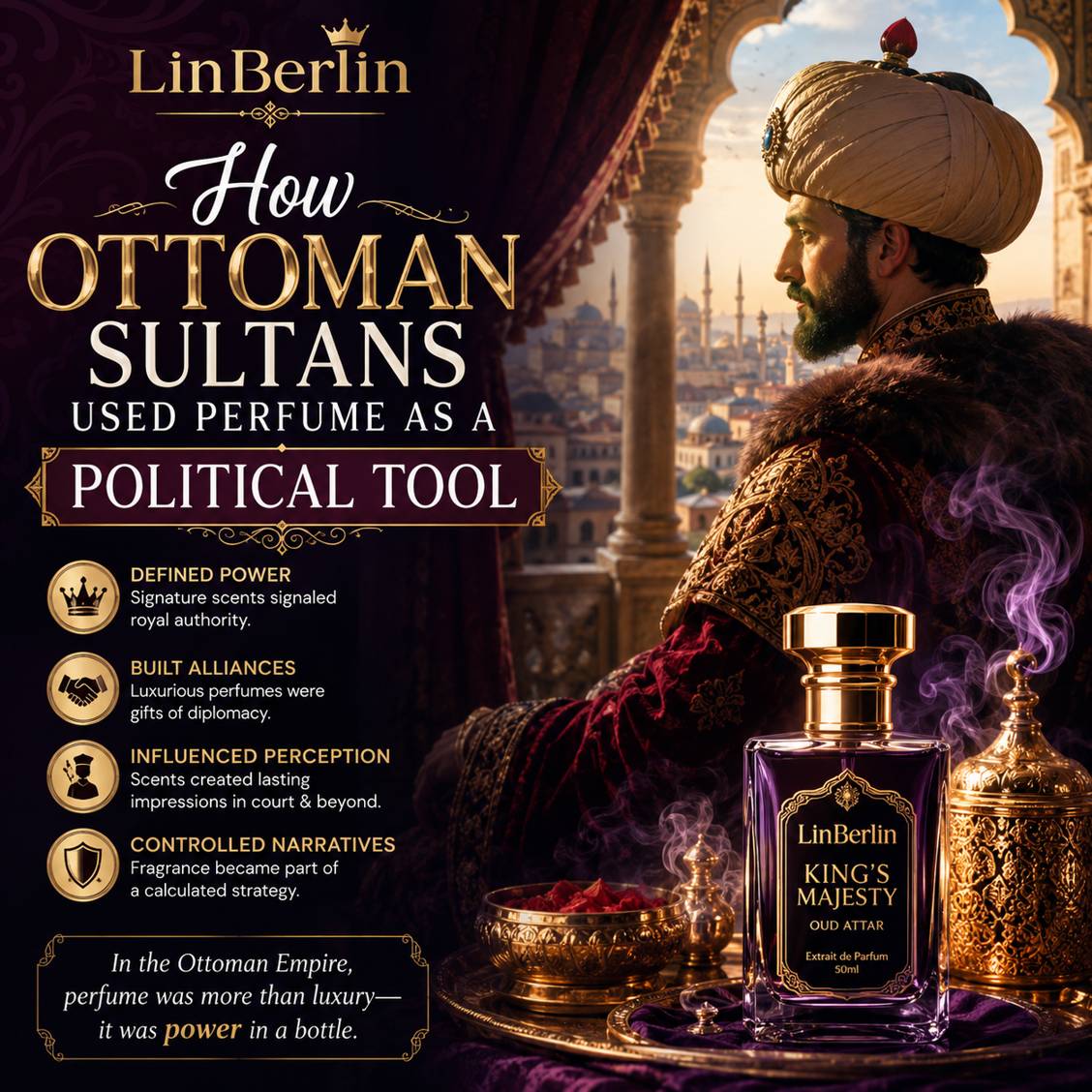
There is a detail from the Ottoman court that rarely makes it into the history books people actually read: before a foreign ambassador was allowed anywhere near the sultan, a servant rubbed rosewater into his palms. Not as a courtesy. As a checkpoint. The scent on his skin was, in a very real sense, part of his credentials — a signal that he had been prepared, softened, brought into the rhythm of the palace before a single word of negotiation was exchanged. Diplomacy, in Topkapı, began at the level of smell.
That's the angle worth sitting with, because it reframes everything that follows. We tend to think of perfume as a personal indulgence — something a person wears for themselves, or for someone they're trying to impress. The Ottomans understood it differently. Scent was infrastructure. It ran through the machinery of the state the way ink ran through its correspondence, and the sultans who understood this best used it with the same precision they brought to treaties and troop movements.
The rosewater handshake
Rosewater was, in Ottoman court protocol, close to a form of currency. Guests had their hands sprinkled with it before entering the sultan's presence, and incense — a blend the palace called buhur suyu — filled the audience chamber before anyone important walked in. So the ambassador arrived already altered. His body carried the scent of the empire before he'd spoken a single sentence to it. That's not decoration. That's a soft, almost invisible form of control — you're inside our atmosphere now, the smell said, before the sultan even entered the room.
And this wasn't reserved for foreign visitors. Grand viziers applied oud and ambergris before appearing at the Imperial Council. Even the highest-ranking officials in the empire had to show up smelling a certain way, in a scent language everyone at court understood but rarely discussed out loud. The fragrance wasn't announced. It didn't need to be. Everyone in that room knew what it meant to walk in properly scented, and what it meant not to.
A signature scent for a signature sultan
Here's the thing that surprises most people when they first learn about Ottoman fragrance culture: each sultan had a documented, personal scent identity, and it wasn't left to chance. Mehmed the Conqueror favored violet and sandalwood — soft, cool notes for a ruler who'd just taken Constantinople and, arguably, didn't need to prove anything else about himself. Suleiman leaned toward sandalwood as well, grounded and steady, which tracks with a reign remembered for legal reform as much as conquest. Abdülhamid II, centuries later, wore a compound of oud and rose for the Friday prayer procession — a scent chosen specifically for the one weekly moment when the public could actually see him.
None of this was accidental. A sultan's scent functioned almost like a seal or a coat of arms, except it moved with him, entered rooms before he did, and lingered after he left. People who couldn't read court documents or interpret imperial iconography could still recognize the ruler's presence in the air. It's a strange kind of branding, honestly — one built centuries before the word existed, and arguably more effective than anything printed or engraved, because scent bypasses conscious thought and lodges itself in memory in a way that images don't.
The workshop that answered only to the palace
Production mattered just as much as the scent itself. The palace ran its own perfume workshop, the halvahane, where court perfumers — some records call them buhurizade, incense masters — prepared flower waters, soaps, and compounded oils exclusively for the royal household and the officials it chose to favor. This wasn't outsourced. It couldn't be bought on the open market by just anyone with money, which is precisely what made it valuable as a political instrument. A scent given by the sultan carried weight because it couldn't be replicated or purchased elsewhere — the same logic, more or less, that makes a rare gift meaningful in any court, in any century.
By the seventeenth century, economic strain forced the palace to shrink its team of incense masters from nine down to three. Even that detail tells you something about priorities: fragrance production was treated as important enough to track, staff, and eventually ration during hard times — not the behavior of a court that saw perfume as frivolous.
Scent, legitimacy, and the sacred relics
Some of the most striking uses of fragrance in Ottoman statecraft had nothing to do with diplomacy at all — they were about religious authority, which was, for the sultans, inseparable from political authority. Each Ramadan, aghas in a state of ritual purity would clean the chamber holding the Sacred Relics — including what was believed to be the Prophet Muhammad's mantle — using rosewater and scented oils. The dust collected from that room was later mixed with musk, amber, and oud into small perfumed balls and distributed to the public after Eid prayers. That's a genuinely fascinating piece of political theater, when you think about it: the sultan's claim to religious legitimacy, quite literally, being handed out to ordinary people in scented form. You couldn't read it. You couldn't frame it on a wall. But you could carry it in your pocket, and you could smell the connection to something sacred every time you did.
Gifts that were never just gifts
Perfume also moved outward, from the palace to the wider world, as a deliberate instrument of favor. A box of ghalia — the thick, paste-like compound of musk and amber the court perfumers prepared — sent to a foreign envoy or a loyal governor said something a letter couldn't. It said: you have been noticed, and noticed specifically enough that the palace spent resources it didn't have to spend on anyone. Unequal gifts, deliberately so. A minor provincial official might receive rosewater. A visiting dignitary from a rival power might receive oud and ambergris worked into a compound reserved for the sultan's own use — a scent that, worn afterward, quietly reminded everyone around that envoy exactly whose favor he carried.
It's worth being honest about the limits of what we actually know here. Much of the archival record — including the recipe for buhur suyu, preserved in a household ledger dating to 1708 — survives through palace bureaucracy rather than the sultans' own words, so a fair amount of what gets repeated about "which sultan preferred which note" comes down to court record-keeping and, later, careful historical reconstruction rather than a diary entry in the sultan's own hand. The broad pattern is well documented. The precise personal motivations behind any single gift, less so.
Wearing that history on your own skin
None of this is just trivia if you actually wear natural attar. The Ottoman court understood something that still holds up under modern skin science: fragrance doesn't perform the same way on every body, and how you prepare your skin changes how long and how honestly a scent lasts. Well-moisturized skin holds oil-based fragrance considerably longer than dry skin does — the natural lipids act almost like a sponge for the aromatic compounds in a good oud attar, letting it unfold in stages rather than evaporating within the hour. Dry or compromised skin, on the other hand, tends to burn through top notes fast and can occasionally react to concentrated naturals, particularly around broken or irritated areas.
If you have sensitive skin, it's genuinely worth patch-testing any new attar on your inner wrist before applying it more broadly — this goes double if you're using active skincare ingredients like retinoids or exfoliating acids nearby, since compromised skin barriers absorb fragrance oils differently and can flare up in ways that have nothing to do with the quality of the attar itself. Pregnant readers, or anyone with a history of fragrance allergies, should treat any new botanical blend with a bit more caution and check ingredients before layering it into a daily routine. Pulse points still work best — wrists, behind the ears, the base of the throat — for the same reason they worked for Ottoman courtiers centuries ago: warmth from the body pushes the oil's molecules outward gradually, the way the sultans' own scent preceded them into a room.
What the sultans actually understood
Strip away the palace ceremony and the political maneuvering, and what's left is a fairly simple insight the Ottomans built an entire court culture around: scent reaches people before language does, and it stays with them after language has been forgotten. A treaty gets filed away. A gift of rare attar, worn on the skin for weeks, keeps doing quiet work long after the meeting that produced it has ended. That's not a bad way to think about fragrance even now — not as an accessory, but as something closer to a message that outlasts the moment it was sent in.