I still remember the first time I sprayed a perfume in a store and thought, “This smells incredible,” only to walk out an hour later wondering… wait, what happened to it? It didn’t smell bad — just different. Softer. Warmer. Almost like a completely new scent had taken over. If you’ve ever felt that confusion, you’re not alone. Honestly, this is one of the most misunderstood parts of perfume science.
Here’s the thing — fragrance isn’t static. It’s alive in a way. It evolves, shifts, disappears, and reappears in layers. That’s exactly where concepts like top notes, heart notes, and base notes come in. If you’re trying to understand how perfume works, you need to think of it less like a single smell and more like a timeline unfolding on your skin.
In this guide, I’ll break down what’s actually happening — not in a textbook way, but in a way that makes sense when you’re wearing a fragrance in real life.
What Are Top, Heart, and Base Notes — Really?
Let’s strip away the fancy terminology for a second. At its core, a perfume is a blend of ingredients that evaporate at different speeds. That’s it. The idea of “notes” is simply a way to describe that timing.
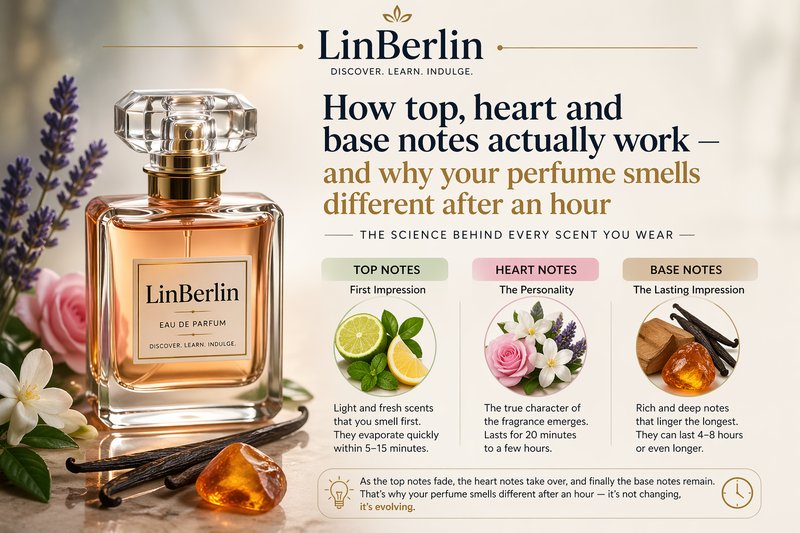
Top notes are the first impression — the part you smell immediately after spraying. They’re usually light, fresh, sometimes sharp. Think citrus, green herbs, airy florals. In my experience, these are designed to grab your attention quickly… but they don’t stick around long.
Then comes the heart. This is where the perfume starts to settle into its true identity. The heart notes bridge the freshness of the top and the depth of the base. Florals, spices, soft woods — these tend to live here. And honestly, this is the part most people end up loving the most.
Finally, the base notes. These are heavier molecules that evaporate slowly. They’re warm, deep, sometimes creamy or smoky. Woods, amber, musk — these form the foundation that lingers for hours.
But here’s what many beginners miss — these layers don’t wait their turn politely. They overlap, blend, and interact constantly.
Why Your Perfume Changes Over Time
If you’ve ever asked yourself, “Why does my perfume smell different after an hour?” — the answer comes down to evaporation and chemistry.
Different fragrance molecules have different weights. Lighter ones evaporate quickly, while heavier ones take their time. So when you spray perfume, you’re essentially starting a countdown. The top notes rise and disappear first, exposing the heart, and eventually the base takes over.
But that’s only part of the story. Your skin plays a surprisingly big role too. Temperature, moisture, even your natural oils — all of these can shift how a fragrance develops. I’ve seen the same perfume smell bright and citrusy on one person, and warm and creamy on another. Same bottle, totally different experience.
And then there’s the environment. Heat speeds things up. Cold slows them down. So a perfume worn outdoors in summer might burn through its top notes in minutes, while the same scent indoors in winter feels much slower and more controlled.
How Perfume Notes Interact — Not Just Layer by Layer
It’s tempting to think of perfume like a three-step process — top, then heart, then base. But honestly, that’s a bit too neat for reality.
In practice, all three layers are present almost from the start. The difference is intensity. Top notes dominate early, but the base is already quietly there in the background. As time passes, the balance shifts.
I like to think of it like music. At first, you hear the high notes clearly. Then the mid tones come forward. Eventually, the bass takes over — but it was always part of the composition.
This overlap is what gives perfumes complexity. Without it, a fragrance would feel flat and predictable. With it, you get that evolving experience — the kind that keeps surprising you throughout the day.
Real-World Tips to Understand Your Perfume Better
If you’re serious about fragrance education, don’t judge a perfume in the first 30 seconds. That’s probably the biggest mistake I see beginners make. What you’re smelling at that moment is only the opening — not the full story.
Instead, give it time. Wear it for at least a couple of hours. Notice how it changes. Does it become sweeter? Warmer? More subtle? These shifts tell you far more about how perfume works than any label ever will.
Also, try testing on skin instead of paper strips whenever possible. Paper can’t replicate body chemistry. It gives you a rough idea, sure, but the real magic — or disappointment — happens on skin.
And one more thing — don’t rush into buying based on first impressions. I’ve done that myself, and honestly, I’ve regretted it more than once.
Common Mistakes Beginners Make With Perfume Notes
One common misunderstanding is assuming the top note defines the perfume. It doesn’t. In fact, many fragrances are designed to hook you with a bright opening that fades into something completely different.
Another mistake is expecting consistency. People often think a perfume should smell the same all day. But that’s not how perfume science works. Change isn’t a flaw — it’s the entire point.
And then there’s over-spraying. When you apply too much, the top notes can become overwhelming, masking the more nuanced layers underneath. You end up missing the balance entirely.
Also — and this might sound obvious — storing your perfume poorly can mess with how it develops. Heat and light can alter the composition over time, which changes how those notes behave.
Closing Thoughts — Learning to Smell With Patience
If there’s one thing I’ve learned after spending time around perfumes, it’s this: you can’t rush the experience. A fragrance isn’t meant to be understood instantly. It reveals itself slowly, almost like a conversation that gets deeper over time.
So next time you test a perfume, pause. Let it evolve. Pay attention to those subtle transitions. That’s where the real beauty lies.
And if you’re just starting your journey into perfume science, keep exploring. Try different compositions, compare how they behave, and trust your nose more than marketing descriptions. Over time, you’ll start to recognize these shifts naturally — and that’s when fragrance really becomes interesting.