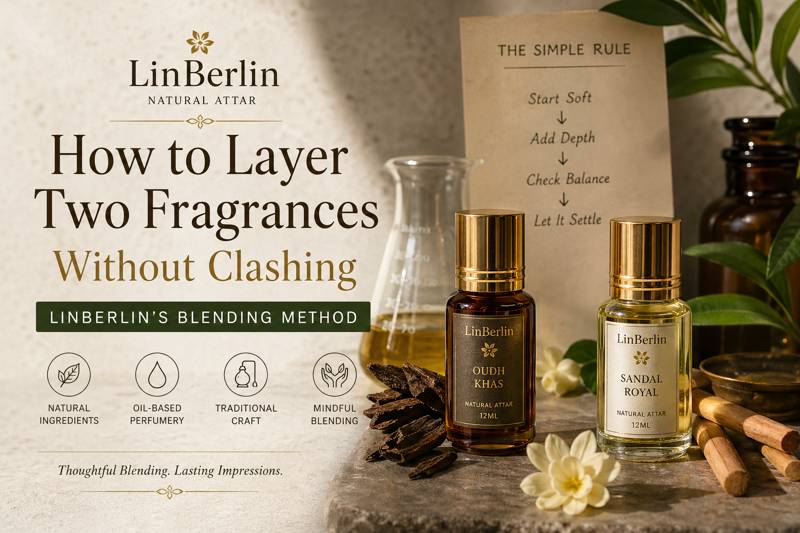
The first thing you notice isn’t the scent — it’s the confusion. One moment your fragrance feels rich and balanced, and the next it’s muddled, sharp, or strangely flat. That’s what happens when two perfumes sit on skin without a plan.
Layering fragrances sounds simple until you actually try it. Most people assume you just apply one after the other and hope they “blend.” But real blending — the kind that feels intentional — follows structure. LinBerlin’s approach comes from oil-based perfumery, where every drop interacts slowly and deliberately.
And once you understand how layering actually works on skin (not paper, not blotters), you stop guessing and start composing.
Why most people get this wrong
The biggest mistake isn’t choosing the wrong scents. It’s ignoring how fragrance behaves over time.
People layer based on top notes because that’s what they smell immediately. Citrus over oud, florals over musk — it feels logical in the moment. But those bright notes fade quickly, leaving heavier bases to collide hours later.
And that’s where things fall apart — because base notes don’t politely blend, they compete.
Another issue is application order. Spraying randomly or applying equal amounts creates imbalance. In oil perfumery, even a tiny shift in ratio changes the entire profile. But most people apply fragrances like they’re independent, not interactive.
Here’s the thing: layering isn’t about stacking scents, it’s about controlling dominance. One fragrance must lead, the other must support.
There’s also skin chemistry (which you can’t fully control), and that adds unpredictability. What smells smooth on one person may turn harsh on another.
The method, step by step
The first step is choosing roles — not scents. Decide which fragrance is your base and which is your accent. The base should be deeper, longer-lasting, something that anchors the blend.
So if you’re working with oud and a citrus attar, the oud leads. Always.
Once that’s clear, apply the base fragrance first. Use a small amount and place it on warm pulse points like the inner wrist or behind the ears. Let it settle for about 60 to 90 seconds. This waiting time matters more than people think — it allows the oil to begin interacting with your skin.
Then apply the second fragrance, but not directly on top. Place it slightly adjacent — maybe the outer wrist or just above the base application point. This creates a diffusion overlap instead of a direct clash.
And don’t rub your skin together. That disrupts the structure and flattens the scent evolution.
The next step is ratio control. Start with less of the second fragrance than you think you need. You can always add more, but you can’t remove excess once it’s there.
After five minutes, smell again. Not immediately — give it time to settle into a shared profile. This is where real blending happens, not in the first impression.
But here’s where experience sharpens things: notice which note is rising too fast. If the top feels sharp, your accent is too strong. If it feels dull, your base is overpowering.
Adjust gradually, never all at once.
Common variations and edge cases
Sometimes the method works perfectly. Other times, the combination just refuses to cooperate.
Take two heavy fragrances — oud and amber, for example. Even with careful ratios, they can feel dense together. In this case, you need space between applications, either physically or in time. Apply one fragrance, wait longer, then introduce the second lightly.
Or consider extremely light scents like soft florals. They often disappear when paired with stronger bases. So instead of layering on skin, apply the lighter fragrance to clothing where it can hold its character longer.
And then there are situations where both fragrances have strong top notes. That’s tricky because they compete immediately. The solution is to reduce one significantly — almost to a trace.
Honestly, not every combination will work. Some ingredients simply clash no matter how carefully you apply them.
LinBerlin's recommendation
At LinBerlin, the best layering combinations start with balance in composition, not just contrast.
A deep oud attar paired with a soft rose works reliably because the rose rounds the sharp edges without overpowering the base. Musk-based attars also perform well as anchors, especially when combined with lighter citrus or green notes.
And if you’re just starting, stick to one dominant oil and one subtle enhancer. Don’t try to layer three or more — it rarely ends well.
The truth is, LinBerlin attars are already blended with intention. Layering should enhance, not complicate what’s already there.
Closing
Once you stop treating fragrances as separate and start thinking of them as interacting elements, layering becomes far more predictable.
It’s not about creativity alone — it’s about control, patience, and understanding how scent evolves on your skin.
And when you get it right, the result doesn’t smell like two fragrances at all. It smells like something that was always meant to be worn that way.