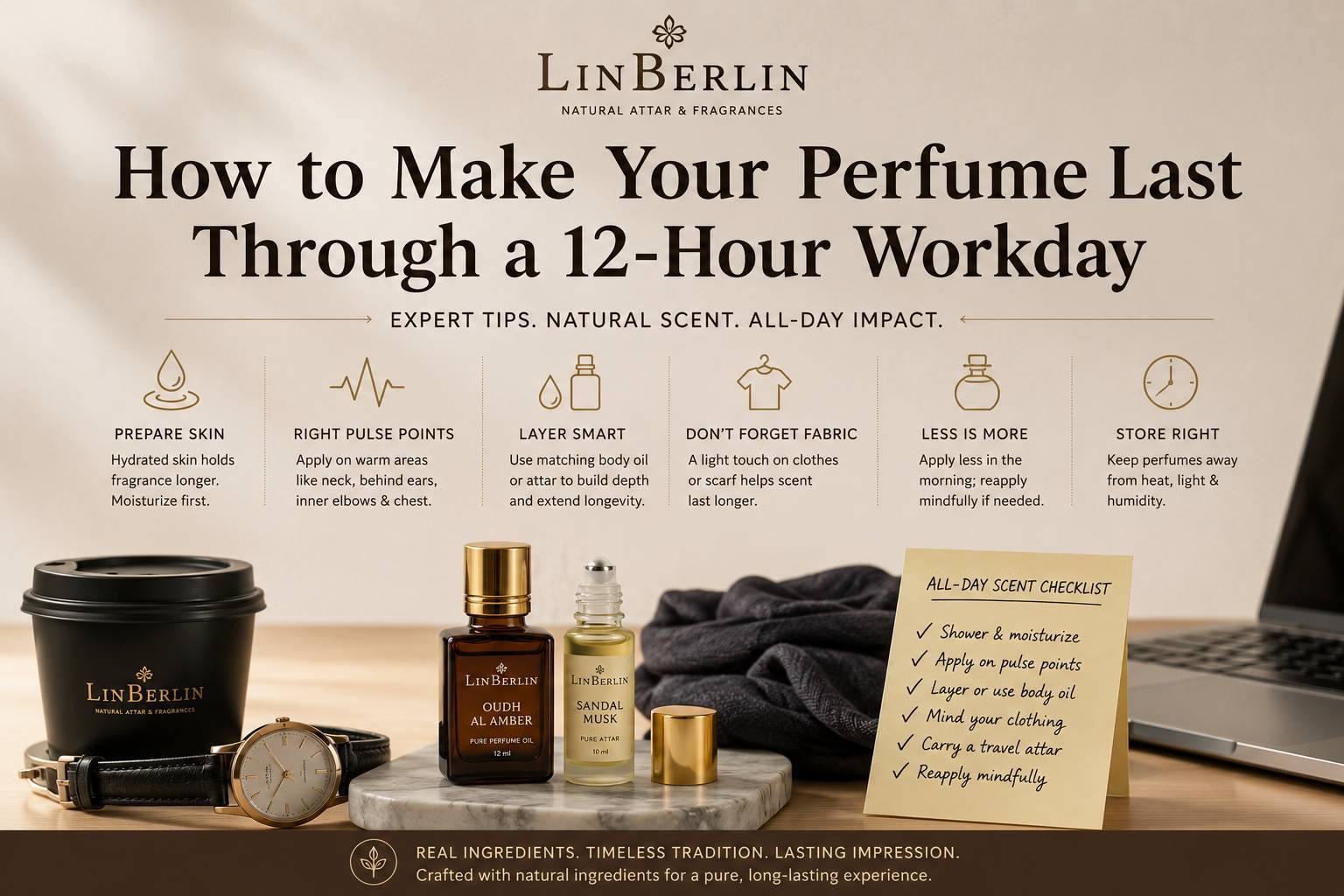
Learn how to make your perfume last through a 12-hour workday with better application, skin prep, layering, and scent-holding techniques. How to make your perfume last through a 12-hour workday
A sharp citrus opening at 8 in the morning can disappear into almost nothing by lunchtime, leaving behind only a faint trace on your shirt collar. Most people assume the perfume itself is weak, but the real issue is usually application technique, skin condition, or where the fragrance was placed in the first place. Knowing how to make your perfume last through a 12-hour workday has less to do with spraying more and far more to do with understanding how scent behaves on skin, fabric, heat, and movement throughout the day.
Some fragrances bloom beautifully during the first hour and then collapse once office air conditioning dries the skin. Others stay close to the body but continue radiating for hours if they're applied properly. After reading this, you'll know how to prepare your skin, apply fragrance more effectively, and avoid the habits that quietly erase a scent before the workday is even halfway over. :contentReference[oaicite:0]{index=0}
Why this matters more than most people realise
A long workday changes fragrance constantly. Body temperature shifts during commuting, coffee breaks, outdoor heat, office cooling systems, and even stress can alter how perfume develops on skin. That's why a scent that felt rich at home may seem almost invisible by mid-afternoon.
Oil-based fragrances and attars often behave differently from alcohol-heavy sprays — they evaporate more slowly and stay closer to the skin, especially in dry indoor environments. But even natural perfume oils need the right surface to hold onto. Dry skin absorbs fragrance quickly and dulls top notes faster than moisturised skin does.
And placement matters more than people expect. Spraying directly onto the front of the neck may smell strong for twenty minutes, but constant airflow and fabric friction can flatten a scent surprisingly fast. Areas with steady warmth and less rubbing usually perform better.
Here's the thing: many people become nose-blind to their own fragrance within two hours and assume it vanished completely. Meanwhile, everyone around them can still smell it clearly. Reapplying too aggressively because of this often creates the heavy cloud people complain about in offices and elevators.
Climate changes everything too (especially in humid cities). Dense oud blends may last all day in cooler weather but feel overwhelming during a packed summer commute, while lighter florals often need smarter layering to survive a dry office environment.
The method explained step by step
1. Start with clean, slightly moisturised skin because fragrance molecules cling better to hydrated skin than dry skin, and applying perfume immediately after a shower while the body is still warm often improves longevity noticeably.
2. Use an unscented moisturiser or light body oil before applying fragrance so the perfume has a smoother surface to bind to instead of sinking into dry patches that mute the scent within hours.
3. Apply fragrance to slower-moving pulse points like behind the ears, the sides of the neck, inner elbows, and the upper chest because these areas release heat gradually throughout the day without as much friction from clothing.
4. Dab or spray lightly onto fabric only after testing the material first since natural oils and darker fragrances can stain delicate fabrics, especially silk or light cotton shirts.
5. Layer carefully rather than heavily by combining complementary scented products or a matching attar beneath a lighter perfume because layered scent structures tend to fade more evenly across a full workday.
6. Avoid rubbing wrists together after application because friction crushes fragile top notes and changes how the fragrance opens during the first hour — this mistake alone shortens the life of many fresh perfumes.
7. Apply less fragrance than you think you need during the morning commute since heat, crowded trains, and office temperatures can amplify projection later in the day even if the scent initially feels soft.
8. Carry a small decant or travel atomiser for strategic touch-ups instead of doing one oversized morning application because controlled reapplication maintains balance without overwhelming people nearby.
9. Reapply only to areas where the scent naturally faded rather than spraying over old layers repeatedly, which can create a muddy smell where fresh top notes clash against lingering base notes.
10. Store your perfume away from sunlight and heat at home because damaged fragrance oils lose brightness and structure faster, making even expensive perfumes disappear earlier than they should.
So what if your skin seems to “eat” every fragrance quickly? In many cases, the issue isn't skin chemistry alone. Low hydration, frequent washing, strong office air conditioning, and even certain medications can reduce scent longevity more than people realise.
And concentration matters. Pure attars and parfum-strength oils usually remain detectable far longer than light eau de colognes, but they project differently. A quieter scent isn't necessarily a weaker one.
People often ask whether applying perfume to hair helps. It can, though alcohol-heavy sprays may dry hair over time if used daily. A small amount on a scarf, jacket lining, or hairbrush tends to work better for long office hours.
Common mistakes that undo good technique
Overspraying in the morning is probably the most common mistake. Someone leaves home thinking the fragrance feels subtle, then enters a heated office where the scent expands dramatically after body temperature rises. What seemed balanced at 7:30 AM becomes overpowering by 10.
Another problem comes from applying fragrance onto completely dry skin. Perfume evaporates quickly from dehydrated skin and often leaves behind only the heavier base notes. That's why some people notice their fragrance smelling flat or oddly woody after a few hours.
But storing perfume in the bathroom causes damage too. Constant temperature changes and humidity slowly weaken delicate ingredients, particularly citrus, herbs, and lighter florals. The perfume may still smell “fine,” yet it loses the structure that gives it staying power.
Some people spray directly onto clothing only and skip skin entirely. Fabric can hold scent well, but it doesn't develop fragrance the same way warm skin does. The result is often a scent that smells static, sharp, or incomplete throughout the day.
Realistically, not every fragrance is designed for twelve hours of performance. Fresh neroli, green tea, airy citrus, and certain transparent floral compositions naturally fade faster than dense amber, oud, resin, or musk-based perfumes. That doesn't make them lower quality.
There’s also one complication worth acknowledging: sensitive skin reacts differently to fragrance oils, alcohol concentrations, and layering products, so techniques that improve longevity for one person may irritate another. Testing slowly always matters more than copying someone else's routine exactly.
Tips that genuinely improve the result
A tiny amount of neutral body oil under perfume can dramatically improve how long fragrance lasts, especially during winter or in heavily air-conditioned offices. Many experienced fragrance wearers use this trick quietly because it changes absorption without changing the scent itself.
Applying fragrance thirty minutes before leaving home also helps more than immediate last-second spraying. The scent settles into the skin and smooths out before exposure to outdoor air, traffic, or heat.
Or try using different application points depending on the season. Behind the knees and lower chest often perform beautifully during cooler months, while wrists may fade too quickly in hot weather because of constant washing and movement.
The truth is, softer projection often creates a better impression during long workdays than extremely loud fragrance does. People notice a scent more positively when it appears naturally as you move rather than announcing itself across the room.
For oil-based attars from brands like LinBerlin, applying a small amount to moisturised pulse points and letting the fragrance warm gradually through the day usually creates better longevity than heavy application all at once (especially with oud and resin-rich blends).
Closing
A perfume that survives a full workday rarely depends on strength alone. Skin preparation, placement, climate, concentration, and even office airflow all shape how a fragrance behaves after those first few hours. Small adjustments often create a bigger difference than switching to a stronger scent entirely.
Tomorrow morning, change just one thing first: moisturise your skin before applying fragrance and avoid rubbing it in afterward. You'll probably notice the scent developing more smoothly by midday, staying clearer into the evening, and feeling far more balanced throughout the entire day.