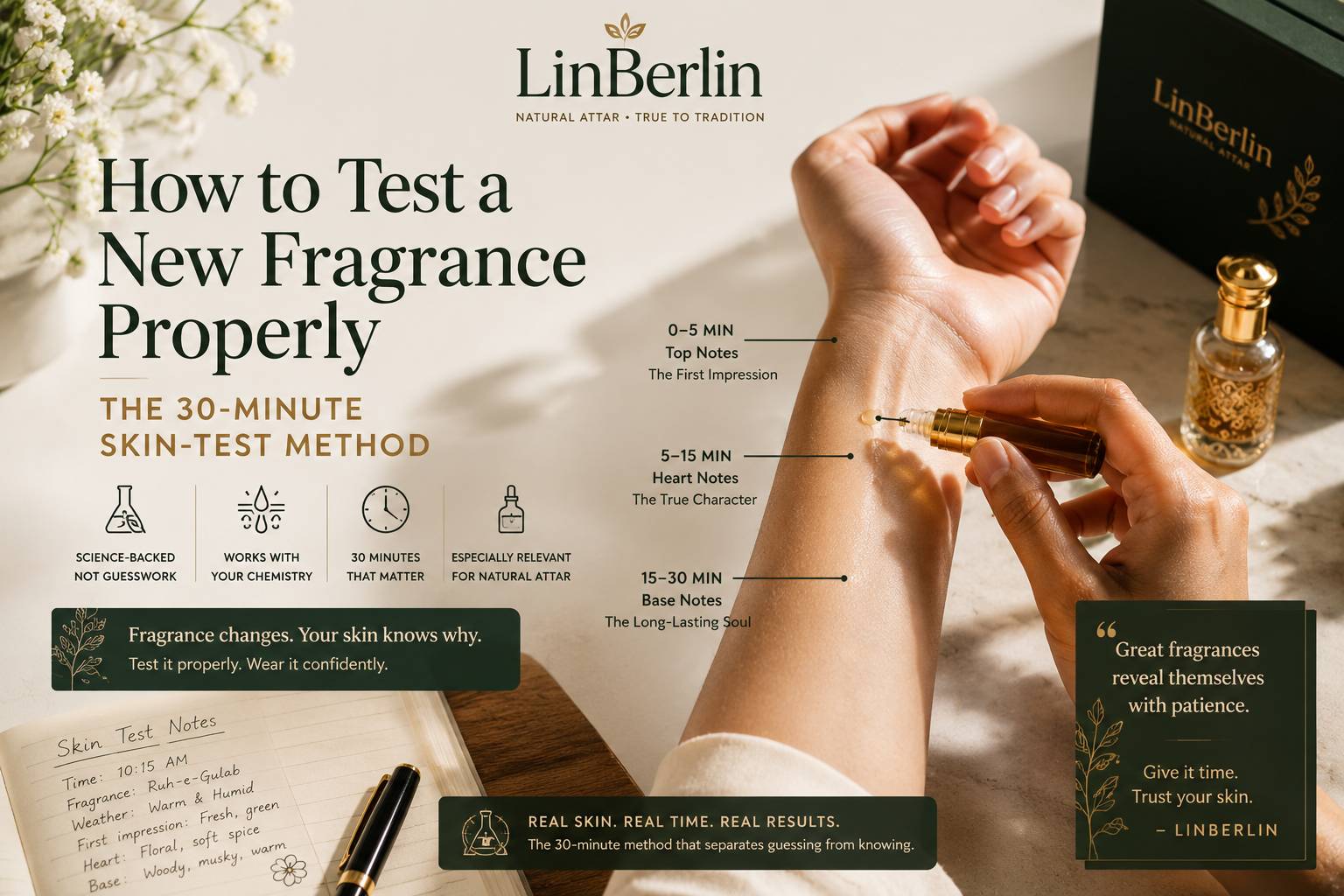
Learn how to test a new fragrance properly with a science-backed 30-minute skin-test method that explains evaporation, skin chemistry, and scent development. How to test a new fragrance properly — the 30-minute skin-test method
A bright citrus accord can disappear faster on one wrist than the other. Not because the perfume changed, but because warm skin, sweat composition, hydration levels, and even tiny differences in sebum production quietly reshape the way aroma molecules evaporate. That’s why experienced perfumers rarely trust the first ten seconds of a fragrance test. The real character often appears later, once the volatile top notes fade and heavier materials begin interacting with skin chemistry.
Testing a new fragrance properly means slowing down enough to watch those changes happen in real time. The 30-minute skin-test method isn’t a marketing ritual or perfume-snob habit. It’s rooted in evaporation curves, molecular weight, diffusion behaviour, and the way human olfaction adapts to scent exposure. A fragrance can smell sharp at minute two, balanced at minute fifteen, and unexpectedly smooth half an hour later.
And that shift becomes even more noticeable with oil-based attars, where alcohol evaporation isn’t dominating the opening stage.
The science explained
The first few minutes after applying fragrance are chemically chaotic. Highly volatile molecules evaporate rapidly from skin temperature alone — often around 32 to 35 degrees Celsius at the surface. Citrus materials such as limonene, bergamot oil fractions, and aldehydes tend to diffuse quickly because of their lower molecular weights and higher vapour pressures. Heavier molecules like patchoulol, vetiverol, sandalwood lactones, or natural musks remain longer because they evaporate more slowly.
Most commercial perfume structures are intentionally designed in layers. Perfumers sometimes describe this as the fragrance pyramid, though the reality is less tidy than the diagram suggests. Top notes create projection and first impact, heart notes build recognisable identity, and base materials provide persistence. But these stages overlap constantly (especially in natural perfumery where raw materials contain hundreds of molecules rather than isolated synthetics).
Skin itself changes the equation. Sebum contains fatty acids and wax esters that can trap or soften aromatic compounds, while dry skin tends to release molecules faster into the air. Humidity matters too. A resinous oud accord tested inside an air-conditioned boutique may feel restrained, yet outdoors in humid weather it can bloom dramatically.
But olfactory adaptation may be the most misunderstood part of fragrance testing. The nose doesn’t smell in a stable, objective way for long periods. Olfactory receptors reduce responsiveness after continuous exposure, which is why people often think a perfume has vanished even when others can still detect it clearly. Molecules such as Iso E Super and certain macrocyclic musks are famous for this effect. Some people smell them intensely. Others barely register them at all.
Gas chromatography studies used by fragrance houses like Givaudan and Firmenich show measurable shifts in aromatic composition over time as materials evaporate at different rates. So the 30-minute waiting period isn’t arbitrary. It reflects the point where the opening volatility settles enough for the fragrance structure to become clearer.
Why it matters for fragrance
Quick paper-strip testing causes people to reject fragrances they might actually love on skin. A perfume heavy in pink pepper, saffron, or aldehydic materials can feel aggressive in the opening before soft woods and resins emerge later. The reverse also happens. Some fragrances produce an impressive opening burst but collapse into a flat drydown after twenty minutes.
That difference explains why experienced fragrance buyers rarely purchase after one spray in a crowded store. They apply, leave, walk outside, and come back to the scent later. The truth is, many perfumes are engineered specifically to impress during the first sixty seconds because that’s how retail environments work.
Temperature changes alter perception more than most people realise. A cold winter evening suppresses diffusion, while summer heat amplifies projection and sweetness. That’s partly why dense amber compositions can feel comforting in December yet suffocating in June. And skin pH, despite being exaggerated online, still plays a minor supporting role because acidic conditions can influence oxidation and stability in certain natural materials.
You’ll also notice texture differences over time. Fresh bergamot may initially sparkle beside lavender, then gradually reveal bitterness once the brighter terpene fractions disappear. Natural jasmine absolutes often shift from airy floral brightness into something almost leathery or animalic after prolonged skin contact. That complexity is exactly what many fragrance enthusiasts are chasing.
So how should someone actually perform a proper skin test? Apply fragrance to clean skin without scented lotion underneath. Use one spray or a small oil application on the wrist or inner forearm, then avoid rubbing the area together because friction creates heat and can distort evaporation patterns. Smell it once immediately, then step away for ten minutes.
By minute fifteen, the transition phase usually becomes clearer — the loudest volatile materials have faded, and the heart structure begins stabilising. At thirty minutes, you’re finally smelling something much closer to the perfume’s intended identity.
Or put differently, that half-hour reveals whether the fragrance actually lives well on your skin instead of merely performing for attention.
What this means for attar specifically
Oil-based attars behave differently because they don’t rely on alcohol as the primary carrier. Alcohol flashes off rapidly, creating the dramatic opening many modern spray perfumes are designed around. Attars unfold more slowly, closer to the skin, and often with softer transitions between stages.
Natural sandalwood oil is a good example. High-quality Mysore-style sandalwood contains santalol compounds that evaporate gradually and blend smoothly with skin lipids. Instead of producing a sharp burst, the aroma expands quietly over time. A traditional ruh gulab attar may seem understated during the first few minutes, then become surprisingly dimensional after body heat warms the oil.
And natural materials rarely behave in perfectly predictable ways. Real oud oils contain complex mixtures of sesquiterpenes, phenols, and oxidised compounds influenced by origin, distillation method, tree infection patterns, and aging conditions. Cambodian oud, Hindi oud, and Borneo oud can evolve very differently during a thirty-minute test.
Here’s the thing: oil perfumery rewards patience more than alcohol-based fragrance does. People accustomed to loud synthetic openings sometimes mistake attars for being weak when the scent is actually unfolding in a slower, denser manner.
There’s also a tactile dimension that matters. Oil sits on skin differently, reducing rapid diffusion while increasing intimacy. That’s why many traditional attars feel personal rather than room-filling. The scent develops almost in conversation with body warmth.
LinBerlin's approach
LinBerlin approaches fragrance testing with the assumption that raw materials deserve time to speak properly. Rather than designing fragrances around an exaggerated opening blast, the focus stays on how natural oils, resins, florals, and woods evolve through actual wear. That means sourcing ingredients that maintain character beyond the first impression — aged oud profiles, carefully selected sandalwood materials, dense rose compositions, and balanced attar structures that remain coherent after extended skin contact.
Some natural ingredients are inherently variable from harvest to harvest (particularly floral absolutes and oud oils), and pretending otherwise would be dishonest. LinBerlin treats that variation as part of authentic perfumery rather than something to erase completely through over-standardisation.
Closing
A fragrance isn’t static liquid trapped in a bottle. The moment it touches skin, temperature, chemistry, airflow, moisture, and perception begin reshaping it minute by minute. That’s why the 30-minute skin-test method remains one of the simplest ways to understand whether a scent genuinely belongs on you.
But beyond chemistry, there’s something deeply human happening during that wait. A perfume settles into memory, mood, and skin in its own rhythm. Some scents become louder. Others become softer, stranger, warmer, or unexpectedly comforting. And the fragrances worth keeping are usually the ones that still feel alive long after the opening notes disappear.