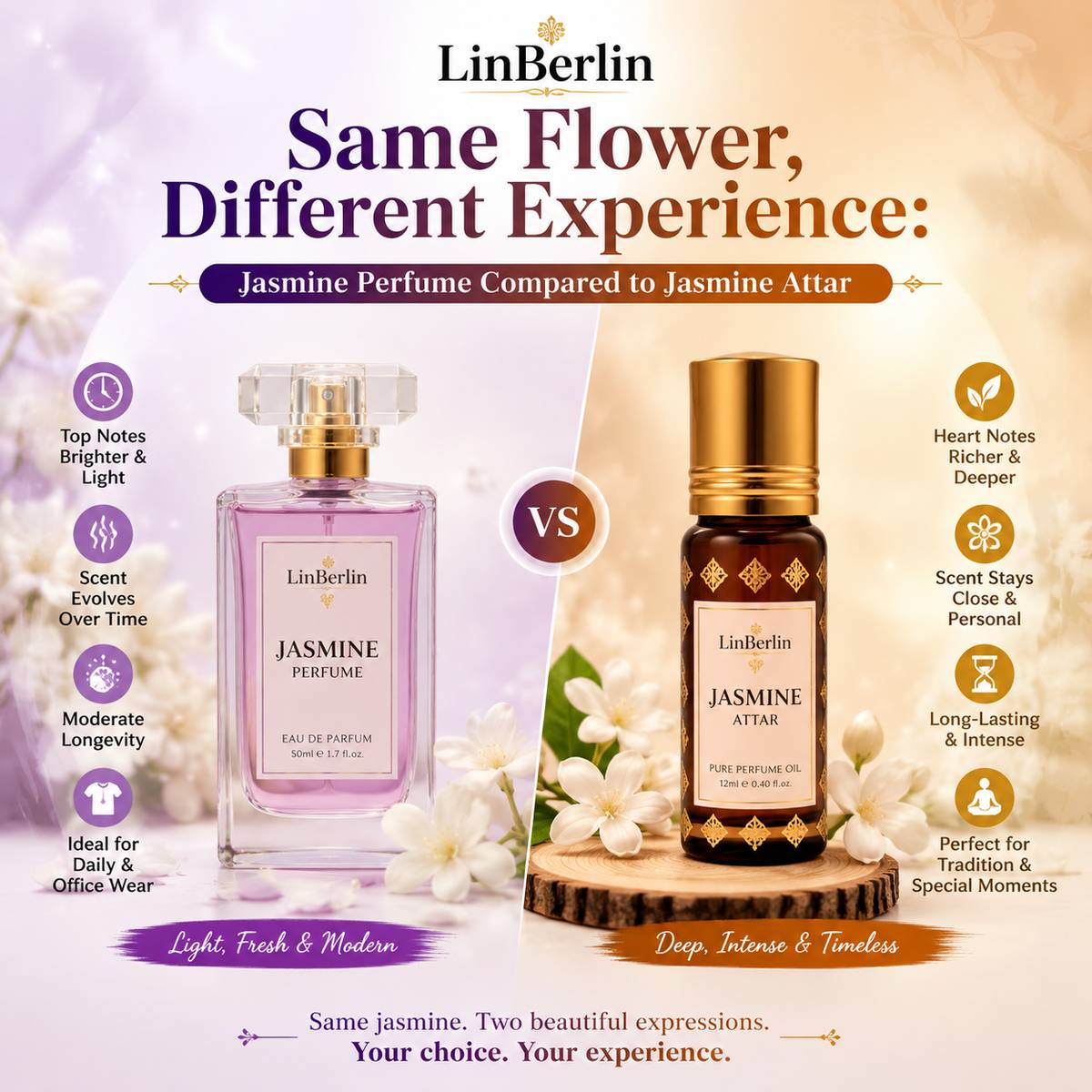
Jasmine only opens at night. Growers who harvest it know this and pick the flowers before sunrise, while the oil concentration is still at its peak — a small, unglamorous fact that ends up explaining almost everything about why jasmine smells so different depending on how it's captured. That single detail is the reason two products made from the same flower can feel like they belong to entirely different fragrance families once they're on your skin.This isn't really a story about which one is "better." It's about what happens chemically and practically once jasmine leaves the field, and why that matters more than most buying guides let on.
Why Jasmine Behaves Differently Once It Leaves the Field
Alcohol-based jasmine perfume is built for speed. The alcohol carries the scent molecules up fast, gives you that bright, immediate bloom the moment you spray, and then evaporates — taking a good portion of the fragrance with it. Attar works the opposite way. Jasmine attar is jasmine absolute suspended in a carrier oil, usually sandalwood or a neutral base, and oil doesn't evaporate anywhere near as quickly. So the scent doesn't burst outward. It sits closer to the skin, releasing slowly, warming up as your body heat works on it over hours instead of minutes.And this is where a lot of people get surprised. They expect jasmine attar to smell "stronger" because it's more concentrated, but concentration and projection aren't the same thing. Attar can be more intense up close while projecting less into a room. Perfume can smell weaker on the skin but fill a hallway.What Actually Happens On Your SkinHere's something you notice fast if you work with fragrance regularly: dry skin eats scent alive. Fragrance molecules — whether in an attar or a spray — need something to bind to, and dry skin just doesn't hold onto them the same way hydrated skin does. People with naturally oily or well-moisturised skin will get noticeably longer wear from either our jasmine perfume or an attar version, simply because there's more surface lipid for the scent to grip.This is also why layering matters so much and why it goes wrong so often. Apply jasmine attar over a heavy, actives-loaded night cream and you'll sometimes get a strange, slightly sour drift a few hours in — not because the attar is off, but because it's reacting with whatever's underneath it. Retinol, vitamin C serums, and strong exfoliating acids can all shift how a natural oil-based fragrance smells as it breaks down on skin. It's not dangerous, usually. Just unpredictable.
Longevity: The Real Difference Buyers Notice First
Realistically, this is the question most people are actually asking when they compare jasmine perfume to jasmine attar. So let's be direct about it.Jasmine perfume, spray format, alcohol-based — expect somewhere around four to six hours on most skin types, with the top notes fading within the first hour. Jasmine attar, oil-based, applied to pulse points — can last eight, sometimes twelve hours, though the character of the scent changes as it dries down. The opening might be sweet and floral-forward; by hour six it's often gone quieter and slightly warmer, closer to the base notes that were always there but hidden under the initial jasmine burst.But — and this is the part that gets left out of most comparisons — a well-formulated jasmine perfume, applied to moisturised skin at pulse points, can outlast a poorly stored or over-diluted attar. Storage and formulation quality matter as much as the format itself. It's not a clean rule that attar always wins on longevity. It usually does. Not always.
Skin Type Changes Everything
Oily skin tends to hold both formats well, though it can occasionally amplify muskier base notes faster than expected. Dry or normal skin usually does better with attar simply because the oil base doubles as a light emollient, giving the fragrance a moisturised surface to cling to rather than fighting against tight, flaky patches. Combination skin is the trickiest — different zones on the same face or wrist can process scent at different speeds, which is part of why fragrance testers are told to apply to the inside of the wrist rather than the back of the hand.Sensitive skin is its own category entirely, and it deserves its own honest answer rather than a marketing one.
How To Apply Jasmine Attar Without Overpowering Your Skincare
A few habits make a real difference here, and none of them are complicated.Apply attar to pulse points — inside wrists, behind ears, base of the throat — after skincare has had a few minutes to settle, not immediately on top of a wet serum. Or, if layering with a moisturiser, choose a fragrance-free base so the two scents aren't competing before either one has had a chance to develop. A single drop goes further than people expect; attar is potent enough that reapplying mid-day usually beats applying too much at once.One small thing worth knowing: rubbing your wrists together after applying attar is a habit worth breaking. It generates friction heat, which some perfumers believe breaks down the top notes faster and shortens the scent's early lifespan. Dabbing rather than rubbing preserves the opening phase longer.
When To Choose Perfume, When To Choose Attar
If you want something that announces itself the moment you walk into a room, then fades gracefully over a few hours, jasmine perfume does that job well. It suits daytime wear, office settings, situations where a lighter sillage is more appropriate. Jasmire was built with exactly that kind of everyday wearability in mind — floral, bright, not overwhelming.Attar suits a different rhythm. Evenings, festive occasions, colder months when scent doesn't travel as easily through the air anyway. It's more intimate by design — the person standing close to you notices it more than someone across the room, which some people love and others find limiting depending on what they want fragrance to do socially.
A Word Of Caution
Jasmine absolute, in either format, is a strong material, and it's not automatically safe for everyone. Anyone with a known jasmine or floral-ester sensitivity should patch test on the inner forearm and wait twenty-four hours before applying to pulse points. Pregnant readers are often advised by their dermatologist or OB to avoid concentrated floral oils in the first trimester specifically, so that's worth a quick conversation before regular use, not after. And if you're currently using strong retinoids or undergoing any kind of chemical peel treatment, give your skin a recovery window before introducing a new oil-based fragrance into the routine — compromised skin barrier plus concentrated fragrance oil is a combination dermatologists tend to flag.The honest caveat here: no article, including this one, can tell you exactly how a fragrance will behave on your specific skin. Body chemistry is genuinely unpredictable. The only reliable test is wearing it yourself for a full day.
Which One Should You Actually Buy
If you're new to jasmine as a fragrance note, start with the perfume. It's more forgiving, easier to control, and gives you a clean introduction to what jasmine smells like before you commit to something more concentrated. Once you know you love it, our jasmine perfume collection makes a natural next step for exploring the oil-based version and seeing how the same flower reads differently once it's had hours to develop on your skin instead of minutes.Same flower. Genuinely two different experiences. Worth trying both before deciding you have a favourite.