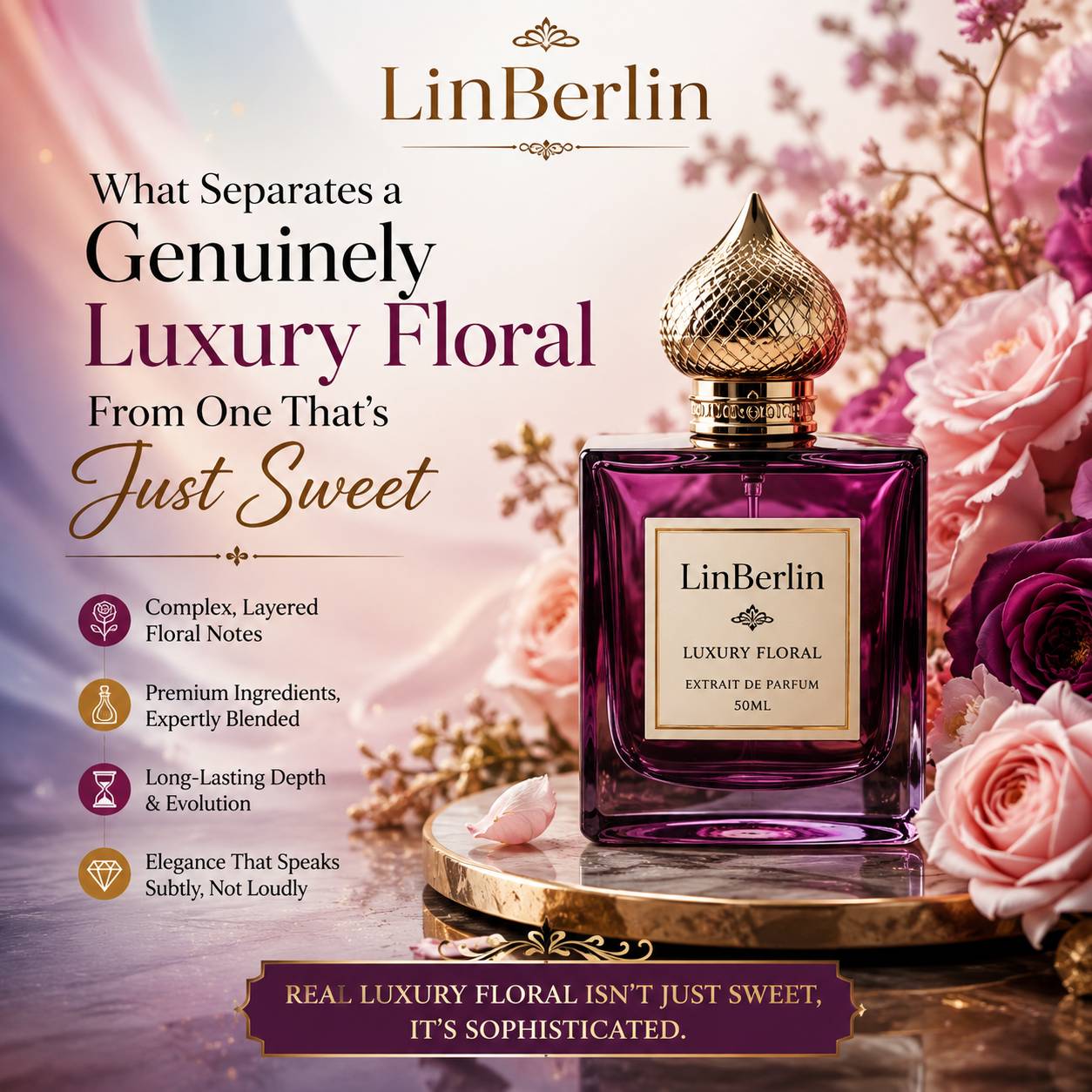
I once watched a woman return a floral perfume three days after buying it — not because it smelled bad, but because her husband kept asking if she'd been eating candy. That's the moment I actually understood the difference between a "sweet" floral and a genuinely luxurious one. It's not about strength. It's not about price, either, though the two often travel together. It's about architecture — whether a scent has a skeleton holding it up, or whether it's just sugar wearing a flower's name.
Most people can't articulate why one floral perfume feels expensive and another feels like it belongs in a mall kiosk. They just know it when they smell it. So let's actually break down what's happening — chemically, botanically, and on your skin specifically — because the answer isn't as simple as "natural is better" or "more oils equals more luxury." Realistically, it's messier than that.
Sweetness Is a Shortcut. Depth Is Not.
Sugar-forward florals lean on a narrow band of aromachemicals — vanillin, certain musks, and synthetic fruit notes — that read as pleasant almost instantly and then flatten out within an hour. There's no unfolding. What you smell at minute five is basically what you smell at minute ninety, just fainter. And that's the tell.
A genuinely layered floral, by contrast, behaves more like a piece of music with movements. The top notes might be bright and almost sharp — sometimes slightly bitter, which surprises people who expect florals to be uniformly soft. The heart settles into something rounder. And the base, if it's built with real botanical material, keeps shifting for hours, sometimes picking up warmth from your own skin chemistry that wasn't "in the bottle" to begin with. This is part of why attars and oil-based perfumery often outperform sugary alcohol sprays in longevity — the oil carries the scent differently, sitting closer to skin rather than evaporating in a cloud.
What Your Skin Actually Does to a Floral Fragrance
Here's the thing most buying guides skip entirely: your skin isn't a neutral canvas. It's an active ingredient in how the perfume performs.
Dry skin tends to burn through top notes fast and mute the sweetness, which is why a floral that smells almost cloying on a well-moisturised arm can smell disappointingly quiet on dry, flaky skin an hour later. Oily skin does the opposite — it holds onto scent longer, sometimes amplifying sweeter notes because sebum interacts with certain aromachemicals in ways that intensify them. Combination skin, unsurprisingly, gives you a bit of both depending on where you apply.
- On dry or dehydrated skin, apply attar or perfume oil right after a light, unscented moisturiser — skin that's slightly hydrated holds fragrance molecules noticeably longer than bare, tight skin does, and this single habit changes performance more than switching perfumes ever will.
- On oily or acne-prone skin, less product goes further, and it's worth testing on a small patch first since oil-based fragrances can sometimes interact with active acne treatments.
- On sensitised or reactive skin — post-facial, post-retinoid, sunburned, freshly waxed — skip fragrance application on that area entirely until the skin barrier has settled, usually a day or two.
I've seen people layer a strong floral attar directly over a fresh retinol application and wonder why their skin flared up red within the hour. It wasn't the fragrance's fault exactly — but the timing made it worse than it needed to be.
The Ingredients That Separate Cheap Sweet from Genuinely Luxury
Synthetic vanillin, certain white musks, and heavy fruity esters are what give budget florals their instant, one-note sweetness. They're not inherently bad — plenty of well-made perfumes use them thoughtfully. But when they're the whole story, the fragrance collapses into a single sensation rather than an experience.
What separates a luxury floral is usually a combination most people never think to ask about: real jasmine or rose absolute (rather than isolated aroma-molecules mimicking them), a supporting cast of woods or resins that give the sweetness somewhere to rest, and — this matters more than people realise — restraint in the sweetness itself. Or, put another way: the best florals are rarely the sweetest ones in the room. They're the most complete ones.
You can actually feel this difference in something like Aurora, our floral luxury perfume, where the floral heart isn't left to stand alone — it's given structure by warmer, quieter notes underneath so the sweetness never tips into something sugary or one-dimensional.
A Quick, Honest Test You Can Do Before Buying
Don't just smell a floral straight from the bottle or off a paper strip and call it done. Paper strips lie a little — they don't have the oils, warmth, or pH your skin has.
- Apply a small amount to your wrist and wait — genuinely wait, not just thirty seconds — about fifteen minutes before judging it.
- Smell it again after two hours; if it still smells like the exact same note as when you applied it, that's usually a sign of a flatter, more synthetic-heavy composition.
- Ask someone else to smell your wrist from close up, not across a room, since sweetness that reads as pleasant from a distance can smell overwhelming up close — and vice versa.
This isn't a perfect science. Skin chemistry, hydration, even what you ate that day can shift results slightly. But it's more honest than judging a fragrance off a first spray in a shop that also smells like forty other perfumes at once.
Where Caution Is Genuinely Warranted
I'd be doing you a disservice if I didn't flag this plainly: floral fragrances, natural or synthetic, are a common trigger for skin sensitivity — and some of the most fragrant natural materials (jasmine absolute, certain rose varieties) can still cause reactions in people prone to allergies, even though they're "natural."
If you're pregnant, it's worth checking with your doctor before regular fragrance use, particularly with concentrated oils applied close to skin rather than sprayed. If you have eczema, rosacea, or generally reactive skin, patch-test any new floral on your inner forearm and wait 24 hours before applying it anywhere else. And if you're using strong actives — retinoids, chemical exfoliants, benzoyl peroxide — give your skin a buffer day between active skincare and fragrance application in the same area.
None of this means avoid florals altogether. It just means treat them the way you'd treat any other product that sits on your skin for hours — with a little attention, not none.
Layering a Floral Without Fighting Your Skincare
People often assume fragrance and skincare exist in separate worlds. They don't — they're stacked on the same surface, competing for the same real estate.
The order matters more than most people realise. Skincare first, letting actives absorb fully — usually a good ten to fifteen minutes — and then fragrance last, ideally on pulse points rather than layered directly over freshly applied serums. Applying attar or perfume oil while skincare is still wet or tacky can actually dilute the fragrance's opening notes and, in some cases, cause mild irritation as the two products mix on the skin's surface rather than settling separately.
And one small thing that's easy to overlook — don't apply fragrance to skin that's just come out of a hot shower. Heat opens pores and can make skin more reactive to concentrated oils, even ones that are otherwise well-tolerated.
What "Sweet" Actually Signals, and When It's a Good Thing
Sweetness itself isn't the enemy here — plenty of celebrated florals have real sweetness in them. The problem is when sweetness is the entire personality of the fragrance rather than one note among several. A well-built floral uses sweetness the way a good meal uses salt: present, felt, but never the only flavour on the plate.
If you're drawn to softer, quieter florals rather than anything overtly sugary, it's worth exploring pieces built around jasmine and rose settling softly into fabric, where the sweetness is present but never loud. And if what you actually want is something that reads as composed and understated rather than attention-seeking, there's a strong case for fragrances built for quiet elegance over anything designed purely to project sweetness across a room.
A Caveat Worth Naming
I won't pretend there's a single objective formula for "luxury" here — a lot of it is genuinely subjective, and what smells complex and layered to one nose can smell muddled to another. Some people prefer the immediacy of a sweeter, simpler floral, and there's nothing wrong with that preference. What this guide is really arguing for is intentionality — knowing what you're buying and why, rather than assuming price or packaging tells you the whole story.
The Practical Takeaway
Before your next floral purchase, do the wrist test, wait the two hours, and pay attention to how your own skin — not the store, not the strip — carries the fragrance over time. Consider your skin type honestly when deciding how much to apply and where. And if you're building a small collection rather than a single bottle, think about how one floral pairs with the rest of what you own; a piece like a genuinely well-matched perfume combination tends to serve you better long-term than several florals that all compete for the same moment.
A floral that's just sweet fades into the background of every other sweet floral out there. A genuinely luxury one gives your skin something to hold onto — and gives you, hours later, a reason to lift your wrist and notice it's still telling a story.