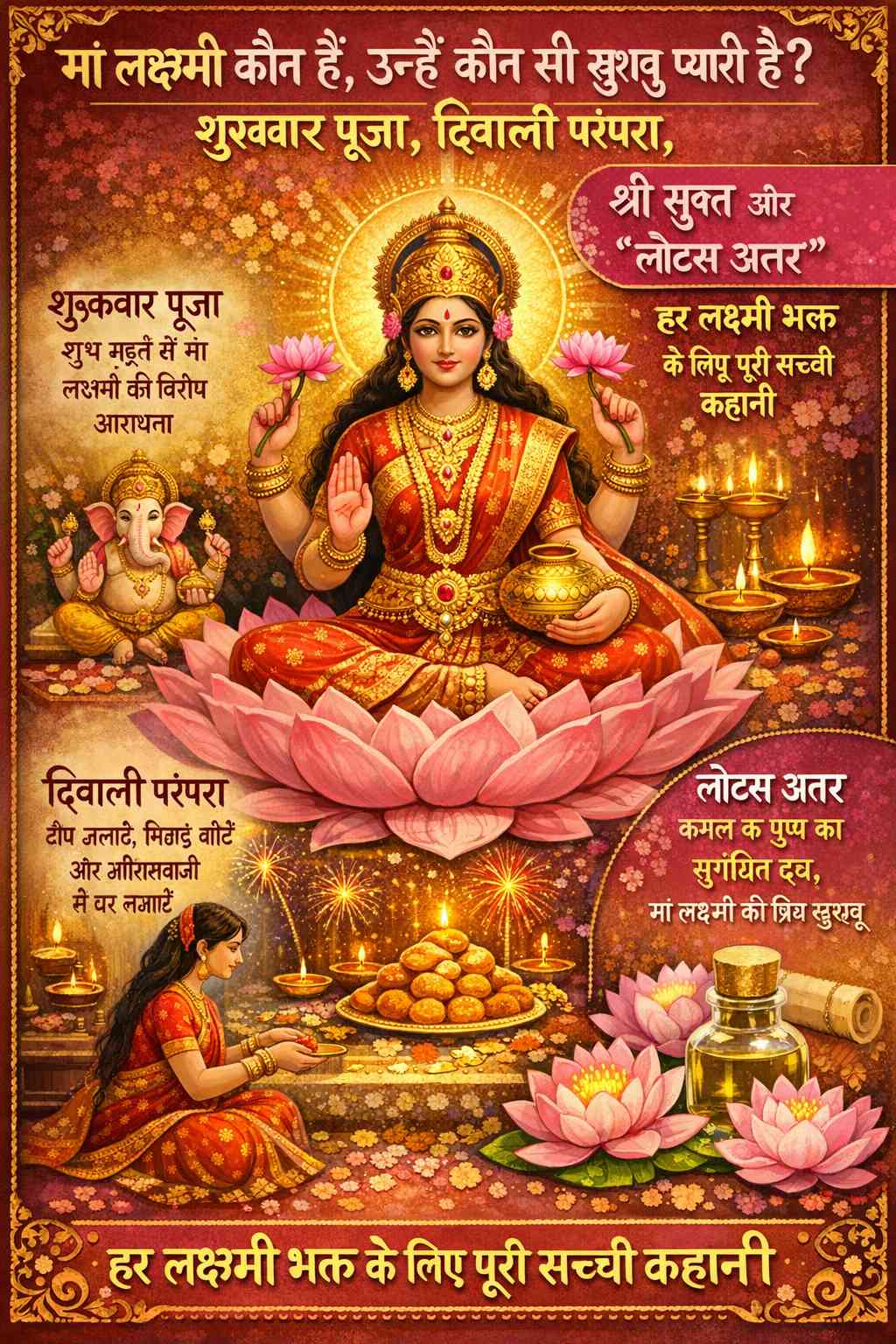
There is a fragrance that every Indian home knows — even if they cannot name it. It rises on Friday evenings, when the diya is lit before Maa Lakshmi's murti and the house has been cleaned with the particular care that her worship demands. It mingles with the smell of fresh marigolds and rice grains arranged in careful patterns on the puja thali. It fills the room just as the family gathers, just as the aarti begins, just as the sound of the conch shell cuts through the quiet evening air.
Maa Lakshmi Aur Attar: Wealth, Grace Aur Sugandh Ki Poori Sachchi Kahani
This fragrance — sweet, floral, deeply auspicious — is the fragrance of Maa Lakshmi's presence. It is the fragrance of abundance recognised. Of grace acknowledged. Of the divine feminine in her most beautiful, most generous, most life-giving form arriving in a home that has prepared itself to receive her.
Maa Lakshmi is the goddess of Shrī — a Sanskrit word that has no perfect English translation because it contains too much. Wealth. Beauty. Auspiciousness. Grace. Prosperity. Good fortune. The quality of rightness that fills a home where love, hard work, and devotion are genuinely present. Shrī is not just money — though Maa Lakshmi blesses with material abundance too. It is the fullness of a life lived well, with gratitude, with beauty, with the recognition that everything good in our lives is ultimately a gift from the divine.
And in her worship — more than in almost any other Hindu devotional tradition — fragrance is not just an offering. It is an invitation. A way of making the home beautiful enough, pure enough, fragrant enough to welcome the goddess whose very nature is beauty and abundance.
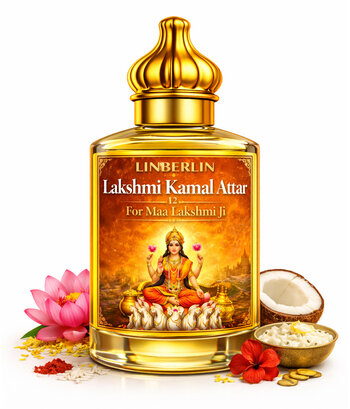
At LinBelin, our Lakshmi Kamal Attar was created with this understanding at its heart — that when you offer Maa Lakshmi the finest, purest, most beautiful fragrance, you are not performing a ritual. You are making your home worthy of her divine presence.
Who Is Maa Lakshmi — Goddess of Shri, Consort of Vishnu, Mother of Abundance
To truly understand the role of fragrance in Maa Lakshmi's worship, you must first understand who she is — not just as a deity of wealth, which is how she is most commonly described, but in the full, extraordinary depth of her divine nature.
Maa Lakshmi is one of the principal goddesses of the Hindu tradition — a form of Adi Shakti, the supreme feminine divine energy, manifested as the goddess of prosperity, beauty, grace, and auspiciousness. She is the eternal consort of Lord Vishnu — the preserver of the universe — and wherever Vishnu goes, Lakshmi accompanies him, for preservation without abundance, without beauty, without grace, is impossible.
She is described in the ancient texts as standing on a fully bloomed pink lotus — the most sacred flower in Indian tradition, which grows in muddy water but remains completely pure and beautiful. This image is not accidental. It is one of the most profound spiritual teachings encoded in her iconography — that true abundance, true prosperity, true grace exists not by avoiding the difficulties of life but by rising above them, remaining pure and beautiful regardless of the circumstances that surround you.
She holds lotus flowers in two of her four hands — representing beauty and purity. Her other two hands are in specific mudras — one giving, one blessing — representing the constant flow of abundance from the divine to the deserving. Gold coins fall from one hand in many of her depictions — not because she is only a goddess of money, but because material prosperity is one of the visible signs of her grace in a devotee's life.
Her eight forms — Ashta Lakshmi — reveal the full breadth of what she represents: Adi Lakshmi (primordial abundance), Dhana Lakshmi (wealth), Dhanya Lakshmi (agricultural prosperity), Gaja Lakshmi (royal power), Santana Lakshmi (the blessing of children), Veera Lakshmi (courage), Vidya Lakshmi (knowledge), and Vijaya Lakshmi (victory). Together these eight forms show that Maa Lakshmi is not the goddess of money alone — she is the goddess of everything that makes human life full, beautiful, and meaningful.
This extraordinary breadth of her nature is exactly why her worship deserves the finest, most complete, most beautiful fragrance offering. LinBelin's Lakshmi Kamal Attar honours this completeness — a 100% alcohol-free, Made in India attar that brings the full graceful abundance of Maa Lakshmi's divine nature into every drop.
The Sacred Connection Between Maa Lakshmi and Fragrance
In all of Hindu devotional tradition, no goddess has a more intimate relationship with beauty, with flowers, and with fragrance than Maa Lakshmi. This relationship is not symbolic or metaphorical — it is deeply practical, deeply devotional, and deeply observed in the living worship traditions of millions of Indian homes.
The ancient texts describe Maa Lakshmi as Padmavasa — she who dwells in the lotus — and Padmapriya — she who loves the lotus. The lotus is her home, her throne, her most sacred symbol. And the fragrance of the lotus — pure, sweet, subtly divine — is considered her most natural and most beloved fragrance in all of creation.
But the connection between Maa Lakshmi and fragrance goes beyond the lotus. In the Shri Sukta — the ancient Vedic hymn to Maa Lakshmi that is among the oldest prayers in Hindu tradition — she is described as being surrounded by the fragrance of flowers, as herself being the essence of beauty and sweetness. The Shri Sukta is recited in her puja to this day, often while offering flowers and attar to her murti — making it one of the oldest continuous fragrance-and-prayer practices in the world.
The tradition is clear and consistent across regions and traditions — Maa Lakshmi is pleased by cleanliness, beauty, and fragrance above all other qualities in a worship space. A home that smells fresh and beautiful, where her murti is adorned with the finest flowers and the purest attar, where every element of the puja thali has been prepared with care and love — this is the home Maa Lakshmi chooses to enter and bless.
Which Fragrance Does Maa Lakshmi Love? The Sacred Scents of Lakshmi Puja
The fragrance traditions of Maa Lakshmi's worship are among the most beautiful and most carefully observed in all of Hindu devotional practice. Each fragrance associated with her worship carries specific meaning rooted in her divine nature and her ancient devotional traditions.
Kamal — Lotus, The Most Sacred Fragrance of Maa Lakshmi
The lotus is Maa Lakshmi's throne, her home, her identity. The fragrance of the lotus — pure, sweet, faintly divine, unlike any other floral fragrance — is considered her most sacred and most beloved offering in all of Indian devotional tradition.
LinBelin's Lakshmi Kamal Attar is named for this sacred connection — Kamal meaning lotus in Sanskrit. When Kamal attar is applied to Maa Lakshmi's fabric garments during her puja or to the altar cloth of her mandir, the fragrance that rises is the fragrance of her very essence — pure, abundant, gracefully divine.
Rose — The Fragrance of Divine Love and Beauty
Red rose is deeply beloved in Maa Lakshmi's worship across India. Rose represents the qualities of divine love, beauty, and the sweetness of abundance — all qualities that Maa Lakshmi herself embodies. In the Diwali puja tradition particularly, rose fragrance is a dominant offering — filling the freshly cleaned home with its warm, sweet, celebratory scent as the goddess of prosperity is welcomed into the space.
Mogra — The Fragrance of Pure Auspiciousness
Mogra — Arabian jasmine — is one of the most auspicious fragrances in Hindu tradition. Its pure white flowers and intensely sweet fragrance are associated with purity, auspiciousness, and the welcoming of divine grace. In South Indian Lakshmi worship traditions particularly, Mogra is used extensively — fresh Mogra garlands and Mogra attar filling the puja space with the most welcoming, most auspicious fragrance possible for the goddess of abundance.
Champa — The Golden Fragrance of Abundance
Champa — Plumeria — has a warm, golden, richly sweet fragrance that perfectly evokes the quality of abundance and divine grace that Maa Lakshmi represents. Its golden color mirrors the gold that is associated with Lakshmi's blessings. Champa attar in Lakshmi puja creates an atmosphere of warmth, abundance, and divine welcome.
Khus — The Fragrance of Earthly Prosperity
Khus — vetiver — is a fragrance with deep roots in Indian devotional tradition. Its rich, earthy, deeply grounding quality represents the connection between divine abundance and earthly prosperity — the way Maa Lakshmi's blessings manifest in real, tangible, practical ways in a devotee's life. Khus attar in Lakshmi puja honours the goddess in her most practical, most life-giving aspect.
Kesar — The Royal Fragrance of Divine Wealth
Kesar — saffron — is among the most precious substances in the world, and its fragrance carries the quality of sacred luxury that is appropriate for the goddess of wealth and abundance. In many regional Lakshmi worship traditions, Kesar attar is used on special occasions — Diwali, Akshaya Tritiya, and Friday pujas of special significance — as a fragrance offering that honours Maa Lakshmi's royal, abundant nature.
How to Use Attar in Maa Lakshmi's Puja — The Complete Devotional Guide
Using attar correctly in Maa Lakshmi's worship transforms the puja from a routine ritual into a genuinely beautiful, genuinely welcoming act of devotion. LinBelin's Lakshmi Kamal Attar is specifically formulated for fabric and clothes — making it perfectly suited for the most meaningful fragrance applications in Lakshmi puja.
Applying Attar to Maa Lakshmi's Fabric Garments During Shringar
The shringar of Maa Lakshmi's murti — the careful adornment of the goddess with fresh flowers, clean clothes, and beautiful fragrance — is one of the most devotionally significant acts in her worship. It is, at its heart, the act of making the goddess beautiful — of offering her the best of what human love and care can provide.
Apply 2 to 3 drops of Lakshmi Kamal Attar on a clean cotton ball and gently touch to the fabric of Maa Lakshmi's garments — her saree, her dupatta, the decorative cloth of her dress. As the puja proceeds and the warmth of the diya fills the space, the lotus fragrance deepens and blossoms — filling the entire mandir area with the sweet, abundant, gracefully divine atmosphere of Maa Lakshmi's presence.
Many devoted Lakshmi bhakts apply attar during shringar while reciting the opening verse of the Shri Sukta — "Hiranyavarnam Harinim" — making the fragrance offering a complete, ancient devotional act that connects the present-day puja to the oldest continuous prayer tradition in Hindu history.
Fragrancing the Puja Space Before Lakshmi Aarti
Before beginning the Friday evening Lakshmi puja and aarti, many devoted bhakts apply LinBelin's pooja attar to the altar cloth of the mandir, to the decorative fabric of the puja space, and to the fabric of the rangoli mat or puja cloth where the puja thali is placed. This creates a complete fragrant atmosphere that greets Maa Lakshmi's arrival with the beauty and sweetness her divine nature deserves.
The effect is immediate and noticeable — the entire puja space transforms from an ordinary domestic room into a genuinely sacred space, filled with fragrance, light, and the quality of welcome that Maa Lakshmi's presence requires.
Wearing Attar on Your Own Puja Clothes
Many devoted Lakshmi bhakts also apply attar to their own puja clothes — their puja saree or salwar, their dupatta — before sitting for Friday puja or Diwali worship. This practice of wearing attar during Lakshmi puja creates a personal fragrant offering — the devotee themselves becoming fragrant as they pray, their body and clothes part of the beauty they are offering to the goddess.
Mantra While Offering Attar to Maa Lakshmi
The most powerful mantra to chant while applying attar to Maa Lakshmi's fabric garments is her primary mantra:
"Om Shreem Mahalakshmiyei Namah"
Or the simpler but equally powerful:
"Jai Maa Lakshmi"
Each repetition of the mantra while applying attar to her garments transforms the simple act of fragrance offering into a complete meditation — fragrance, mantra, and sincere devotion offered simultaneously to the goddess of abundance.
Friday Puja, Diwali and Akshaya Tritiya — Attar in Maa Lakshmi's Most Sacred Occasions
Maa Lakshmi's devotional calendar is rich with auspicious occasions, each carrying its own fragrance traditions observed by devoted bhakts across India.
Friday — Shukravar, The Most Sacred Weekly Day of Maa Lakshmi
Friday is Maa Lakshmi's primary sacred day of the week — observed with special puja, fasting, and fragrance offerings by millions of devoted bhakts across India. On Friday evenings, after the home has been cleaned with particular thoroughness, the Lakshmi puja begins — and the fragrance offering is central to the entire ritual.
The Friday tradition of applying lotus and rose attar to Maa Lakshmi's fabric garments and to the puja space before the evening aarti is one of the most universally observed fragrance rituals in all of Indian household worship. This weekly ritual of cleanliness, beauty, and fragrance is, in essence, a weekly renewal of the invitation to Maa Lakshmi — a weekly statement that the home has been prepared with love and care for her divine presence.
Diwali — The Festival of Lights and the Most Sacred Night of Lakshmi Puja
Diwali is the most important festival in Maa Lakshmi's worship calendar — the night when she is believed to visit and bless the homes that have been most beautifully prepared for her arrival. The cleaning, the diyas, the rangoli, the sweets — every element of Diwali preparation is, at its heart, preparation for Maa Lakshmi's visit.
In this context, the fragrance of the home on Diwali night matters enormously. LinBelin's Lakshmi Kamal Attar applied to Maa Lakshmi's fabric garments during Diwali shringar, to the puja cloth of the altar, and to your own puja clothes before the Diwali aarti creates a fragrant atmosphere worthy of the most important night of the year — welcoming the goddess of abundance with the beauty and purity she deserves.
Akshaya Tritiya — The Day of Inexhaustible Prosperity
Akshaya Tritiya — one of the most auspicious days in the Hindu calendar — is particularly sacred in Maa Lakshmi's worship tradition. On this day, any act of devotion, any act of giving, any act of beginning something new is believed to multiply without end — Akshaya meaning inexhaustible. The fragrance offering made to Maa Lakshmi on Akshaya Tritiya carries this quality of inexhaustible abundance — a small act of devotion whose blessings multiply and continue.
Kojagari Purnima — The Full Moon Night of Lakshmi
Kojagari Purnima — the full moon of the Ashwin month, just after Navratri — is considered Maa Lakshmi's own full moon night. On this night, she is believed to walk the earth asking — "Ko jagarti?" — who is awake? Who is worthy of my blessings? Devoted bhakts stay awake through the night, performing Lakshmi puja under the full moon, offering fragrance and prayer through the night. The attar applied to Maa Lakshmi's fabric garments on Kojagari Purnima carries the full weight of this beautiful, ancient tradition.
Maa Lakshmi's Worship Across India — Regional Traditions and Fragrances
The worship of Maa Lakshmi is as diverse and as beautiful as India itself — each region bringing its own unique devotional culture, its own specific fragrance traditions, and its own intimate relationship with the goddess of abundance.
In South India — where Lakshmi worship has some of its oldest and most elaborate traditions — the Vaibhava Lakshmi vrata observed by women every Friday is one of the most widely practiced devotional rituals in the country. Here Mogra garlands, lotus flowers, and Mogra and lotus attar dominate the fragrance offerings. The Sri Mahalakshmi temples of Tamil Nadu, Karnataka, Andhra Pradesh, and Kerala are among the most beautiful in India — their fragrance traditions maintained with extraordinary care.
In Maharashtra — where Mahalakshmi is worshipped with particular devotion — the Mahalakshmi Ashtami puja is among the most elaborate household worship rituals in the state. Here, Champa and rose attar fill the puja space with the warm, sweet fragrance that Maharashtrian Lakshmi worship is known for.
In Gujarat and Rajasthan — where Diwali Lakshmi puja is an art form of extraordinary beauty — rose and kesar attar are most beloved. The elaborate rangoli, the hundreds of diyas, and the finest fragrance create a Diwali atmosphere that is genuinely transcendent.
In North India broadly — UP, Bihar, MP, Delhi — the Friday Lakshmi puja tradition is universally observed across all communities. Here lotus and rose fragrance dominate, with the weekly puja creating a consistent fragrance tradition that fills millions of homes with Maa Lakshmi's presence every Friday evening.
LinBelin's complete attar collection honours all of these beautiful regional traditions — making the finest devotional fragrance for Maa Lakshmi's worship accessible to every bhakt across India.
The Shri Sukta and Fragrance — The Ancient Connection
The Shri Sukta — the ancient Vedic hymn composed in praise of Maa Lakshmi — is one of the oldest continuous prayers in human civilisation. Composed in Sanskrit and found in the Rigveda, it has been recited in Maa Lakshmi's puja for thousands of years without interruption — making it one of the longest-running devotional practices in world history.
The Shri Sukta describes Maa Lakshmi in terms of extraordinary sensory beauty — her golden complexion, her lotus throne, her garlands of flowers, the fragrance that surrounds her divine form. When the Shri Sukta is recited during Maa Lakshmi's puja — as it is in millions of homes every Friday — and the air of the puja space is simultaneously filled with the fragrance of lotus and rose attar, the effect is one of the most complete and most ancient devotional experiences available to the modern Lakshmi bhakt.
The fragrance rising from the altar cloth and Maa Lakshmi's fabric garments during Shri Sukta recitation is not just a pleasant addition to the puja. It is a direct connection to the sensory world that the ancient composers of the Shri Sukta themselves inhabited — the world of lotus ponds, fragrant gardens, and divine beauty that they encoded into every verse of this extraordinary prayer.
Why Alcohol-Free Attar Is Essential for Maa Lakshmi's Puja
The principle of purity — Shuddhi — is perhaps more important in Maa Lakshmi's worship than in any other Hindu devotional tradition. This is because Maa Lakshmi herself is the embodiment of purity and auspiciousness — she does not enter and bless spaces that are impure, unclean, or lacking in devotional sincerity.
Alcohol is universally considered ritually impure in Hindu tradition — ashudh. Using alcohol-based perfume or synthetic fragrance spray in Maa Lakshmi's puja is not just ritually incorrect — it is, from the perspective of traditional Lakshmi worship, counterproductive. You are simultaneously trying to welcome the goddess of purity and auspiciousness while introducing an element that her worship tradition specifically identifies as impure.
LinBelin's Lakshmi Kamal Attar is 100% alcohol-free — a commitment that aligns perfectly with the core principle of Maa Lakshmi's worship. Every element of her puja should be as pure, as clean, and as beautifully prepared as possible. The fragrance offering should be no exception.
Beyond ritual purity, alcohol-free attar is practically superior for the delicate fabrics used in Maa Lakshmi's shringar — the fine silk sarees, the zari-work fabric, the delicate embroidered cloth of her garments. Alcohol-based fragrances can fade these precious fabrics over time. LinBelin's alcohol-free Lakshmi Kamal Attar protects these beautiful fabrics while filling them with divine fragrance that lasts for hours.
Gifting Lakshmi Kamal Attar — Sharing the Goddess's Abundance
In Indian culture, gifting items associated with Maa Lakshmi is considered deeply auspicious — a way of sharing the goddess's blessings with the people you love. LinBelin's Lakshmi Kamal Attar makes one of the most beautiful and most meaningful devotional gifts possible.
For Diwali — the most natural gifting occasion of the year — gifting a fellow devotee an attar specifically created for Maa Lakshmi's puja carries the full meaning of the festival: sharing abundance, sharing beauty, sharing the goddess's blessings with the people you care about. For Akshaya Tritiya, for house warmings and griha pravesh ceremonies, for the beginning of a new business venture where Maa Lakshmi's blessing is sought — LinBelin's Lakshmi Kamal Attar is the gift that carries the full grace and abundance of the goddess herself.
How to Store Your Lakshmi Kamal Attar
Keep your LinBelin Lakshmi Kamal Attar in a cool, dark place — away from direct sunlight, heat, and other strong fragrances. The lotus and floral notes in the attar are particularly sensitive to heat and sunlight, which can alter the fragrance character over time.
Always close the bottle immediately after use. Use a fresh cotton ball for every application. For Maa Lakshmi's fabric garments, apply with a particularly gentle touch — 2 to 3 drops on cotton is ideal for a full, beautiful fragrance that lasts through the entire puja and well beyond.
Why LinBelin Lakshmi Kamal Attar for Maa Lakshmi's Puja
LinBelin's Lakshmi Kamal Attar was created with a complete understanding of what Maa Lakshmi's worship requires — the purity, the beauty, the fragrance of the lotus, the grace that transforms an ordinary puja into a genuine invitation to the goddess of abundance.
It is 100% alcohol-free — because Maa Lakshmi's worship demands absolute purity in every offering. It is Made in India — because Maa Lakshmi's tradition is rooted in the Indian soil, in the lotus ponds of the subcontinent, in thousands of years of devotional beauty that has made Indian worship culture one of the most fragrant in the world. It is specifically formulated for fabric and clothes — because the most meaningful applications in Lakshmi puja happen on fabric: on her divine garments during shringar, on the altar cloth before aarti, on the devotee's own puja clothes during Friday worship.
Browse LinBelin's complete pooja attar collection and bring the grace and abundance of Maa Lakshmi's sacred lotus fragrance into your home puja today.
15 Most Asked Questions About Maa Lakshmi Attar and Puja
Q1. Which attar is best for Maa Lakshmi puja?
Lotus (Kamal) attar is the most sacred fragrance for Maa Lakshmi worship — she is Padmapriya, the lover of the lotus. LinBelin's Lakshmi Kamal Attar is 100% alcohol-free, Made in India, and crafted for fabric and puja clothes, bringing the goddess's most beloved fragrance to your home worship.
Q2. Which fragrance does Maa Lakshmi love most?
Lotus is Maa Lakshmi's most beloved fragrance — she is described in the Shri Sukta and ancient texts as Padmavasa, she who dwells in the lotus. Rose, Mogra, Champa, and Kesar are also deeply traditional in her worship across different regions and occasions.
Q3. Which day is best to offer attar to Maa Lakshmi?
Friday — Shukravar — is Maa Lakshmi's most sacred weekly day. Diwali is the most important annual occasion. Akshaya Tritiya and Kojagari Purnima are also particularly significant for attar offerings to the goddess.
Q4. How to use attar in Maa Lakshmi puja correctly?
Apply 2-3 drops of LinBelin's Lakshmi Kamal Attar on clean cotton and gently dab on Maa Lakshmi's fabric garments during shringar, or on the altar cloth before aarti. Designed for fabric — never for direct application on stone or metal murti.
Q5. Is alcohol-free attar necessary for Maa Lakshmi puja?
Yes, absolutely. Maa Lakshmi is the goddess of purity and auspiciousness — alcohol is considered ritually impure in her worship. LinBelin's Lakshmi Kamal Attar is 100% alcohol-free, completely appropriate for Maa Lakshmi's puja.
Q6. What fragrance is best for Diwali Lakshmi puja?
Lotus and rose attar are the most traditional and most beloved fragrances for Diwali Lakshmi puja across India. LinBelin's Lakshmi Kamal Attar — with its pure lotus fragrance — creates the complete, beautiful, abundantly fragrant atmosphere that Maa Lakshmi's most sacred night deserves.
Q7. Can attar be applied on Maa Lakshmi's fabric saree or dress?
Yes. Applying attar to Maa Lakshmi's fabric garments during shringar is one of the most traditional and devotionally significant practices in Lakshmi worship. LinBelin's Lakshmi Kamal Attar is formulated for gentle, safe fabric application.
Q8. What mantra to chant while offering attar to Maa Lakshmi?
Chanting "Om Shreem Mahalakshmiyei Namah" while applying attar to Maa Lakshmi's garments transforms the fragrance offering into a complete devotional act — mantra, fragrance, and sincere devotion offered simultaneously to the goddess of abundance.
Q9. Which fragrance is used in South Indian Lakshmi puja?
Mogra garlands and Mogra attar are most prominent in South Indian Lakshmi worship, particularly in the Friday Vaibhava Lakshmi vrata tradition. Lotus and rose are also widely used in Tamil Nadu, Karnataka, and Andhra Pradesh Lakshmi temple traditions.
Q10. How long does Maa Lakshmi attar fragrance last on fabric?
LinBelin's Lakshmi Kamal Attar releases fragrance gently over 8-12 hours on fabric — meaning Maa Lakshmi's garments remain beautifully fragrant from morning shringar through the evening Friday aarti and beyond.
Q11. Can Lakshmi Kamal Attar be gifted on Diwali?
Yes. Gifting LinBelin's Lakshmi Kamal Attar on Diwali carries the full meaning of the festival — sharing abundance, beauty, and Maa Lakshmi's blessings with the people you love. It is one of the most meaningful and most devotionally appropriate Diwali gifts possible.
Q12. What is the significance of lotus fragrance in Maa Lakshmi worship?
The lotus is Maa Lakshmi's throne and most sacred symbol — she is Padmavasa (dwelling in the lotus) and Padmapriya (lover of the lotus). Lotus fragrance in her worship recreates her divine environment, making the puja space a sacred space worthy of her presence.
Q13. Can attar be used during Shri Sukta recitation?
Yes. Applying attar to Maa Lakshmi's fabric garments while reciting the Shri Sukta creates one of the most complete and ancient devotional experiences in Hindu tradition — connecting the fragrance offering to the oldest continuous prayer to Maa Lakshmi in existence.
Q14. Where can I buy pure lotus attar for Maa Lakshmi puja online?
LinBelin offers authentic Made in India 100% alcohol-free Lakshmi Kamal Attar for Maa Lakshmi puja online at our Lakshmi Kamal Attar product page or explore our complete pooja attar collection.
Q15. What makes LinBelin Lakshmi Kamal Attar different from regular perfume?
LinBelin's Lakshmi Kamal Attar is 100% alcohol-free, Made in India, formulated for fabric and clothes, and crafted with genuine understanding of Maa Lakshmi's worship tradition and her most sacred fragrance — the lotus. Regular perfumes are alcohol-based and completely inappropriate for puja use.
Conclusion — Welcome Maa Lakshmi With the Fragrance She Deserves
Maa Lakshmi does not come to homes by force or by obligation. She comes where she is genuinely welcomed — where the floors are clean, the diyas are lit, the flowers are fresh, and the fragrance in the air tells her, without words, that this home has been prepared for her with love, with care, and with the sincere desire for her divine presence.
The fragrance you choose for your Lakshmi puja is part of this welcome. A pure, alcohol-free, lotus-fragrant attar applied to Maa Lakshmi's fabric garments with sincere devotion and the chant of "Om Shreem Mahalakshmiyei Namah" — this is a welcome worthy of the goddess of abundance.
LinBelin's Lakshmi Kamal Attar was made for this welcome. For your Friday puja. For your Diwali celebration. For Akshaya Tritiya. For every moment when you want to fill your home with the grace, beauty, and abundant blessing of Maa Lakshmi's divine presence.
Browse LinBelin's complete pooja attar collection and welcome Maa Lakshmi into your home with the fragrance she truly deserves.
Jai Maa Lakshmi! 🙏 Om Shreem Mahalakshmiyei Namah 🪷
LinBelin — Devotional Attar, Made in India 100% Alcohol-Free | Fabric and Clothes Attar | For Pure Puja | Available Online Across India