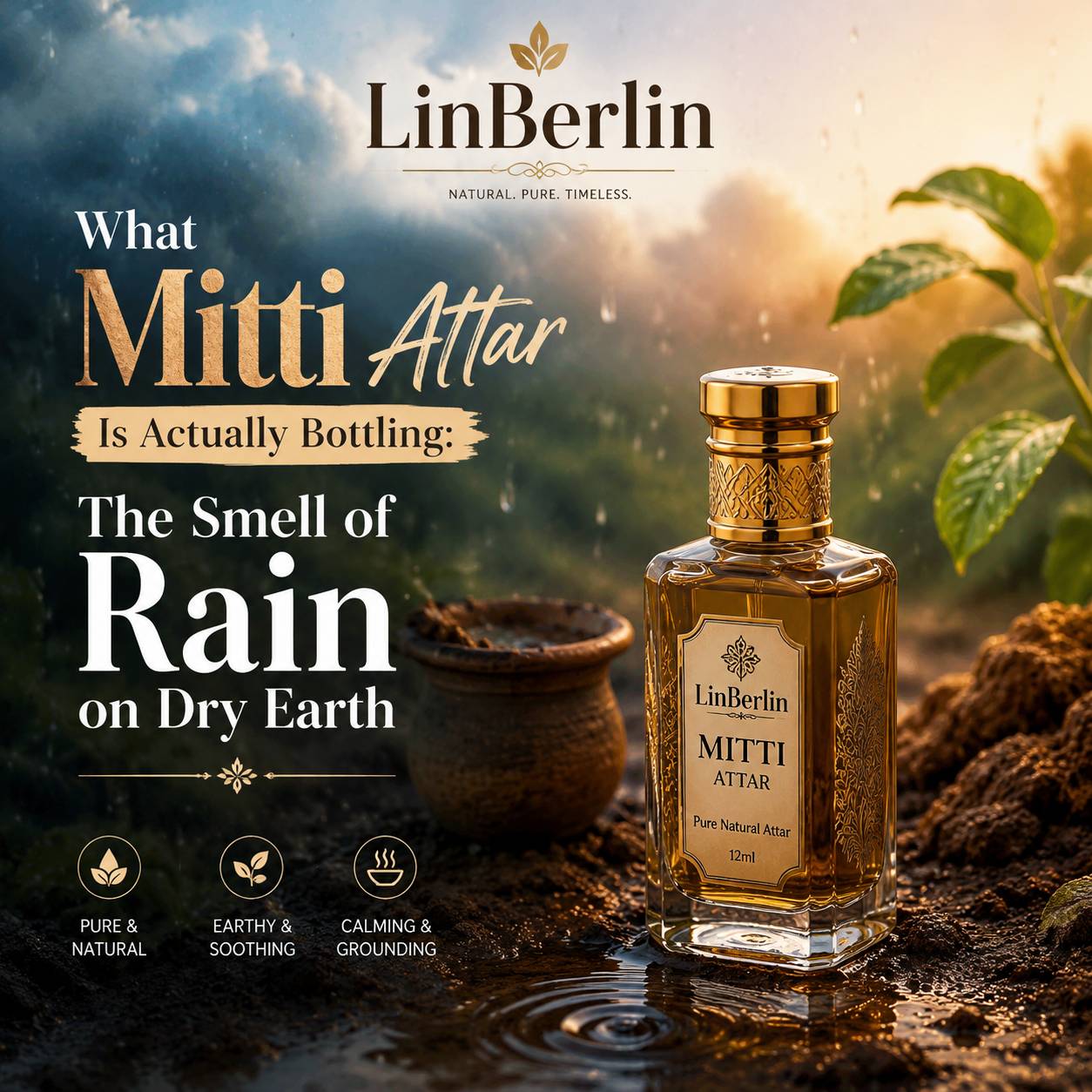
There's a compound called geosmin that the human nose can pick up at roughly five parts per trillion, which is an absurd level of sensitivity for something as unglamorous as wet soil. Bacteria in dry earth release it the moment rain hits, and we're wired — evolutionarily, apparently — to notice. Long before anyone bottled it, before anyone gave it a name, this was already the smell that told desert-dwelling ancestors that water had arrived. That instinct is what a good mitti attar is trying to recreate. Not a flower. Not a fruit. Rain, and the ground it lands on.
Why This One Doesn't Behave Like Other Attars
Most attars are built to remind you of something pleasant and familiar — jasmine at dusk, rose in a garden, oud in a temple. Mitti attar is built to remind you of a moment. That's a different job entirely, and it shows up in how the fragrance actually performs on skin. It doesn't open with a bright top note the way a citrus or floral attar does. It opens low, almost flat, and then warms into something earthier as it meets body heat. On some people it reads as smoky. On others, closer to wet stone. The variation isn't a flaw in the oil — it's the oil reacting honestly to different skin chemistries, which is exactly what a genuine, clay-distilled attar is supposed to do.
So here's the thing worth knowing before you buy: if a "mitti attar" smells identical on everyone who wears it, in exactly the same way, every time — that's usually a sign it's been built on synthetic geosmin replicas rather than the traditional deg-bhapka method, where unglazed clay is distilled over sandalwood oil until the clay itself releases that rain-on-earth character into the base. LinBerlin's version, sold as Suroor e Khak, follows that older process, which is part of why it behaves a little differently from bottle to bottle and skin to skin.
Skin Type Changes the Story More Than People Expect
Dry skin tends to lose earthy, base-heavy attars faster than you'd think, because there's less natural oil on the surface to hold the heavier molecules in place. If your skin runs dry, mitti attar can fade to a whisper within two or three hours instead of sitting with you all afternoon. Oily and combination skin, on the other hand, usually does this fragrance a favor. The extra sebum acts almost like a fixative, letting the earthy base notes linger and deepen over time rather than evaporating early. And sensitive or reactive skin sits somewhere in between — it's — well, it's more complicated than that, because sensitivity isn't really about how long a scent lasts, it's about whether the skin barrier reacts at all, which has nothing to do with dryness or oiliness and everything to do with individual tolerance.
People with eczema-prone or compromised skin barriers should apply attar to clothing or a scarf rather than directly onto irritated patches. Concentrated botanical oils, even natural ones, can sting on broken or inflamed skin. That's not a LinBerlin-specific caution — it applies to any oil-based fragrance, attar or otherwise.
Layering With Skincare: Where People Actually Go Wrong
The biggest mistake isn't overapplying the attar itself. It's applying it on top of the wrong skincare. Retinoids, exfoliating acids (glycolic, salicylic, lactic), and benzoyl peroxide all thin or sensitize the skin barrier temporarily, and layering a concentrated attar directly over freshly treated skin can cause a mild burning or flushing sensation that has nothing to do with an allergy — it's just chemical irritation stacking on top of itself. If you're using any of these actives at night, the safer window for attar is on unmedicated skin, ideally the inside of the wrist or behind the ear, well away from wherever the actives were applied.
Moisturized skin holds scent longer than dry skin, and this matters more with earthy attars than with lighter ones. A thin layer of an unscented or lightly scented barrier cream underneath the attar gives the oil something to bind to, which noticeably extends wear time. Skip the moisturizer step and the fragrance behaves more like it was dabbed onto paper — present, but thin, and gone sooner than expected.
Who Should Be Cautious
Pregnant readers, or anyone with a history of fragrance-triggered migraines, should patch test any concentrated attar — mitti attar included — on a small area like the inner forearm and wait 24 hours before wearing it more broadly. Certain individuals develop heightened scent sensitivity during pregnancy, and earthy, mineral-forward notes like this one can read as unexpectedly strong to a nose that's temporarily more reactive than usual. Nut oil carriers occasionally appear in traditional attar bases too, so anyone with a tree nut allergy should ask before buying, rather than assume.
Buying Guide: What to Actually Look For
Realistically, most people shopping for mitti attar have never smelled a genuine one before, which makes it easy to be sold on something that isn't. A few honest markers help. Color first — authentic clay-distilled mitti attar tends to run amber to deep brown, never watery or perfectly clear. Texture second, since real attars carry a slight viscosity from the sandalwood or other oil base they're distilled into, rather than feeling thin like alcohol-based perfume. And price is a signal too, though not the only one — a properly made, small-batch mitti attar involves slow, labor-intensive distillation, so it's rarely the cheapest bottle on the shelf.
There's a limitation worth being upfront about: geosmin, the actual molecule responsible for that "rain smell," is present in trace amounts even in traditional deg-bhapka mitti attar, and its exact concentration can vary batch to batch depending on the clay source and distillation conditions. That means two bottles from the same maker, made months apart, can smell subtly different from each other. It's not inconsistency for its own sake — it's a natural product responding to natural variables. Anyone expecting laboratory-identical uniformity from batch to batch should know that going in.
How to Apply It for the Best Longevity
Pulse points still work, but with mitti attar specifically, the inner elbow and back of the neck tend to hold the earthy base notes better than the wrists, which see more washing and friction throughout the day. A single drop is usually enough — this is a concentrated oil, not a spray, and overapplication tends to push it into "damp basement" territory rather than "rain on warm earth." Let it sit on skin for a minute before adding clothing, since fabric can absorb the top layer of oil before it's had a chance to bloom.
Or, for those who want it to last into the evening, a light reapplication behind the ears around midday does more than doubling the initial amount would.
The Takeaway
Mitti attar isn't trying to smell expensive or exotic in the way most perfume marketing pushes for. It's trying to recreate something almost everyone has smelled at some point in their life and never had a name for. But it does deserve a little more care than a typical floral attar — the right skin prep, the right patch test if you're pregnant or sensitive, and a realistic expectation about batch variation. Get those right, and Suroor e Khak ends up being one of the more honest fragrances a person can wear — earthy, quiet, and genuinely different depending on who's wearing it.