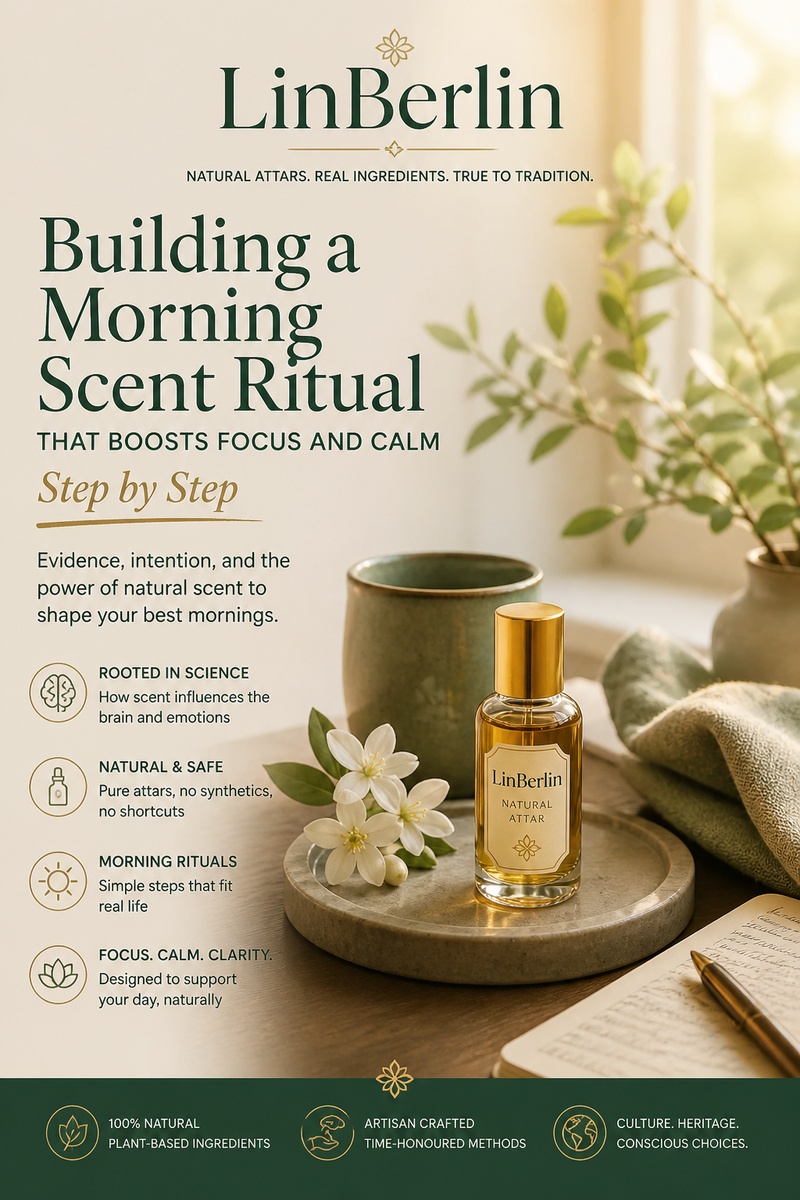
The quiet moment just after waking has a particular texture: light filtering through curtains, the faint hum of a distant street, and a mind that hasn’t yet decided what kind of day it will be. It’s in this in-between state that scent slips in most easily, shaping attention before thoughts become crowded. A morning scent ritual that boosts focus and calm isn’t a mystical idea; it’s rooted in how the brain processes smell and memory. And while fragrance marketing often promises more than science can support, there’s enough credible research to make this practice worth understanding—and refining with intention.
What the research actually shows
The pathway from nose to brain is unusually direct — unlike other senses, smell bypasses the thalamus and connects quickly to the olfactory bulb, which sits close to the amygdala and hippocampus. That proximity matters. These regions are deeply involved in emotion, memory, and associative learning. When you smell something familiar, your brain doesn’t just register it; it often retrieves context, mood, even fragments of past experience.
Studies by researchers like Rachel Herz have shown that scent-linked memories tend to be more emotionally vivid than those triggered by visual or verbal cues. Lavender, for example, has been associated in several small clinical trials with reduced anxiety and mild improvements in sleep quality. But the results aren’t universal. Peppermint has been studied for alertness, with some evidence suggesting it may improve perceived energy and task performance—but again, findings vary depending on context and expectation.
And expectation plays a larger role than people assume. If you believe a scent is calming, your brain often cooperates (a subtle placebo effect, but a real one). That doesn’t make the effect fake; it means perception and biology are working together.
Here’s the thing: there is no single scent that reliably produces focus or calm for everyone. The research supports trends, not guarantees.
The practical reality
In daily life, scent doesn’t act like a switch you flip. It behaves more like a cue — a consistent signal that your brain learns to associate with a certain state over time.
Think about how coffee smells before it’s even tasted. For many people, that aroma alone begins to wake the mind. The same principle applies to a scent ritual. If you apply the same attar each morning while preparing to work, your brain gradually links that scent with focus.
But it only works with repetition and context. Using a calming scent once and expecting instant clarity won’t do much. Using it daily, in a similar environment, while engaging in the same activity—that’s where the shift happens.
And what about mood on difficult mornings? This is where things get less predictable. A scent won’t override stress or poor sleep. It can soften the edges slightly, but it won’t replace rest, nutrition, or mental clarity.
So what should you realistically expect? A gentle nudge, not a dramatic change.
There’s also individual variation to consider (genetics, past experiences, and cultural associations all influence how a scent is perceived). What feels grounding to one person may feel heavy or distracting to another.
How to apply this with attar
Attars offer something particularly useful here: a slower, closer-to-skin diffusion that doesn’t overwhelm the senses. That makes them well suited for a morning ritual where subtlety matters.
Start small. Apply a tiny amount to pulse points—wrists or behind the ears—and give it a few seconds to settle before moving on with your routine. This moment of pause is part of the ritual itself.
For focus, lighter compositions with citrus or herbal notes can feel sharper and more clarifying. For calm, woods or soft florals often create a sense of steadiness. But don’t overthink the category. Pay attention to how you actually feel after wearing it.
Or you might prefer to rotate between two scents—one for focused workdays, another for slower mornings. That contrast can reinforce the psychological cue.
And consistency matters more than complexity. A single, well-chosen attar used regularly will do more than a shelf full of rarely worn options.
LinBerlin's perspective
At LinBerlin, the approach to scent and wellbeing is deliberately restrained. Natural attars are valued for their depth, sourcing, and cultural history—but they aren’t positioned as tools that can control your mood on demand.
Instead, the focus is on creating compositions that people want to return to. If a scent becomes part of your daily rhythm, any sense of calm or clarity comes from that relationship, not from exaggerated claims about ingredients.
And that distinction matters. Because trust in a fragrance builds over time, through repeated experience, not through promises.
Closing
A morning scent ritual doesn’t need to be elaborate to be meaningful. Choose one attar, use it consistently, and let your brain do what it naturally does: form associations. Over days and weeks, that quiet signal can begin to shape how your mornings feel.
It won’t fix everything. But it might give you a small, reliable moment of focus and calm—and sometimes, that’s exactly enough to start well.