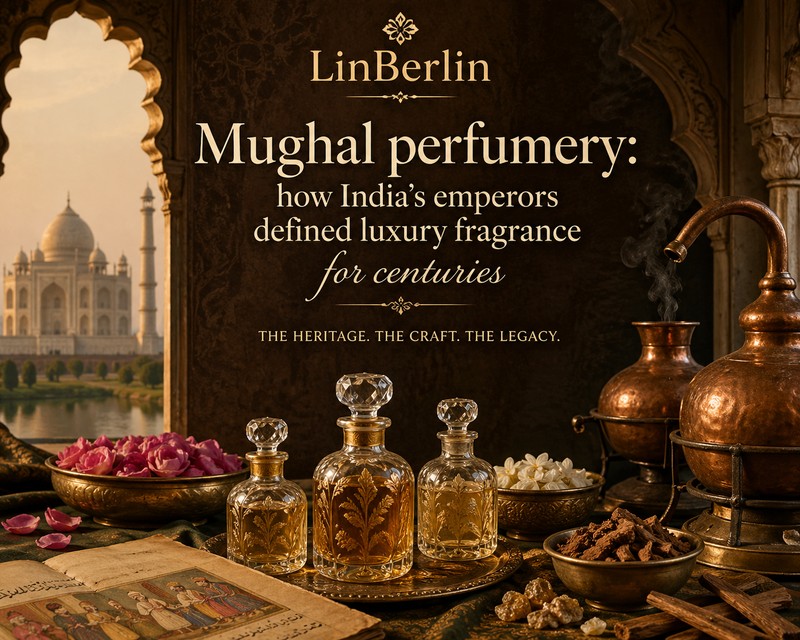
A copper deg warms slowly over a low flame, its lid sealed with clay, while rose petals soften into something far more enduring than their brief bloom. In the courtyards of imperial India, scent wasn’t decoration — it was atmosphere, memory, and sometimes quiet power. Mughal perfumery grew out of this intimacy with materials and meaning, turning distilled oils into markers of refinement that still echo through attar traditions today.
The story of fragrance in the Mughal courts isn’t just about indulgence, as it’s often reduced to. It’s about craft, movement of knowledge, and a very deliberate shaping of taste. And if you look closely, you’ll notice how many of those choices still guide how natural perfumery is understood across South Asia and beyond.
The historical roots
Long before the Mughals established their courts in the Indian subcontinent, aromatic materials had already been moving across trade routes linking Persia, Central Asia, and the Indian plains. Sandalwood from the south, rose from Kannauj, and resins from Arabia formed a network of scent long before it became imperial language.
But under emperors like Akbar and Jahangir, something shifted. And it wasn’t just scale — it was intention. The court became a place where fragrance was studied, refined, and documented. Jahangir’s memoirs, for instance, don’t just mention scent casually; they dwell on it, describing distillation experiments and seasonal variations in flowers.
Nur Jahan, often remembered for her political influence, played an equally significant role in shaping fragrance culture. She is widely associated with refining the extraction of rose attar (though accounts vary, and some traditions credit earlier distillers), and her patronage helped establish Kannauj as a centre for attar production that continues even now.
So what exactly made Mughal perfumery distinct? It wasn’t just the ingredients. It was the method of slow hydro-distillation using deg and bhapka apparatus, and the pairing of volatile floral extracts with sandalwood oil as a base. This created depth, longevity, and a kind of warmth that alcohol-based perfumery often struggles to replicate.
And the truth is, this wasn’t an isolated innovation. It drew from Persian techniques, adapted to Indian materials, and then evolved into something unmistakably local.
The cultural significance
Within Mughal society, scent moved far beyond personal adornment. It marked rituals, structured daily life, and even influenced how space was experienced. Court gatherings were scented deliberately — textiles infused, fountains perfumed, even letters sometimes carried traces of attar.
But it wasn’t only about display. Fragrance held spiritual associations too, particularly within Sufi traditions that were deeply intertwined with Mughal culture. Certain attars were used in gatherings, shrines, and moments of reflection, where scent acted almost as a bridge between the physical and the unseen.
And then there’s the social language of scent — subtle but powerful. To wear a particular attar could signal refinement, regional identity, or even seasonal awareness. Khus in summer, rose in spring, oud in cooler months; these weren’t arbitrary choices, they were understood codes.
You might wonder, was this knowledge limited to the elite? Not entirely. While the most refined blends were certainly tied to court life, techniques and materials filtered outward into bazaars and regional practices. Artisans, distillers, and traders all played a role in shaping what eventually became a shared sensory culture.
Honestly, what stands out is how integrated scent was into daily experience. It wasn’t reserved for special occasions — it was woven into ordinary moments, from clothing to hospitality.
How this tradition lives today
Walk through parts of Kannauj even now, and you’ll still find distillation units that echo Mughal-era methods. The equipment may look modest, but the process remains precise, seasonal, and deeply dependent on the skill of the distiller.
But things have changed too. Synthetic fragrances, shifting consumer habits, and the pressures of scale have altered how perfumery operates in India today. Many traditional attar makers have had to adapt, sometimes blending older techniques with newer demands.
And yet, there’s a quiet persistence here — a refusal to let certain practices disappear. Small producers continue to work with natural materials, often in limited batches, maintaining knowledge that isn’t easily written down or industrialised.
Or think about how oud has travelled. Once filtered through Mughal courts and regional trade, it now circulates globally, particularly in Middle Eastern perfumery, yet still carries traces of those earlier exchanges.
LinBerlin's connection to this tradition
LinBerlin approaches this history with a certain restraint. It doesn’t attempt to recreate Mughal perfumery as a fixed aesthetic — that wouldn’t be honest to how fluid and layered these traditions are.
Instead, the focus is on materials and method. Using natural oils, working with attar-style compositions, and respecting the role of sandalwood as more than just a base (it’s structure, memory, and texture all at once). There’s also an emphasis on wearability — how these scents live on fabric, how they evolve through the day.
Here’s the thing, drawing from tradition isn’t about imitation. It’s about understanding why those choices were made in the first place, and then carrying that thinking forward in a way that still feels grounded.
Closing
The Mughal courts may be long gone, but the language they shaped around scent hasn’t disappeared. It lingers in attar shops, in seasonal habits, in the quiet preference for oil over spray.
And if you ever find yourself drawn to these fragrances, take your time with them. Let them sit, change, settle. That’s where their meaning really reveals itself — not in the first impression, but in what stays behind.