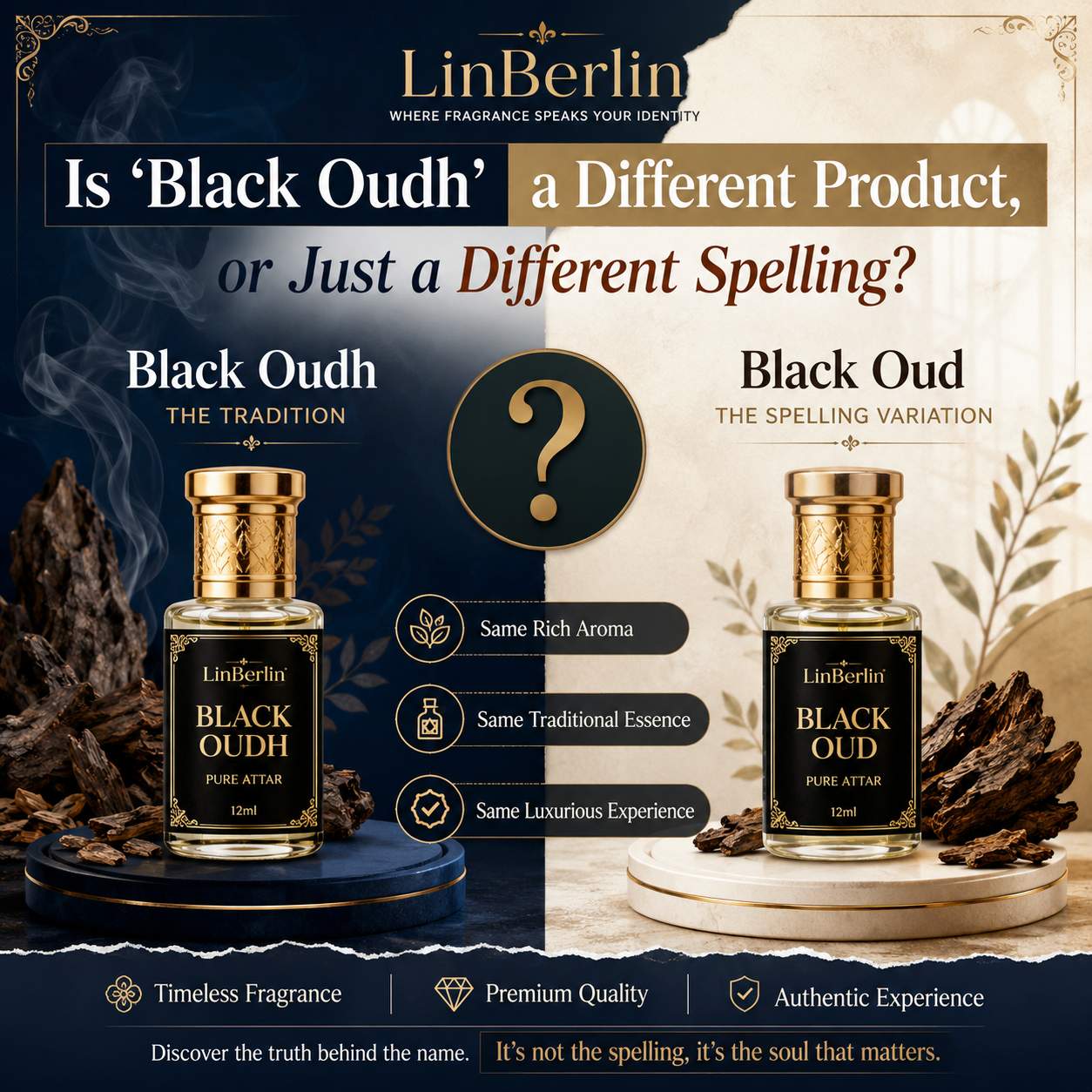
A customer once wrote to LinBerlin asking why her bottle labelled "Black Oudh" smelled nothing like the "Black Oud" her sister bought from a market stall in Old Delhi. Same words, near enough. Completely different oils. That question — more than any marketing line — is the honest starting point for this whole conversation.
Spelling Isn't the Problem. Sourcing Is.
Let's clear this up first: "oudh" and "oud" are the same word, just transliterated differently from Arabic and Hindi-Urdu roots. One isn't more authentic than the other. So if you've been avoiding a bottle because it spells the word one way and your usual attar spells it another, you can stop doing that — it's not a red flag on its own.
But here's the thing that actually matters, and it's not spelling at all. It's what's inside the bottle. "Black Oudh" as a name gets used loosely across the fragrance market — sometimes for a genuinely dark, resinous, aged agarwood distillation, and sometimes for a synthetic base dyed to look moody and marketed with the word "black" because it sounds premium. Realistically, the name tells you almost nothing about quality. It tells you about branding.
What Makes an Oud Attar "Black" in the First Place
In genuine attar-making, a black or dark oud usually comes from one of a few things: highly resinous agarwood (the kind with dense, oil-saturated wood from older trees), extended fermentation and distillation cycles that pull deeper, smokier notes from the wood, or oils that have been aged in the traditional dabbers for years, darkening naturally over time the way whisky darkens in a barrel. None of that happens overnight, and none of it is cheap.
A short list of what genuinely dark oud tends to smell like — and it's worth saying these three notes rarely show up equally, one usually dominates depending on the source wood:
- Deep, almost leathery smoke, sometimes with a barnyard edge that softens after the first ten minutes on skin
- A resinous sweetness underneath, closer to dried fruit or dark honey than anything floral
- An earthy, almost medicinal bitterness that lingers in the dry-down and reads as animalic rather than clean
LinBerlin's own black oudh attar (Oud e Zulmat) was built around that traditional profile — dense, smoky, unapologetically heavy — rather than chasing the trend of a "black" fragrance that's really just a standard oud with darker packaging.
How Black Oudh Actually Behaves on Skin
This is where my writer-brain and my skincare-brain start talking to each other, because oud attars don't behave the same on every skin type, and nobody tells people this clearly enough.
On dry skin, oud — especially a dark, resin-heavy oud — tends to sit closer to the surface and fade faster. Dry skin doesn't hold onto oil-based fragrance the way hydrated skin does, so if you've applied a dark oudh and felt like it disappeared by lunchtime, that's probably not the oil's fault. It's the skin's. Moisturised skin, on the other hand, acts almost like a sealant. The natural lipids and any applied moisturiser slow down evaporation, which means the same oud that vanished on dry skin can linger six, eight hours on well-hydrated skin.
Oily skin sits somewhere in between, and it's — well, it's more complicated than that, actually, because oily skin often amplifies the sharper top notes of an oud before settling into a longer wear than dry skin gives you. You'll notice the smoke and bitterness more intensely in the first twenty minutes, then it mellows.
A practical note most guides skip: never apply attar directly onto freshly exfoliated or actively irritated skin. Chemical exfoliants (glycolic, salicylic, retinoids) thin the outer skin barrier temporarily, and a concentrated oil like oud attar sitting on that compromised barrier can sting, or in some cases trigger redness that has nothing to do with an actual fragrance allergy. Apply attar on pulse points that haven't had active skincare on them that day, or wait a few hours after using strong actives.
Layering Black Oudh Without Fighting Your Skincare Routine
People assume attar and skincare don't interact much. They do, constantly. Heavy occlusive moisturisers (thick shea or petroleum-based creams) can actually mute an oud's top notes because they create a barrier that slows the oil's initial diffusion into the air. If you want the full smoky opening of a dark oudh, apply it to skin that's been moisturised with something lighter — a gel-based or lotion-based product — rather than a thick night cream.
And if you layer black oudh with a musk-based attar, something interesting happens that a lot of people don't expect. The musk doesn't compete with the darker oud notes — it rounds them out, softening the smokiness into something closer to skin-warmth than smoke. There's a good breakdown of this specific pairing in this piece on black oudh and musk together, if you want to try building a signature layer rather than wearing oud alone.
So, does black oudh work for daytime? Not really, in most cases. It's a heavy, evening-leaning fragrance by nature — the resinous depth that makes it interesting after sunset can feel overwhelming under office lighting at 10am. For warmer months or daytime wear, something with a lighter oud base tends to sit better on skin without becoming cloying by afternoon. LinBerlin has covered this exact seasonal mismatch in a separate guide on why lighter oudh attars suit warm-weather wear, which is worth a read if black oudh turns out to be too much oil for your daily routine.
Sensitivity, Pregnancy, and When to Be Cautious
This part matters more than the marketing copy on most attar sites will admit. Oud, particularly dark, resinous oud, is a concentrated botanical oil, and concentrated botanical oils are a known trigger for contact sensitisation in people with reactive or eczema-prone skin. If you've had a reaction to essential oils before — lavender, tea tree, sandalwood, anything applied topically — patch test any new attar on the inner forearm and wait 24 hours before applying it to pulse points like the neck or wrists.
Pregnancy is another area where caution is genuinely warranted, not just a legal disclaimer. Some care providers advise limiting exposure to concentrated essential oils during the first trimester, largely out of caution rather than confirmed risk, since research on topical fragrance oil exposure during pregnancy is limited. If you're pregnant or nursing, it's worth checking with your doctor before wearing any strong attar daily, dark oud included.
One more honest caveat: LinBerlin's own testing and customer feedback suggest dark ouds are more likely than lighter florals or citrus attars to trigger mild skin warmth or a slight tingling sensation on very fair or reactive skin types — not a true allergy, more a histamine-adjacent response to the concentration. It usually fades in minutes. But if it doesn't, or if it comes with visible redness lasting longer than an hour, that's your skin telling you to dilute the oil with a carrier (jojoba works well) rather than pushing through it.
Buying Guide: What to Actually Check Before You Purchase
A few things worth checking before you commit to a bottle labelled black oudh, beyond just trusting the name:
- Ask whether the darkness comes from the wood itself or from added colourants — a reputable seller will tell you plainly, and hesitation on this question is itself useful information
- Check the price point against known agarwood market rates. Genuine aged oud is expensive to produce, so a black oudh priced dramatically below similar oud attars is worth questioning
- Look at how the brand describes the scent journey — top, heart, and dry-down notes that read as generic ("woody, warm, long-lasting") rather than specific usually signal less transparency about sourcing
Realistically, no single check guarantees authenticity on its own. But together, they narrow the odds considerably.
Where Black Oudh Fits Alongside Other Fragrances
Black oudh rarely sits alone in a well-built fragrance wardrobe. It pairs interestingly against brighter, warmer ouds too — there's a noticeable contrast when a shadowed black oud sits beside something golden and resinous rather than another dark note, which LinBerlin explores in this comparison between black oud and royal oud. And for readers who like building an evening rotation rather than sticking to one attar, there's a broader look at how two fragrances can occupy the same evening without clashing, in this piece on fragrance pairings for one evening.
Tobacco lovers, in particular, tend to gravitate toward dark oud for a reason — the two notes share a similar smoky, dried-leaf register that deepens rather than competes. There's more on that specific combination in this exploration of dark oud alongside tobacco and velvet notes, for anyone building toward a heavier, more masculine-leaning profile.
The Short Answer
So — different product or different spelling? Both, depending on where you're buying from. The spelling itself is meaningless. What separates a real black oudh from a dressed-up standard oud is the sourcing, the distillation method, and honestly, how the brand talks about it when you ask direct questions. Apply it on well-moisturised, non-irritated skin, patch test if you're prone to reactions, go easy during pregnancy, and expect it to behave differently depending on your skin type. That's really the whole picture — not the name on the label, but everything that happened to the wood before it ever reached the bottle.