I still remember the first time I smelled what someone confidently called “pure oud.” It was deep, smoky, slightly sweet—and honestly, a bit confusing. Later that same week, someone else handed me an “agarwood oil” sample that smelled almost identical. That’s when the question really hit me: are oud and agarwood actually different, or are we just using fancy words for the same thing?
If you’re into attar, especially natural attar or pure attar oil, you’ve probably faced this exact confusion. And it’s not just beginners—even seasoned fragrance enthusiasts mix these terms up. The truth is a little nuanced. Not complicated, but definitely more interesting than a simple yes or no.
So let’s break it down properly—without the marketing fluff, without the jargon overload. Just real clarity based on how these ingredients actually behave in the world of perfumery.
What Agarwood Actually Is (And Why It’s So Rare)
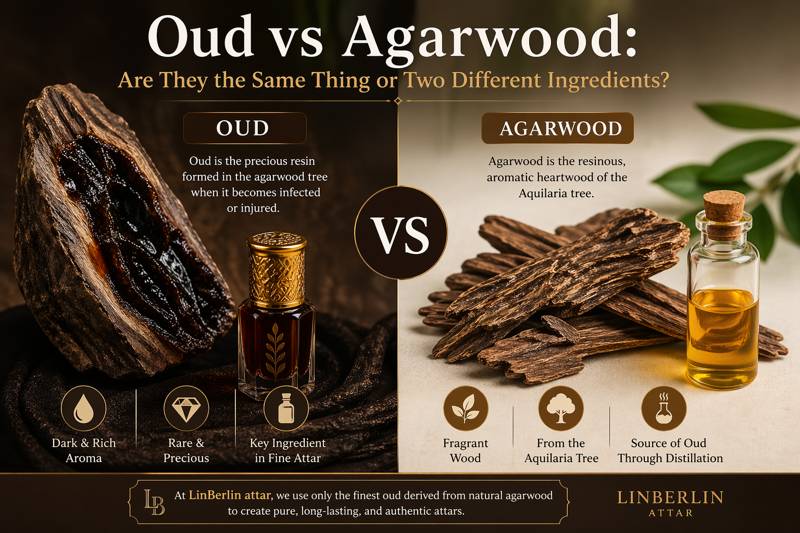
Here’s the thing—agarwood is not a perfume ingredient by default. It’s a raw material. A tree, technically. Specifically, it comes from Aquilaria trees found in parts of Southeast Asia.
But not every tree produces agarwood. In fact, most don’t. The magic only happens when the tree gets infected by a particular type of mold. Sounds strange, I know—but in response, the tree produces a dark, resinous substance to protect itself. That resin is what we call agarwood.
In my experience, raw agarwood has a very grounding presence. If you ever get to smell the wood chips themselves, it’s less “perfumey” and more earthy, almost meditative. Slightly bitter at first, then warm as it settles.
And because this process is rare and unpredictable, high-quality agarwood is incredibly valuable. That’s why genuine products—especially natural attar—aren’t cheap. There’s no shortcut to producing real agarwood.
So Then… What Exactly Is Oud?
This is where things start to overlap—and confuse people.
Oud is essentially the oil extracted from agarwood. That’s it. Not a different material, not a separate plant—just a different form of the same thing.
Think of it this way. Agarwood is the source. Oud is the distilled essence.
When agarwood is processed—usually through traditional distillation methods—it produces a thick, aromatic oil. That oil is what the fragrance world calls oud. And yes, this is the same oud used in high-end perfumes, traditional attar blends, and pure attar oil formulations.
But here’s where it gets tricky. The word “oud” has been heavily commercialized. I’ve seen products labeled as oud that barely contain any real agarwood-derived oil. Sometimes it’s synthetic, sometimes it’s just a woody accord.
So while all real oud comes from agarwood, not everything labeled oud is actually authentic. That distinction matters more than most people realize.
Oud vs Agarwood: The Real Difference (Finally Simplified)
If we strip away all the confusion, the difference becomes pretty straightforward.
Agarwood is the raw, resin-infused wood formed inside infected trees. Oud is the oil extracted from that wood.
But the experience of each can feel different.
When you smell agarwood in its raw form—like chips burned gently—it feels raw, almost primal. There’s texture to it. You can sense the wood, the resin, the layers evolving slowly.
Oud oil, on the other hand, is more concentrated and refined. It spreads on the skin, changes over time, and interacts with your body chemistry. In a good natural attar, oud becomes smoother, deeper, sometimes even slightly sweet depending on the origin.
And honestly, this is why many enthusiasts fall in love with pure attar oil. It captures that depth in a wearable form.
Still wondering which one is “better”? That’s like asking whether coffee beans are better than brewed coffee. Different forms, different experiences.
How Oud Shows Up in Attar (And Why It Feels Different)
Now this is where things get really interesting—especially if you’ve explored LinBerlin attar or similar premium blends.
In traditional attar making, oud is rarely used alone. It’s blended with other natural ingredients—florals, herbs, spices—to create something more balanced and wearable.
I’ve noticed that when oud is blended into attar, it acts almost like a backbone. It anchors the fragrance. Without it, many blends would feel too light or disappear too quickly.
But not all oud-based attars are equal. Some lean heavily into the smoky, animalic side. Others soften it with rose or sandalwood, making it more approachable.
And here’s a small but important detail—real oud-based attar evolves slowly. If a fragrance smells exactly the same after hours, chances are it’s not built on authentic agarwood oil.
Common Mistakes People Make When Buying Oud or Agarwood
Let me be honest—this is where most people get misled.
One big mistake is assuming that a higher price always means real oud. It often does, but not always. Branding can inflate prices just as easily as quality can.
Another mistake? Trusting the word “oud” on the label without asking questions. I’ve seen products marketed as “oud attar” that contain zero natural agarwood. It’s all synthetic composition.
Also, many people expect oud to smell universally pleasant right away. That’s not how it works. Real oud can be intense, even challenging at first. It grows on you. Slowly.
And finally—ignoring the source. Cambodian oud smells different from Indian oud. Even within the same region, variations exist. That’s part of the beauty, but also part of the confusion.
Final Thoughts: What You Should Actually Take Away
So, are oud and agarwood the same thing? Not exactly—but they’re deeply connected. One is the source, the other is the refined expression of it.
If you’re exploring attar seriously, understanding this difference changes how you shop, how you smell, and even how you appreciate fragrances. It’s not just about picking a scent anymore—it becomes about understanding the story behind it.
If you’re just starting out, try a small amount of a well-crafted natural attar that uses real oud. Wear it a few times. Let it evolve. That’s when it really starts to make sense.
And once you get it—you really get it—there’s no going back to synthetic shortcuts.