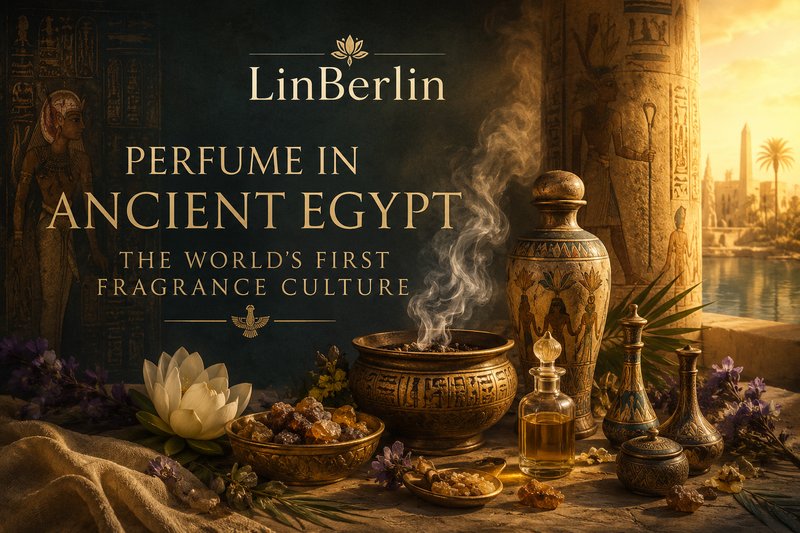
Explore perfume in ancient Egypt through temples, trade, ritual, and daily life — a deeply human story behind the world's first fragrance culture. Perfume in ancient Egypt: the world's first fragrance culture
Long before glass perfume bottles lined shop shelves, cones of scented fat softened slowly under the heat of Egyptian banquets, releasing waves of myrrh and cinnamon into crowded rooms beside the Nile. Temple priests rubbed fragrant oils onto statues at dawn. Workers carried aromatic resins across desert routes from Punt. Even funerary chambers held traces of scent meant to accompany the dead into eternity. Perfume in ancient Egypt wasn't decorative in the modern sense. It sat inside religion, medicine, diplomacy, trade, and ordinary daily life all at once.
What survives today are fragments: residue in alabaster jars, scenes painted onto tomb walls, and Greek writings describing Egyptian perfumers with near disbelief. But those fragments still reveal something remarkable. Ancient Egypt may well have shaped the first large-scale fragrance culture the world had ever seen.
The historical roots
Along the Nile Valley, scent became organised knowledge surprisingly early — not merely personal grooming but an entire economic and religious system tied to agriculture, trade, and temple authority. By the time of the Old Kingdom around 2600 BCE, fragrant oils and incense already appeared in burial sites and ceremonial records. Archaeologists have uncovered perfume vessels in tombs belonging to elite Egyptians, while inscriptions mention scented unguents prepared for rituals and royal households.
The Egyptians didn't invent fragrance from nothing, of course. Resin burning existed in older cultures across Mesopotamia and the Arabian Peninsula. But Egypt transformed perfume into something more structured and culturally central (especially inside temple life). That's an important distinction.
One of the most famous aromatic substances was kyphi, a complex temple incense prepared from ingredients such as wine, raisins, honey, myrrh, juniper, cinnamon, and sweet rush. Recipes changed across centuries and regions, which makes modern reconstruction difficult. Some surviving descriptions come from later Greek writers like Plutarch rather than directly from Egyptian texts, so historians still debate the exact formulas.
And then there was Punt.
Egyptian expeditions to the Land of Punt, likely located near parts of present-day Eritrea, Somalia, or coastal Sudan, brought back myrrh trees, frankincense, ebony, and aromatic gums. Queen Hatshepsut's famous expedition in the 15th century BCE wasn't just political theatre. Relief carvings at Deir el-Bahri show incense trees being transported alive back to Egypt, which tells you how valuable these materials had become.
Trade routes stretched outward through the Red Sea, Nubia, the Levant, and Mediterranean ports. Scent moved with empire. So did technical knowledge about extraction, blending, and preservation. Egyptian perfumers worked with oils from moringa and balanos trees because these stayed stable in heat longer than animal fats alone. They infused petals, woods, herbs, and resins slowly rather than distilling alcohol-based perfume in the modern sense. Distillation would emerge much later in the Islamic Golden Age.
And honestly, the truth is many people today underestimate how sophisticated these formulations were. Ancient perfume wasn't primitive perfume. It was simply built on different materials and different ideas about what fragrance should do.
The cultural significance
Inside ancient Egyptian life, fragrance carried spiritual meaning before it carried status. Temple rituals depended heavily on scent because pleasant aroma was associated with divine presence and purity. Priests burned incense multiple times a day while washing, dressing, and anointing sacred statues hidden inside temple sanctuaries. These weren't symbolic gestures alone. Egyptians believed the gods could literally inhabit these spaces through ritual care.
Myrrh smoke drifting through temple halls mattered because smell itself mattered.
Perfume also marked social identity, though not always in the exaggerated way modern films portray. Wealthier Egyptians certainly had greater access to imported resins and costly oils, but scented products weren't reserved only for royalty. Workers, musicians, craftspeople, and servants appear in artwork wearing perfumed cones during feasts and celebrations. Some scholars think these cones were partly symbolic in paintings, while others argue they represented real wax-based aromatic mixtures worn on wigs or heads during gatherings. The debate isn't fully settled.
But daily cleanliness was genuinely important in Egypt's hot climate, and scent became tied to ideas of civility, attractiveness, and health. Oils protected skin from dryness and sun exposure. Herbal preparations masked unpleasant odours in crowded cities. Certain resins were valued medicinally as well — frankincense and myrrh appeared in healing practices alongside religious use.
What did ordinary perfume actually smell like back then? That's usually the first question readers ask.
The answer is complicated because ancient Egyptian fragrance profiles were heavier, resinous, and oil-rich compared to many modern Western perfumes. Floral notes existed, particularly blue lotus and lily, but resins, woods, spices, and balsamic sweetness dominated elite blends. Think warm honeyed smoke rather than airy freshness.
And scent crossed into death rituals too. Mummification involved aromatic substances not only for preservation but also for sanctity. Cedar oil, resins, beeswax, and incense became part of preparing the body for the afterlife. Tombs held perfume vessels because fragrance accompanied the soul beyond earthly existence. That's a very different emotional framework from contemporary perfume marketing.
Here's the thing: ancient Egyptian fragrance culture wasn't obsessed with individual self-expression the way modern perfume advertising often is. Much of it centred on harmony between body, ritual, environment, and cosmos. Personal beauty existed within collective religious life rather than outside it.
How this tradition lives today
Egypt's ancient perfume traditions never survived in a perfectly unbroken line, and it's better to acknowledge that clearly than pretend modern fragrance practices are identical to those of pharaonic temples. Cultures evolve. Trade shifts. Religions change. Languages disappear. Still, important threads remained alive across the Middle East, North Africa, and South Asia through incense traditions, oil perfumery, herbal medicine, and ceremonial scent use.
Modern Egyptian markets still sell jasmine oil, lotus-inspired blends, myrrh, and incense mixtures to locals and visitors alike. Some contemporary perfumers attempt reconstructions of kyphi using surviving textual references, though no one can claim absolute historical accuracy. Or perhaps accuracy isn't really the point. The persistence of resinous perfumery itself tells its own story.
And oil-based fragrance traditions continue strongly across Arab and South Asian cultures, where attars, bakhoor, oud oils, rose distillations, and incense rituals remain part of family life, hospitality, weddings, and prayer spaces. The materials have shifted over centuries, but the underlying respect for scent as atmosphere rather than mere accessory still feels deeply connected to older traditions.
You can even see echoes of ancient Egypt in modern niche perfumery — smoky accords, amber resins, labdanum, incense blends, and dense balsamic structures keep returning because people continue responding emotionally to these ancient aromatic textures.
LinBerlin's connection to this tradition
LinBerlin approaches fragrance from the belief that scent has cultural memory attached to it, not just commercial value. That perspective naturally overlaps with older perfume traditions shaped by oils, resins, botanicals, and patient blending methods rather than quick synthetic intensity.
Many modern perfume brands borrow Egyptian imagery without understanding the deeper history behind it. LinBerlin tries to take a quieter route instead — focusing on authentic raw materials, oil-based fragrance traditions, and the slower sensory experience that natural attars offer. There's respect in that restraint.
And while no contemporary brand can recreate ancient Egyptian perfumery exactly, working with ingredients such as myrrh, frankincense, floral absolutes, and warm spice accords keeps part of that historical language alive in a modern form. Not as nostalgia, but as continuity.
Closing
Somewhere inside museum jars and temple ruins, faint traces of ancient aroma still survive after thousands of years. That fact alone says something powerful about how deeply humans have always connected scent with memory, identity, and belief.
Perfume in ancient Egypt wasn't a side detail of civilisation. It helped shape how people prayed, celebrated, healed, mourned, and understood beauty itself. And the next time a resinous attar or smoky incense oil lingers on your skin, it may be worth pausing for a moment to recognise how old that sensory language truly is.