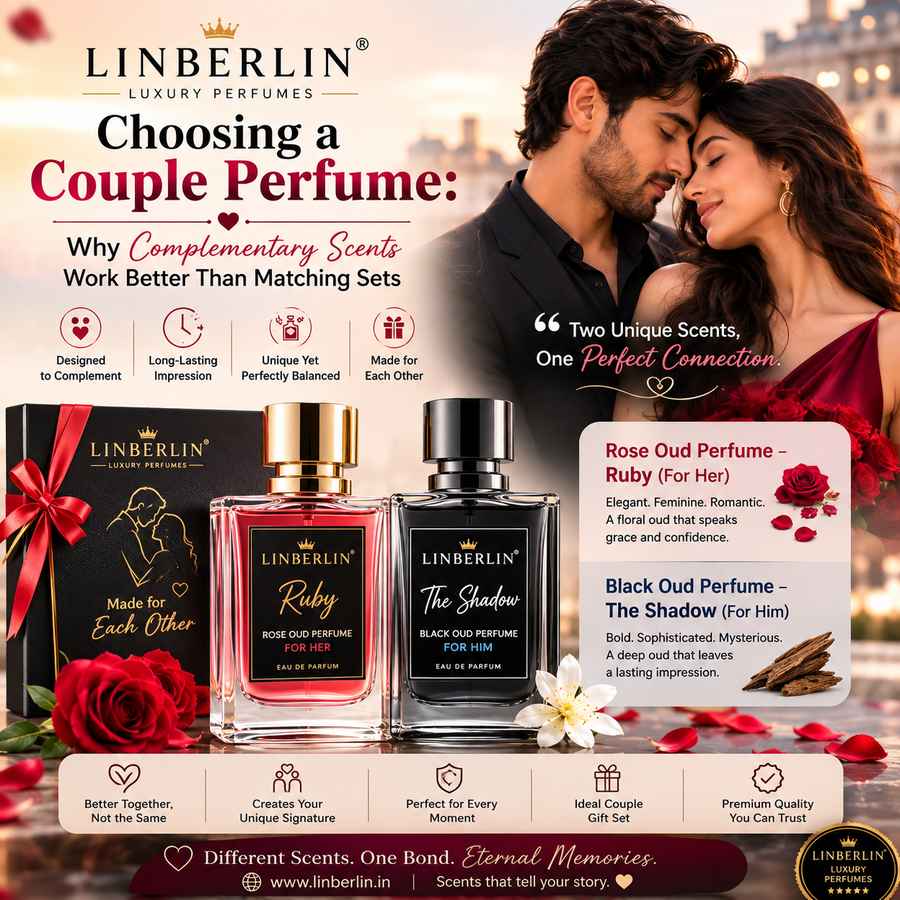
A lot of people buying fragrance for two assume the goal is finding one bottle that works on both of them. It almost never does. Skin chemistry alone makes that unlikely — the same rose or oud can smell noticeably different on two different people, warmer on one, sharper on the other — and beyond that, most couples simply don't want to smell identical. What actually works, more often than not, is two fragrances that share something in common without being the same thing twice.
Why "Matching" Isn't the Same as "Complementary"
Matching perfume sets — a "his" and "hers" version of one scent, usually just the same base with slightly different sweetness or strength — are easy to market but harder to actually enjoy long-term. They tend to smell like a compromise rather than a pairing, because the formula gets pulled in two directions to fit two different preferences at once.
Complementary pairing does something different. It keeps two distinct fragrances intact, each fully expressing its own character, but connects them through one shared note or family — oud, rose, amber, whatever the anchor happens to be. Standing close to someone wearing the paired scent, you notice the connection without either fragrance losing its individuality. That's a much harder thing to fake with a single blended formula, and it's part of why couple perfume as a category has moved away from single-bottle matching sets toward paired combos over the last few years.
What Actually Makes Two Fragrances Work as a Pair
Not every two-bottle combination reads as a pairing, and it's worth understanding why. A shared base note does most of the work. If one fragrance is oud-based and the other is a completely unrelated aquatic or citrus scent, there's no real connection between them — they just happen to be sold together. But when both fragrances build on the same foundational note in different directions, the pairing actually holds together when the two people are near each other, even though each scent is fully wearable on its own.
Contrast matters just as much as connection, though. Two florals paired together, or two woody scents with nothing to differentiate them, tend to blur into each other rather than feel like a considered pairing. The stronger combinations usually put a lighter, brighter scent against a deeper, warmer one — rose against black oud, citrus against amber, that kind of structure — so each half has its own clear identity even while sharing DNA with the other.
Choosing Between an Attar-Based Combo and a Spray Perfume Combo
This is a decision a lot of first-time buyers don't realise they're making. Attar-based couple sets, oil-based rather than alcohol-based, tend to sit closer to the skin and fabric, developing more slowly over the day rather than announcing themselves immediately the way alcohol-based sprays do. They also generally last longer on fabric than skin, which changes how you'd apply them — a small dab on clothing rather than a spray on the wrist.
Spray perfumes project faster and fade faster, which suits people who like an immediate, noticeable scent but don't mind reapplying through the day. Neither format is objectively better; it comes down to how the two people wearing it actually want the scent to behave — quick and expressive, or slower and closer to the skin.
A Few Things Worth Checking Before Buying a Couple Set
- Whether the two scents in the set genuinely share a connecting note, or whether they've just been bundled together for the packaging — the product description or notes list usually makes this clear if you read past the marketing copy.
- How each half performs on its own, not just as a set — a fragrance you'd never wear individually isn't suddenly better because it's paired with something else.
- Whether the format (attar or spray) actually suits both people's daily routine, since a fragrance that needs reapplying every few hours works differently for someone at a desk all day versus someone constantly moving between places.
Honestly, the safest way to judge a couple perfume before committing is to try each half separately first, if that's an option, rather than assuming the paired concept alone guarantees you'll both like wearing it.
An Example of How This Plays Out in Practice
LinBerlin's Ruby & Shadow romantic perfume combo is a fairly clear example of the complementary approach rather than the matching one — a rose oud built for her against a black oud built for him, both sharing oud as the connecting thread but developing in noticeably different directions from there. It's the kind of pairing where each bottle is meant to be worn and enjoyed on its own, with the shared oud base being what ties the two together when worn by two people close to each other, rather than the two scents being designed to blend on one person's skin.
Not every couple wants that kind of shared-but-distinct approach, and that's a fair preference to have. Some people would rather each choose something entirely their own, with no attempt at connection at all — there's nothing wrong with that either, and it depends more on personal taste than any fixed rule about how couple fragrance is "supposed" to work.
Buying fragrance for two people, at its core, is less about finding a single scent that fits both and more about finding two scents that respect each person's own preference while still telling a shared story when worn together — which is really the whole point of a couple perfume in the first place.