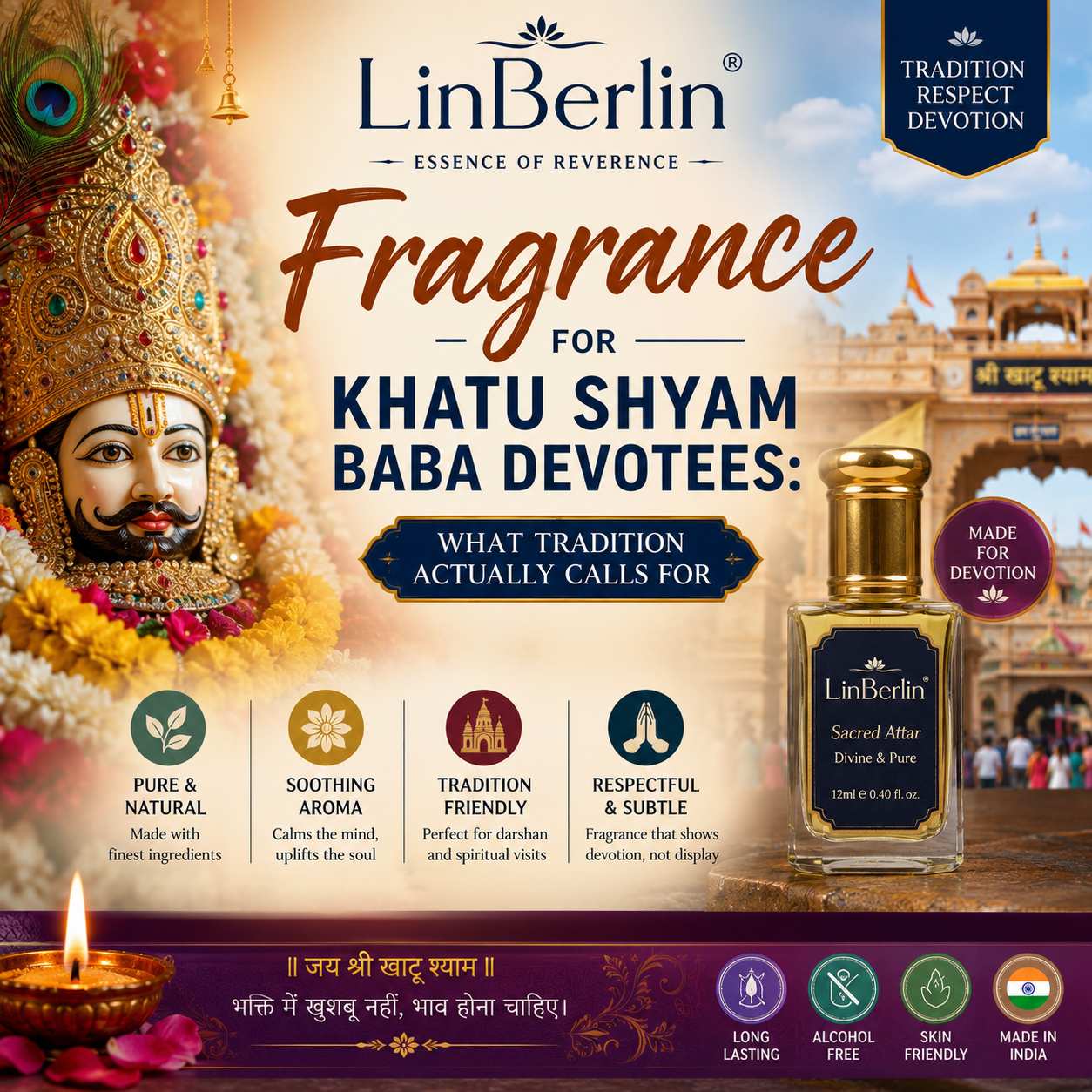
Walk into any Khatu Shyam mandir on a Tuesday evening and you'll notice it before you see it — a thickness in the air, something between smoke and sweetness, that arrives a full ten seconds before the aarti bell does. Ask a hundred devotees what fragrance means to their bhakti and you'll get a hundred slightly different answers. But almost none of them will say "optional." That's the part outsiders miss. For Shyam Baba devotees, fragrance isn't decoration around the worship. It's part of the offering itself, standing alongside the flowers, the bhog, the flame.
Why Fragrance Carries Weight in Khatu Shyam Bhakti
Barbarik — the figure who became Khatu Shyam Baba after Krishna blessed him for his unmatched devotion and sacrifice — occupies a place in Hindu tradition that's equal parts warrior and saint. Devotees don't just petition him for favours; they build a relationship with him, one that's sustained through daily seva, not occasional visits. And in that daily relationship, fragrance functions almost like a form of speech. It's how a devotee says, without words, that this moment of worship has been prepared for, not rushed through. There's also a practical layer to this that often gets overlooked. Temple spaces, home mandirs, community gatherings during Phalgun Mela — these are collective spaces, and scent travels through them the way sound does. A well-chosen attar doesn't just honour Baba; it shapes the atmosphere for everyone standing nearby.
What Traditional Practice Actually Calls For
Here's the thing — traditional practice around Khatu Shyam worship has never demanded expensive or elaborate fragrance. What it asks for is sincerity, and a fragrance profile that matches the character devotees associate with Baba: strength without harshness, sweetness without excess, something that feels regal but not showy. This is roughly where attars made from natural ingredients — rose, saffron threads, agarwood, musk bases — earn their place over synthetic alcohol sprays. Not because the tradition explicitly bans spray perfumes (it doesn't), but because oil-based attars have historically been the format used in temple and home worship across North India, largely because they don't carry alcohol, which many devotees avoid using anywhere near the deity or the diya flame. Families who've maintained a Shyam Baba mandir at home for generations often describe the same ritual with small personal variations — a dab of attar on the idol's garland, or on a cotton wick before it's lit, or simply worn by the devotee themselves before they begin their prayers. None of these is more "correct" than another. What matters is consistency and intention.
Choosing a Fragrance That Fits the Occasion
Not every attar suits every moment of Shyam Baba seva, and this is where a lot of newer devotees get a little lost. A fragrance meant for daily morning puja tends to sit lighter — something that won't overwhelm a small room used repeatedly through the week. But for larger occasions — Baba's Mela, Ekadashi, or a special Tuesday — devotees often reach for something with more depth and presence. This is where a blend like Shahi Darbar attar for Shyam Baba tends to come up in conversation among devotees who've tried several options over the years. The name itself gestures at what it's built for — a "royal court" fragrance, weighted enough to feel appropriate for a deity often depicted with regal, warrior symbolism, but composed carefully enough not to tip into something overpowering in a small home shrine. If you're newer to this and unsure where to even begin, it helps to read through how other devotees have approached the question of a devotional fragrance offering that feels genuinely sacred rather than performative. There's a difference, and most long-time devotees can tell within seconds which one they're smelling.
Mistakes Devotees Sometimes Make Without Realising
A few patterns show up often enough among newer devotees that they're worth naming plainly. Over-application is probably the most common one. More attar doesn't mean more devotion — it usually just means a room that becomes hard to breathe in after twenty minutes, which defeats the purpose entirely. A drop or two, applied with care, does more than a heavy-handed pour ever will. Switching fragrances too often is another. Some devotees, in their enthusiasm, rotate through different attars weekly, chasing whatever's new. But there's something to be said for consistency — Baba's presence in a home shrine becomes associated, over months and years, with a particular scent signature. That association is part of what makes the ritual feel grounded rather than random. And then there's the opposite mistake: using a fragrance chosen purely for cost, without any thought to whether it's synthetic or natural. Synthetic alcohol-based sprays, while inexpensive, tend to carry chemical undertones that shift and sour over hours — not ideal for a space meant to hold stillness and devotion for extended periods.
How This Connects to Broader Krishna Devotion
Khatu Shyam worship doesn't exist in isolation from wider Krishna bhakti traditions, and this shows up clearly in fragrance choices too. Many households that maintain a Shyam Baba mandir also perform seva for Laddu Gopal Ji, and the fragrance vocabulary between the two often overlaps — sweet, floral-forward notes for Gopal Ji's more playful, childlike form, layered against the deeper, more resinous notes reserved for Baba's warrior aspect. Reading about how devotees approach Laddu Gopal Ji's shringar and daily attar seva actually clarifies quite a bit about Shyam Baba worship too, since both traditions share a similar underlying philosophy about scent as an act of care rather than mere ritual requirement.
A Note of Honesty Here
It would be dishonest to claim there's one single, universally agreed-upon "correct" fragrance for Khatu Shyam Baba worship. There isn't. Practices genuinely vary by region, by family lineage, by which sampradaya or local tradition a devotee follows. What's offered in a Rajasthan household might differ slightly from what's used in a Delhi or Mumbai mandir, even though the underlying devotion is identical. So take fragrance guidance — including this article — as a starting framework, not a rulebook carved in stone.
Fragrance Beyond the Mandir
Interestingly, many devotees carry this same instinct — that scent should feel intentional rather than accidental — into how they present themselves outside worship too. Someone who's particular about the attar on their home shrine often ends up equally particular about what they wear day to day, gravitating toward the same principle of restraint over excess. For readers curious about extending that mindset into daily life, it's worth exploring how a quieter, more grounded fragrance identity can carry that same sense of intention into an office or an everyday setting.
Where to Start If You're New to This
If you're just beginning your own Shyam Baba seva and feel uncertain about fragrance, the simplest path is this: pick one natural attar, use it consistently for a season, and pay attention to how the space feels over time rather than judging the very first application. Devotion built through fragrance, like most things in this tradition, reveals itself slowly — through repetition, not through the first impression.