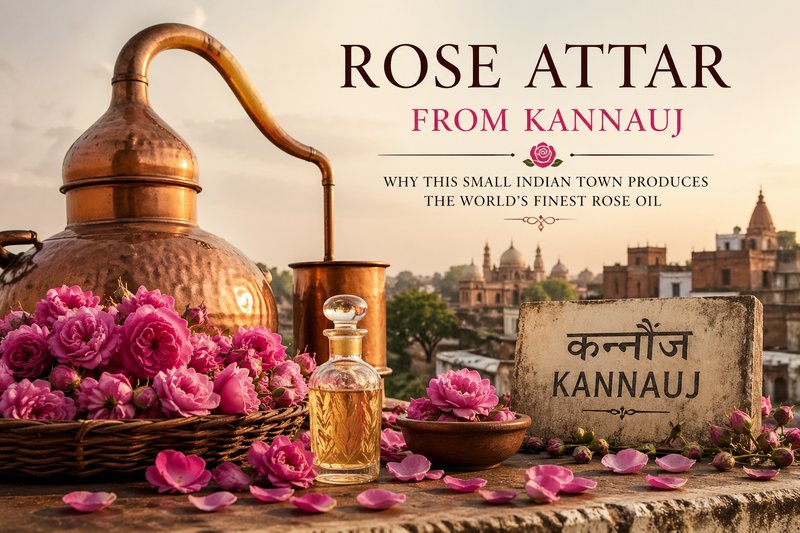
At sunrise in Kannauj, the air carries a sweetness that feels almost visible, as if the fields themselves are exhaling slowly after the cool of night. The scent isn’t sharp like fresh-cut roses from a florist. It’s softer, deeper, touched by earth and copper and the faint dampness of clay. This is where rose attar from Kannauj begins—not in a lab, not in a factory, but in a place where scent still follows the rhythm of the sun.
Spend a little time understanding how this oil is made, and you start to notice something most people miss: this isn’t just a fragrance material. It’s a living tradition shaped by climate, craft, and patience. By the end, you’ll recognise why Kannauj’s rose attar doesn’t just smell different—it behaves differently on skin, in time, and in memory.
The origin and history
Kannauji perfumers rarely talk about “history” as a distant thing. For them, it’s something they inherited—methods passed down quietly, often within families, with little written record. And yet, the roots of this craft stretch back to the Mughal era, when emperors developed a fascination with capturing the scent of flowers in oil rather than alcohol.
It’s said that the earliest rose distillation in this region was refined under royal patronage, where experimentation with copper stills and sandalwood oil led to what we now call attar. But the real story isn’t just royal curiosity; it’s continuity. The same deg-bhapka system—those bulbous copper vessels connected by bamboo pipes—still defines production today.
But here’s where Kannauj becomes unique—its geography and water chemistry play a role that’s often underestimated. The soil composition, the mineral profile of local water, even the seasonal humidity influence how the roses release their aroma during distillation (and experienced distillers adjust their fire intensity accordingly).
And while many regions grow roses, Kannauj became the centre not because of scale, but because of refinement. The town evolved into a network of small distilleries, each holding subtle variations of technique. Over generations, this created a collective expertise that’s difficult to replicate elsewhere.
What makes it distinctive
Fresh Kannauj rose attar doesn’t open with a blast of sweetness. It unfolds slowly, almost reluctantly, revealing layers that feel more like texture than scent.
There’s a green facet at first—slightly herbal, almost like crushed stems. Then comes a warm, honeyed rose heart, but without the sugary heaviness you might expect. And underneath, always, a grounding softness from sandalwood, which acts not just as a base but as a living carrier of the rose itself.
So what actually creates this complexity? It starts with the flowers. The Damask rose used here is harvested before full bloom, when its aromatic compounds are most concentrated. Timing matters down to the hour. Delay the harvest, and the oil loses nuance.
The distillation method adds another layer. In the deg-bhapka system, steam passes through the rose petals and carries volatile compounds into a receiver filled with sandalwood oil. But this isn’t a single pass. It’s repeated distillation over multiple cycles, allowing the oil to gradually absorb the full character of the rose.
And the truth is, not every batch reaches the same depth. Small changes—temperature fluctuations, flower quality, even how tightly the lid is sealed—can shift the final scent. That variability isn’t a flaw; it’s part of what makes natural attar feel alive.
(There’s also an ongoing debate among experts about how much of the final profile comes from the rose itself versus the sandalwood interaction, and the answer isn’t entirely settled.)
How to recognise, appreciate, or choose
Most people encounter “rose attar” through diluted or synthetic interpretations, so the first experience with authentic Kannauj attar can be surprising. It won’t smell like a rose garden in full bloom. It will smell quieter, denser, more grounded.
So how do you tell if what you’re smelling is genuine?
Start with the opening. A natural attar will feel integrated from the first moment. There’s no sharp alcohol lift, no abrupt sweetness. Instead, it settles onto the skin almost immediately, as if it belongs there.
Then watch how it evolves. Over an hour, the scent should deepen rather than fade into flatness. The rose becomes warmer, slightly spiced, sometimes even hinting at dried petals. If it stays linear, chances are it’s been simplified or blended with synthetics.
And pay attention to texture. Real attar has a tactile quality—it feels smooth, almost creamy in how it moves through its phases. Synthetic versions often feel hollow by comparison.
Here’s the thing: price alone isn’t a reliable indicator. Some authentic attars are surprisingly accessible, while some expensive ones are heavily adulterated. Trust your nose, but also your patience.
Or ask yourself this: does the scent change in a way that keeps you curious? If it does, you’re likely dealing with something genuine.
LinBerlin’s approach to this
Working with Kannauj isn’t about simply sourcing an ingredient. It’s about choosing the right distiller, the right batch, and sometimes even the right season.
At LinBerlin, selection starts at origin—evaluating not just the final oil but the process behind it. Small-batch distillations are preferred, where control and attention remain human rather than industrial. And sandalwood quality is treated as equally important as the rose itself, because the final attar is always a dialogue between the two.
But consistency still matters. So batches are assessed for balance, depth, and how they behave over time on fabric as well as skin (since natural oils interact differently depending on surface).
Closing
Some fragrances announce themselves loudly and disappear just as quickly. Kannauj’s rose attar does the opposite. It lingers quietly, revealing more the longer you stay with it.
If you ever come across a true sample, give it time. Let it sit, let it warm, let it change. That’s where its real character lives—and once you notice it, it’s difficult to go back to anything simpler.