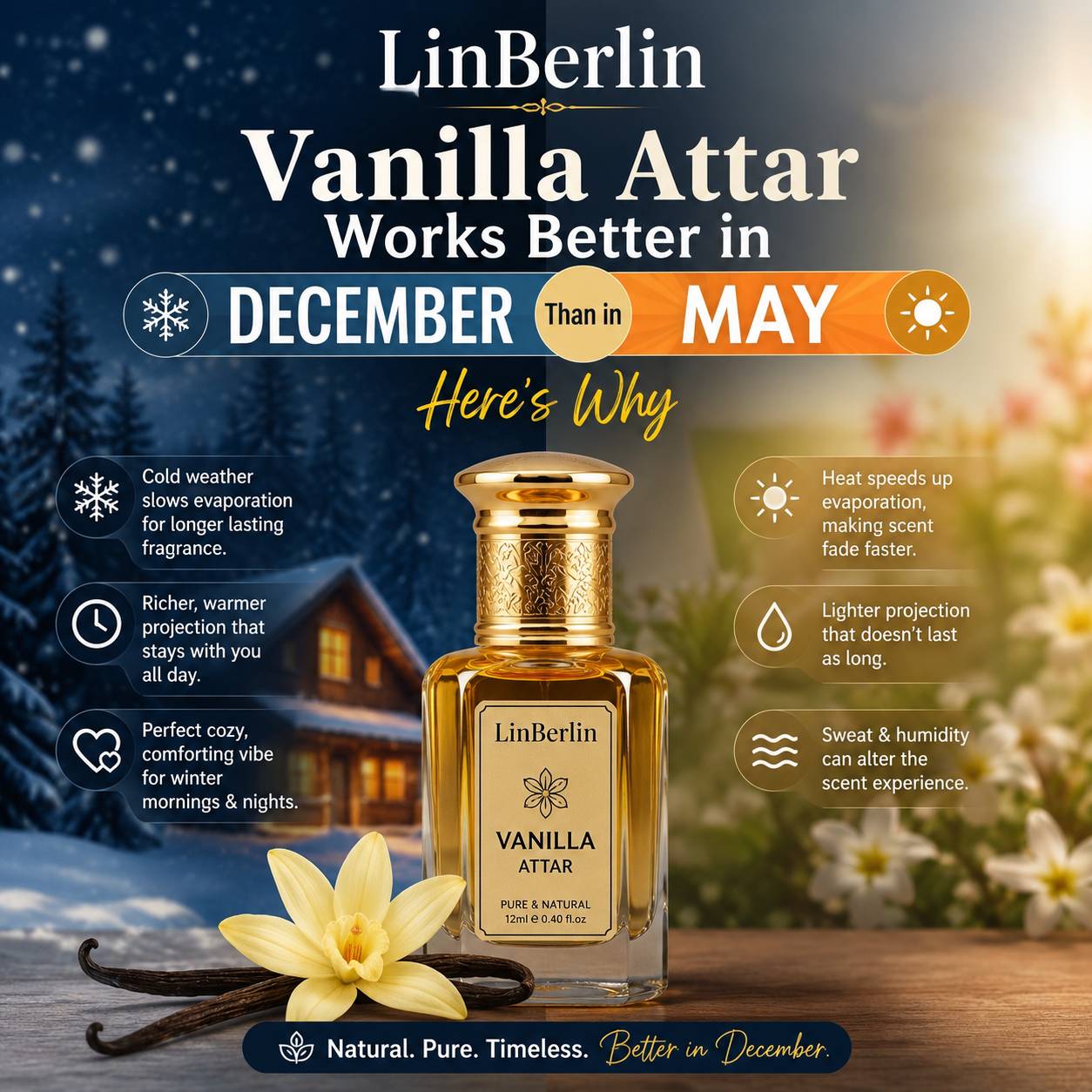
My grandmother kept two bottles of the same vanilla oil on her dressing table — one she used from October through February, and one she never touched until spring found its way back. I used to think this was just a ritual, the kind older women keep for no particular reason. It wasn't. She'd figured out, decades before anyone wrote a skincare article about it, that vanilla behaves like an entirely different material depending on what season your skin is living in.
That's really what this guide is about. Not "is vanilla attar good" — of course it is — but why the same oil that felt syrupy and cloying in May can feel like the most natural thing in the world once December sets in. The answer lives less in the fragrance itself and more in your skin, your moisturiser, and the air around you.
Why cold skin holds scent differently than warm skin
Warm skin releases fragrance fast. In summer, higher skin temperature and increased blood flow to the surface push volatile molecules off faster — that's why a light citrus or aquatic attar can feel perfectly proportioned in July but has usually vanished by lunch. Vanilla's heavier, sweeter molecules behave the opposite way in heat. They amplify. Warm, humid skin makes vanilla's natural sugariness sit heavier in the air around you, and on a hot day that can tip from comforting into overwhelming fairly quickly.
December skin is a different surface altogether. Cooler temperatures slow the rate at which fragrance molecules evaporate, and drier winter air actually helps hold the scent closer to the skin instead of pushing it outward in a cloud. The result — and this took me a while to actually notice, not just read about — is that vanilla in winter smells rounder. Softer. Less like a dessert and more like warmth itself.
The moisture factor nobody mentions
Here's the thing most buying guides skip entirely: fragrance doesn't cling to dry skin the way people assume it does. It actually needs a bit of lipid, a bit of moisture, to hold onto. Dry, flaky skin has micro-gaps in the barrier that let fragrance molecules escape faster and unevenly, which is part of why winter attar application often disappoints people who skip moisturiser first. A well-hydrated arm or wrist gives vanilla oil something to bind to, and that's the difference between a scent that fades in ninety minutes and one that's still there at dinner.
So the real trick for December wear isn't really about the attar at all. It's about what's underneath it. Apply a light, fragrance-free moisturiser or a barrier cream first, let it settle for a minute or two, then apply the attar to the same points — inner wrists, behind the ears, the base of the throat. Skip this step and even the richest vanilla oil will thin out faster than it should, especially if your skin runs naturally dry in colder months (and most skin does).
Skin type actually changes how vanilla wears
Dry skin tends to need vanilla the most and holds it the least without help — the barrier just isn't retaining oils well, so layering under a humectant-rich moisturiser matters more here than for any other skin type. Oily and combination skin, by contrast, often projects vanilla for longer without much effort at all, since the skin's own sebum acts as a natural fixative; the trade-off is that oily skin can sometimes push the scent's sweetness forward more aggressively than intended, so a lighter hand at application helps.
Sensitive or reactive skin is its own conversation, and a more serious one. Vanilla attar, like most naturally derived aromatic oils, contains trace aromatic compounds that can trigger irritation in skin that's already compromised — think eczema flare-ups, recently exfoliated skin, or areas treated with retinoids or acids. If you're using retinol, tretinoin, or AHA/BHA exfoliants as part of an evening routine, apply attar well away from those active zones, or better yet, wear it on clothing or hair instead of directly on treated skin. This isn't a small caveat. Skin barrier damage from actives combined with essential-oil-based fragrances is one of the more common causes of unexpected irritation people bring up after the fact, and it's avoidable with just a bit of spacing.
Pregnancy is another point worth being honest about. Most natural attars, vanilla included, are generally considered low-risk for topical use, but there isn't strong consensus across dermatology sources, and some people experience heightened scent sensitivity or skin reactivity during pregnancy regardless of the ingredient. If you're pregnant or nursing, it's worth a quick conversation with your doctor before making any fragrance a daily habit — not because vanilla attar is particularly risky, but because caution costs nothing here.
What changes about the scent itself in cold weather
Beyond how your skin holds it, vanilla's actual character shifts with temperature. In heat, its sugar-forward top notes dominate — it can read almost like warm caramel from a distance. But as temperatures drop, the deeper resinous undertones in a well-made vanilla attar start to come forward: something closer to dried tonka, aged wood, a whisper of something almost smoky. This is the layer that gets buried in summer heat and finally gets room to breathe once the air cools.
That's not incidental — it's actually the whole appeal of building a genuine vanilla attar rather than a synthetic vanillin spray. Vanoor was built around exactly this seasonal duality, blending real vanilla resin notes with a base that doesn't collapse into one-dimensional sweetness the moment temperatures rise or fall. A lot of commercial vanilla perfumes are essentially one note stretched thin; a proper attar has structure underneath the sweetness, and that structure is what December weather reveals.
Layering vanilla attar without overdoing it
One mistake I see constantly, especially from people newer to attar, is applying the same amount in December as they would in May. Because the scent throws less in cold air, there's a temptation to apply more — two dabs becomes four, four becomes six. This usually backfires within an hour, once body heat and indoor central heating catch up and the fragrance blooms unexpectedly strong in a warm room.
A better approach: apply a small amount to two or three pulse points after moisturising, wait ten minutes, then assess. Cold outdoor air will read the scent as fainter than it actually is. Vanilla attar rewards patience more than most fragrance categories — it takes time to fully open on skin, sometimes twenty to thirty minutes, and the version you smell at application is rarely the version that settles in an hour.
And if you're wearing it to layer with other notes, December is a genuinely good season for that. Vanilla's warmth pairs beautifully with rose in cooler weather, where the way vanilla and rose settle together in cold air reads completely differently than it does in summer humidity — softer, less floral-forward, more skin-like. Lavender is another strong winter partner; pairing lavender's herbal calm against vanilla's warmth tends to feel purpose-built for short winter days and long evenings indoors.
A quick word on longevity expectations
Realistically, no attar — natural or otherwise — lasts identically on every person. Skin pH, hydration, diet, even medication can shift how long a fragrance stays detectable. What's true across most wearers is that our vanilla attar performs better on moisturised skin in cooler months than in the peak of summer, simply because it's not competing against as much surface oil, sweat, and heat-driven evaporation. If you've tried a vanilla attar before and felt it faded too fast, it might genuinely be worth a second try once the weather turns, rather than assuming the oil itself was the problem.
Common mistakes worth avoiding
Applying attar directly after a hot shower, before skin has cooled — this can cause the scent to blow out too fast and read differently than intended, since pores are still open and blood flow is still elevated. Skipping moisturiser entirely in winter and expecting the same wear time as a well-hydrated day. And rubbing wrists together after application, which a surprising number of people still do out of habit — it breaks down the top notes through friction and heat, actually shortening how long the fragrance lasts rather than helping it spread.
Where this leaves you
If there's one takeaway worth carrying into cold weather, it's that vanilla attar isn't a static product — it's an ingredient that responds to what your body and the air around it are doing. Moisturised skin, a lighter application than you'd use in summer, and a bit of patience while it opens will get you closer to what a well-made vanilla oil is actually capable of. December doesn't just tolerate vanilla attar better than May does. It's arguably the season the fragrance was built for.