A woman once told me she'd stopped wearing her favourite perfume entirely — not because she'd fallen out of love with it, but because her skin had. Same bottle, same formula, same spritz on the wrist she'd used for six years. And somewhere along the way, between a new skincare routine and a couple of birthdays, it had started smelling faintly sour on her within the hour. That's not a perfume going bad. That's skin changing, and fragrance format mattering a lot more than most of us give it credit for.
This is really the question underneath "spray or oil" — it's not about which one is more luxurious or which one photographs better on a dressing table. It's about which format your particular skin, your particular routine, and your particular life actually works with. And the honest answer is that most women have never been told this properly, so they end up loyal to a format purely out of habit rather than fit.
What's actually different between the two
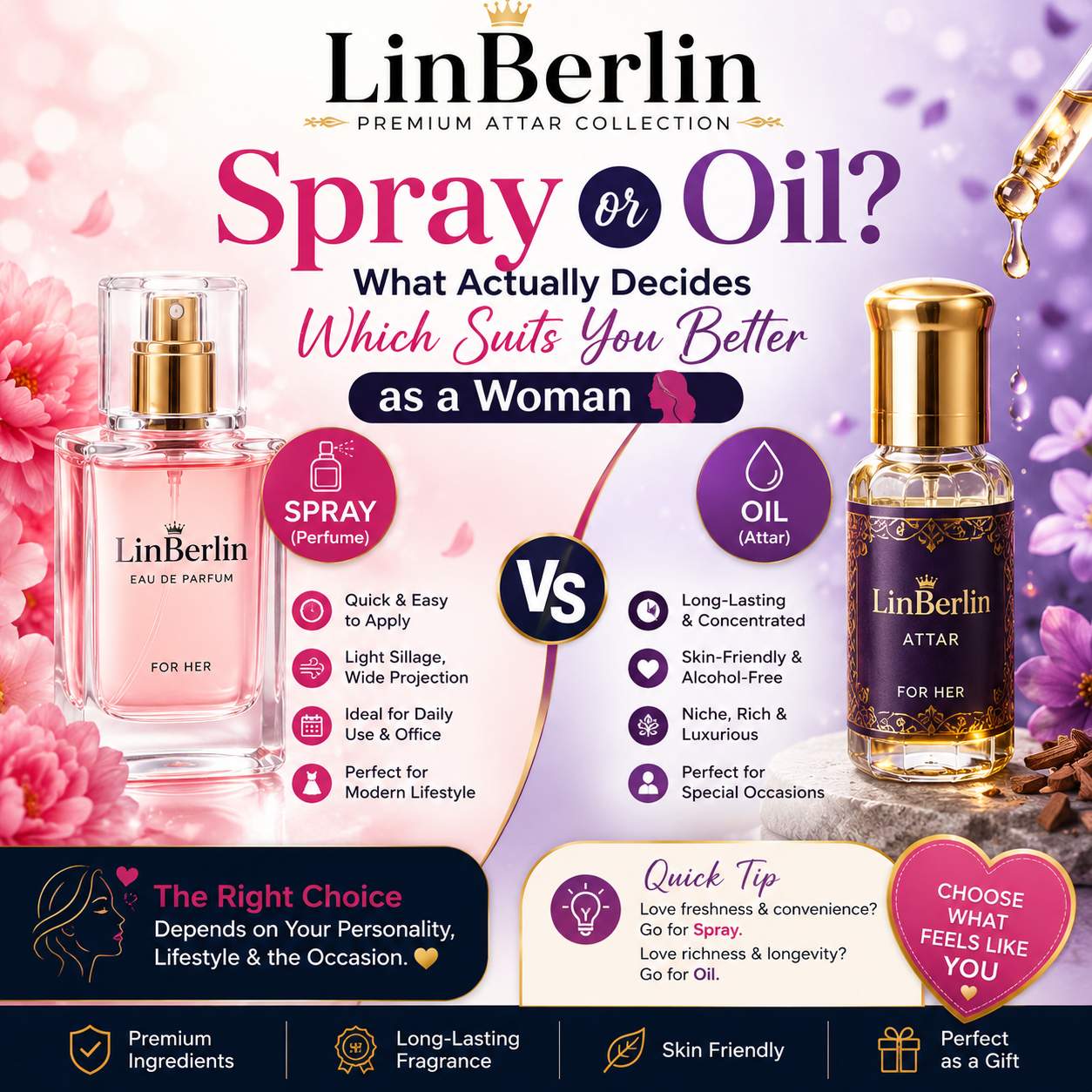
Spray perfumes are alcohol-based. The alcohol carries the fragrance oils, helps them disperse into the air on application, and then evaporates fairly quickly — taking the lighter top notes with it as it goes. That's why a spray perfume often smells strongest in the first ten minutes and then settles into something quieter. Oil-based attar works on a completely different principle. There's no alcohol carrier. The fragrance oils sit directly on the skin, blended usually with a base oil, and they release slowly as your skin's own warmth works on them throughout the day. Less initial projection, but — and this is the part people underestimate — considerably more staying power once it settles in. Neither is objectively better. They're just built for different jobs, and different skin.
Your skin type decides more than you'd think
Dry skin and alcohol-based sprays don't always get along well. The alcohol can pull existing moisture from the skin surface, and on already-dry skin that sometimes shows up as a scent that reads thin, or fades within two or three hours no matter how generously it was applied. It's not that the perfume is weak. It's that dry skin has less natural oil to hold onto the fragrance molecules once the alcohol carrier has evaporated. Oil-based attar tends to solve exactly this problem, because it doesn't rely on the skin's own oils in the same way — it brings its own base oil along, so to speak. On dry skin, attar often lasts noticeably longer than a spray from the same scent family would, sometimes six to eight hours versus three or four. Oily and combination skin is a different story. Skin with more natural sebum already acts as a fixative, which means spray perfumes that might fade quickly on drier skin can actually perform beautifully — sometimes even long enough that a lighter, more restrained application works better than a heavy one. Attar can occasionally feel a touch heavy or overly rich on very oily skin, particularly in warmer climates, simply because there's already so much natural oil for the fragrance to bind to. Sensitive or reactive skin is where things get more particular. Alcohol can sting or heighten redness on compromised skin, especially if applied over freshly exfoliated or actively treated areas. Well-made natural attar, free of synthetic alcohol, is often gentler here — though "natural" doesn't automatically mean risk-free, which is worth sitting with for a second rather than glossing over.
How your skincare routine changes the answer
Here's something most fragrance guides skip entirely: what's already on your skin before the perfume goes on matters as much as the perfume itself. Moisturised skin holds scent longer. This is just true, across both formats, but it matters more for spray perfume — a well-hydrated base gives the alcohol something to settle into rather than evaporating off dry skin almost immediately. So if you're someone who skips moisturiser most mornings, a spray perfume is probably underperforming for you right now without you realising why. Retinol, glycolic acid, vitamin C in higher concentrations, anything from an active-heavy routine — these can leave skin more permeable and more reactive than usual for a few hours after application. Layering alcohol-based spray directly over freshly applied actives sometimes causes a stinging sensation, or in more sensitive individuals, visible redness. It's not dangerous, usually, but it's uncomfortable and entirely avoidable. The general guidance: let active skincare fully absorb, give it twenty to thirty minutes at minimum, before reaching for spray perfume. Attar tends to be gentler in this specific scenario, though caution around citrus-forward or high-concentration floral absolutes still applies regardless of format. So — if your mornings involve a serious actives routine, you might actually find attar the more forgiving, lower-friction choice, even if you've always thought of yourself as a "spray person."
Where floral scents like Aurora fit into this
Florals carry their own set of considerations, mostly because floral absolutes — jasmine, rose, tuberose — tend to be some of the more concentrated, characterful notes in perfumery. They can smell genuinely different depending on format. In spray form, a floral composition tends to open bright and a little sharp, then soften as the alcohol clears. In oil form, that same floral heart often reads warmer and rounder from the very first moment, because there's no alcohol sharpness cutting through it. This is part of why Aurora, our floral luxury perfume for women, was built as an oil-based composition rather than a spray. The florals at its centre are meant to unfold slowly against skin warmth rather than announce themselves all at once and then recede. For someone with dry to normal skin who's drawn to floral fragrance but has found spray florals fading disappointingly fast, this is genuinely worth testing. Realistically, floral notes are among the ones that benefit most from the oil format's slow-release quality — they get to actually develop, rather than peaking early and thinning out by afternoon.
A few honest situations that call for caution
Pregnancy is one worth flagging directly. Certain concentrated florals and specific essential oil types are generally advised against, or at minimum used more sparingly, during pregnancy — particularly in the first trimester. If that applies to you, it's worth checking individual notes with whoever you're buying from rather than assuming natural automatically means safe in every circumstance. A known history of fragrance allergy matters here too, and it applies to both formats, not just synthetic sprays as people sometimes assume. Patch testing on the inner arm, then waiting 24 hours before full application, is a genuinely useful habit — even for something as reputable as a well-sourced attar. And skin that's actively irritated, whether from a new treatment, sunburn, or a reaction to something else entirely, is not the moment to introduce a new fragrance of either kind. Wait until it's settled.
So which one actually suits you
If your skin runs dry, if your routine is light on actives, and if you gravitate toward scents that feel rich and slow-building rather than bright and immediate — oil-based attar is very likely the better match. It'll last longer on you and probably smell more like itself, rather than a thinner echo of what it's supposed to be. If your skin runs oily or combination, if you like the initial lift of a fragrance announcing itself, and if you're not layering over heavy actives — spray can genuinely work well, sometimes better than attar would on the same skin. But here's the thing worth admitting honestly: skin changes. What suited you at twenty-five might not suit you now, and a format that used to fade too fast might suddenly last beautifully after a change in skincare or even just a change in season. There's no permanent verdict here, only what's true for your skin at this particular point in your routine — which is really the only reliable way to choose, format aside, name aside, everything else aside.