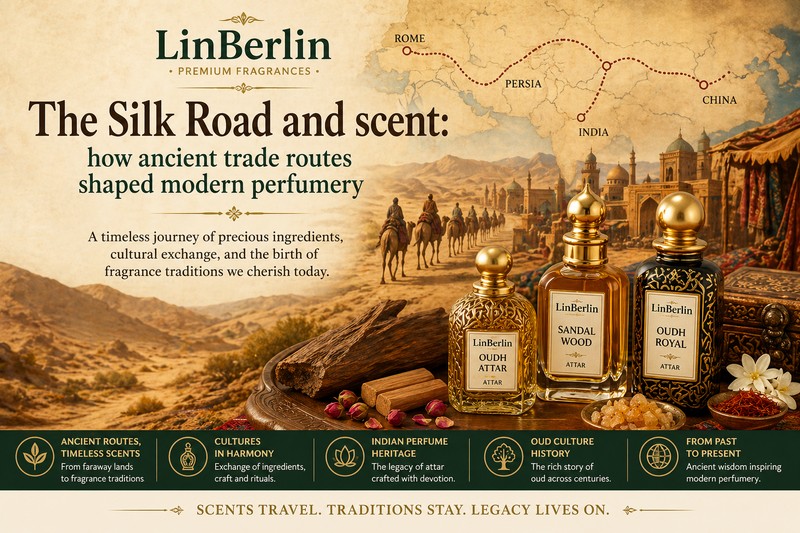
The Silk Road and scent: how ancient trade routes shaped modern perfumery
I once picked up a tiny bottle of oud in a quiet market, and something about it felt… older than memory. Not just rich or woody — but layered with history. It made me pause and think: how did this scent travel across continents and centuries to reach my hands?
That question opens the door to something bigger. The story of attar history, Indian perfume heritage, and oud culture history isn’t just about fragrance. It’s about trade, migration, and human curiosity. Long before airplanes and online stores, scents moved slowly — carried by traders, camels, and ships.
And honestly, once you start connecting those dots, modern perfumery feels less like a product industry and more like a living archive of the Silk Road itself.
Where scent first became a traded treasure
The Silk Road wasn’t just silk — that’s the part most people get wrong. It was a network of routes connecting Asia, the Middle East, and Europe, and along those paths moved spices, resins, oils, and yes, perfumes.
In my experience studying this, what stands out is how scent was never considered a luxury alone. It had purpose. Frankincense for rituals, rose oil for royalty, sandalwood for meditation. These weren’t optional extras — they were part of daily life in many cultures.
India played a massive role here. The early distillation techniques used in attar making — especially in places like Kannauj — were already refined centuries ago. Traders carried these oils westward, while Middle Eastern merchants introduced resins like oud into Indian markets.
Indian perfume heritage and the art of attar
There’s something deeply grounding about Indian perfume heritage. It’s not rushed. It’s not driven by trends. It evolves slowly, almost stubbornly, sticking to methods that have worked for generations.
Attar making is a great example. Copper stills, water distillation, natural ingredients — and a patience that honestly feels rare today. I’ve seen how even small changes in temperature or timing can alter the final scent completely.
And here’s the thing — attars weren’t designed to impress a room. They were designed to connect with the wearer. That intimacy is something many modern fragrances try to recreate but don’t always get right.
Oud culture history: from rare wood to global obsession
Oud has one of the most fascinating journeys. It starts as a reaction — when certain trees get infected, they produce a dark, aromatic resin. That resin becomes oud.
Now imagine traders discovering this centuries ago. Something rare, unpredictable, and deeply complex. It didn’t take long for oud to become one of the most prized materials along trade routes.
In the Middle East, oud became a symbol of status and spirituality. In India, it blended into existing traditions. And eventually, it made its way into Western perfumery — though often in diluted or synthetic forms.
But honestly, nothing quite matches the depth of natural oud. It’s not an easy scent. Some people don’t like it at first. And that’s okay.
How ancient trade shaped modern fragrance choices
Here’s where things get interesting for today’s buyers. Many modern perfumes still follow structures influenced by these ancient exchanges.
The idea of layering scents — base, heart, top — reflects how different ingredients traveled and combined across regions. Spices from India, resins from Arabia, florals from Persia — all meeting in a single composition.
Even today, when you choose between an attar and a synthetic perfume, you’re indirectly choosing between traditions shaped by those routes.
So when someone asks, “Why does this fragrance feel different?” — the answer often lies in history.
Real-world insights for modern fragrance lovers
If you’re exploring scents today, it actually helps to understand this background. Not in a textbook way — but in a practical sense.
For example, if you enjoy warm, deep, evolving scents, you’re probably drawn to ingredients that traveled through older trade routes — oud, sandalwood, amber. These aren’t just smells; they carry a certain rhythm.
On the other hand, if you prefer clean, sharp, quick-impact fragrances, you might lean toward modern compositions influenced by Western perfumery.
Neither is better. It’s more about what resonates with you.
And honestly, trying both is the only way to really understand the difference.
Common misunderstandings about scent history
One thing I’ve noticed is people often romanticize the past too much. Not every ancient perfume was refined or pleasant by today’s standards. Some were intense — even overwhelming.
Another misconception is that modern perfumes have no connection to history. That’s not true at all. They’re built on it — just adapted for convenience and consistency.
Also, people assume natural always means better. It doesn’t. Natural ingredients can vary a lot, and not every batch is perfect. That unpredictability is part of their charm, but it’s also a limitation.
Where this journey leaves you
So what does all this mean for you as a reader or buyer?
It means the next time you pick up a fragrance, you’re not just choosing a scent. You’re touching a piece of history — shaped by trade, culture, and time.
If you’re curious, start exploring attars. Notice how they evolve. Try something with oud, even if it feels unfamiliar at first.
Because once you begin to see fragrance this way, it stops being just a product — and becomes an experience you carry with you.
And honestly… that’s where it gets really interesting.