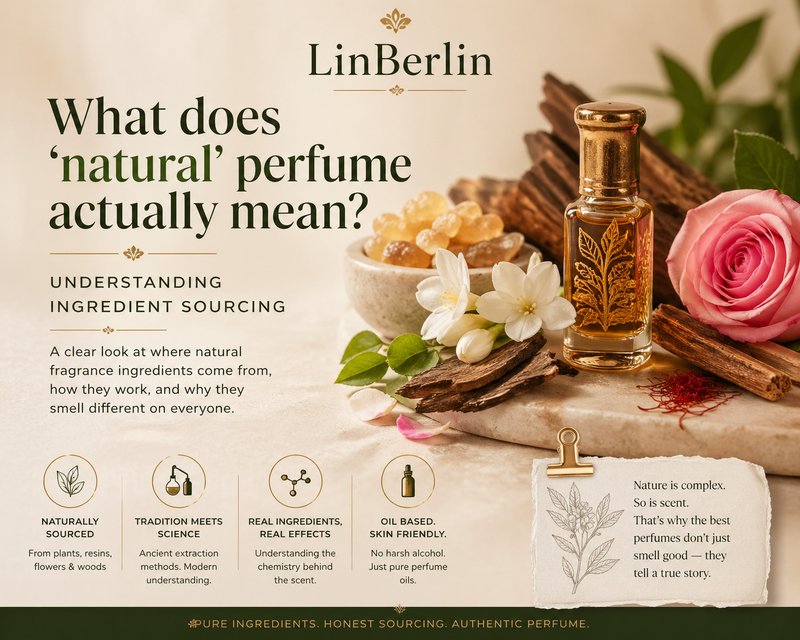
The first thing people notice isn’t the label — it’s how a scent behaves on their skin. A rose attar that felt rich in the bottle suddenly turns airy after an hour. A sandalwood oil lingers on one person for a full day but fades quickly on someone else. Somewhere in that experience, the question forms quietly: what does “natural” perfume actually mean, and why does it behave so differently?
That word shows up everywhere now. Natural. Clean. Botanical. But behind it sits a very real, very physical system of molecules, evaporation, and biology that determines what you smell and how long it lasts.
The science explained clearly
Every scent you smell is made of volatile molecules small enough to evaporate into the air and reach your olfactory receptors inside the nose. These receptors are proteins that bind to specific molecular shapes, triggering electrical signals your brain interprets as smell. Natural perfume is built entirely from molecules derived from plant, animal, or mineral sources, rather than synthesized in a lab (even though, chemically, both can produce identical structures).
But origin matters because natural extraction methods rarely produce a single isolated compound. Instead, you get a complex mixture of hundreds of molecules — terpenes, esters, alcohols, aldehydes — each with different molecular weights and evaporation rates. That complexity is what gives natural attars their layered evolution over time.
And evaporation rate is where the real difference begins. Lighter molecules, like those found in citrus oils, evaporate quickly because of their lower molecular weight. Heavier molecules, such as sesquiterpenes in sandalwood, evaporate slowly and act as natural fixatives — they anchor lighter notes and extend longevity.
But here’s where biology enters the picture. Your skin isn’t a neutral surface. It has its own lipid composition, microbiome, hydration level, and pH. These factors influence how scent molecules dissolve, evaporate, and even chemically interact after application (a subtle but real effect).
So when someone says a natural perfume “doesn’t last,” it’s often not a flaw in the material itself. It’s the combination of molecular volatility and how those molecules behave on a specific person’s skin.
What this means in practice
You’ve probably noticed that some natural fragrances feel softer or closer to the skin compared to conventional sprays. That’s not because they’re weaker. It’s because natural compositions rely heavily on materials that evolve rather than project aggressively.
And that evolution is part of the experience. A well-made attar doesn’t hit you all at once. It unfolds — top notes appear briefly, heart notes settle in, and base notes linger for hours (sometimes quietly, but persistently).
So if you’re expecting a natural perfume to behave like a synthetic-heavy eau de parfum, there’s going to be a mismatch in expectation.
Another detail people notice is inconsistency between batches. One bottle of rose oil smells slightly deeper than the last. That’s not poor quality. It’s agricultural reality. Soil composition, climate, harvest timing, and extraction technique all influence the final profile.
And honestly, that variability is part of what makes natural perfumery feel alive. You’re not smelling a fixed formula. You’re smelling a crop, a season, a place.
There’s also the question many people don’t ask out loud: why do some natural oils feel richer or smoother than others? That often comes down to how carefully they were distilled or aged. Slow distillation preserves delicate molecules. Aging allows harsher edges to soften as components integrate over time.
Common misconceptions about this
A common belief is that natural automatically means safer or better for the skin. That isn’t always true. Many natural materials are highly potent and can cause irritation if not properly diluted. Clove oil, for example, contains eugenol, which can be sensitizing in high concentrations.
Another misconception is that synthetic ingredients are inherently inferior. Some synthetic aroma molecules are designed to replicate rare or endangered natural scents without ecological damage. And in some cases, they’re more stable or predictable.
But natural perfumery isn’t trying to compete on those terms. It’s working with complexity rather than control.
People also assume that stronger projection equals higher quality. That idea comes from modern perfume structures built for sillage and longevity. Natural attars operate differently. They tend to stay closer to the body, revealing themselves in movement and warmth rather than broadcasting across a room.
So if a natural perfume feels intimate, that’s not a limitation. It’s a design philosophy.
How to use this knowledge
Start by applying natural perfume to well-hydrated skin. Moisture slows evaporation, giving lighter molecules more time to develop. A small amount on pulse points is usually enough — warmth helps diffusion without overwhelming the composition.
And don’t judge the scent in the first five minutes. Give it time to settle. What you smell after thirty minutes is often closer to the true character.
If longevity matters to you, look for compositions built around naturally heavier materials like woods, resins, or aged oils. These act as anchors and extend the life of the fragrance.
Or try layering. Applying a base oil first and then adding a lighter floral or citrus note can improve both depth and staying power.
Closing
The idea of “natural” in perfume isn’t just about avoiding synthetics. It’s about working with living materials that carry variability, complexity, and a certain unpredictability. Once you understand how molecules behave — and how your own skin shapes that behavior — the experience shifts. You stop asking why it changes, and start noticing how it evolves.
And that’s where natural perfumery becomes far more interesting than a label on a bottle.