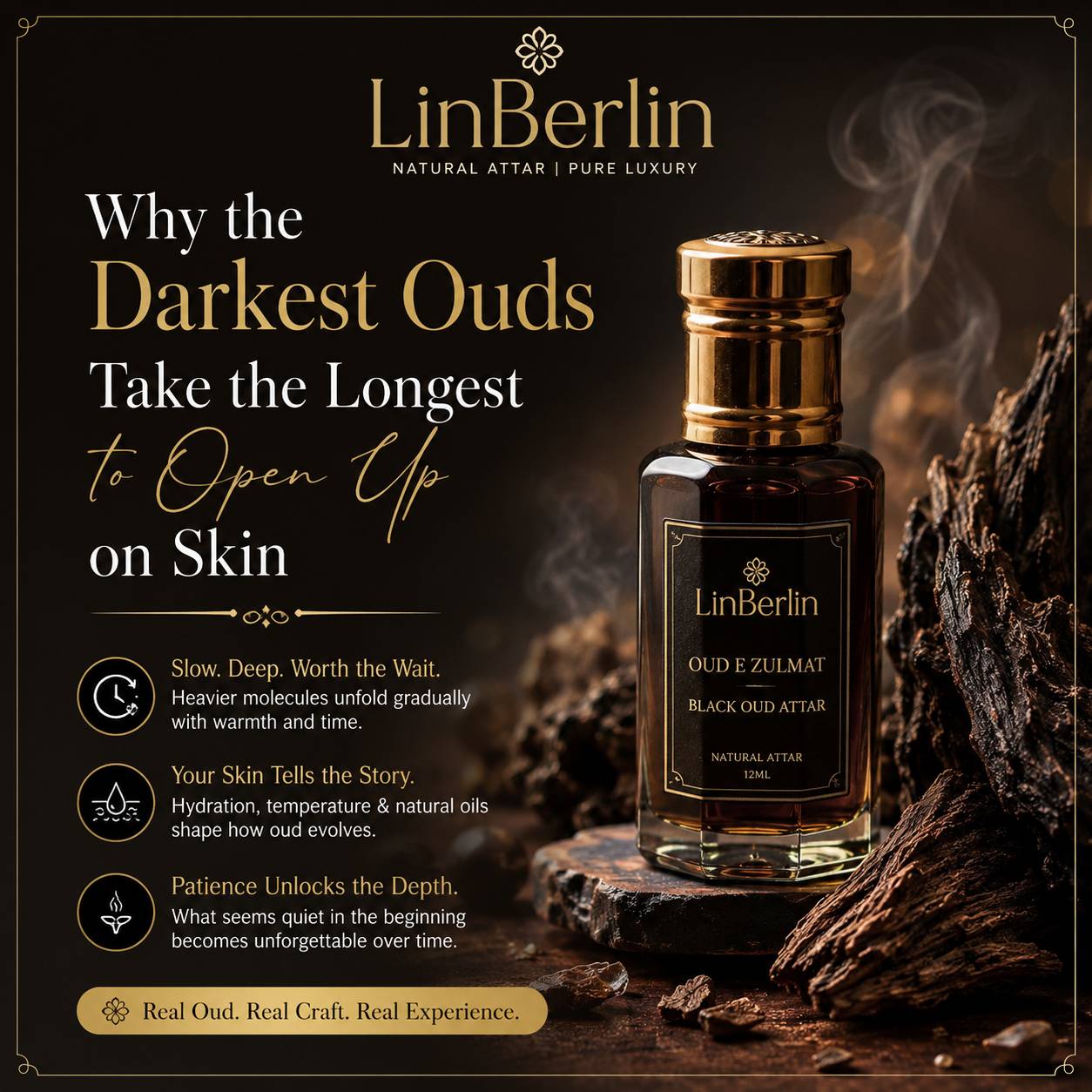
Why the Darkest Ouds Take the Longest to Open Up on Skin
I once had a customer return a bottle three days after buying it, convinced it had gone bad. It hadn't. She'd applied it, smelled something sharp and medicinal for the first twenty minutes, and assumed the oil was faulty. What she was actually smelling was a dark oud doing exactly what dark ouds do — resisting her, slowly, before deciding to reveal itself. That's the part nobody tells first-time attar buyers. The darker the oud, the longer the courtship.
This isn't a minor curiosity for people who collect fragrance oils. It's the single biggest reason enthusiasts either fall in love with black oud or give up on it entirely within the first hour of wearing it.
The Colour Is Not Decoration — It's Density
Dark oud oils get their colour from age, distillation method, and resin content. A deep, near-black oud has usually gone through longer fermentation of the agarwood chips, or repeated distillation cycles (hydro-distillation runs where the same wood is re-cooked to pull out heavier, more resinous fractions), or it's simply older stock that's been resting in glass for years, oxidising and thickening. All three processes do the same thing to the molecular makeup: they concentrate the heavier compounds and reduce the lighter, more volatile top notes that would otherwise burst out fast.
And that's really the whole story in one sentence, though it deserves unpacking. Lighter ouds — the honeyed, greener ones — carry more volatile terpenes near the surface of the oil. Those evaporate quickly, which is why a light oud can smell "finished" opening within ten or fifteen minutes. A black oud attar has comparatively few of those quick-moving molecules. What it has instead is a dense base of heavier sesquiterpenes and resin-like compounds that need body heat, moisture, and time to loosen and lift off the skin.
Skin heat is doing more work here than people realise. Actual skin temperature — not room temperature, not the air around you — is what drives evaporation rate. Heavier oud molecules simply need a longer, sustained period of warmth before they release fully into the air, which is why a dark attar smells almost sedate on someone with cooler extremities and startlingly loud on someone with a naturally warmer body.
What "Opening Up" Actually Means, Chemically
People use "opening up" loosely, but there's a real mechanism behind it. In the first 20 to 40 minutes on skin, alcohol-free oud oils don't have a solvent carrying the scent forward the way an alcohol-based perfume does. The oil itself has to warm, thin slightly, and let its molecules migrate to the surface. With a dark oud — something like our own <a href="https://www.linberlin.in/black-oudh-attar-oud-e-zulmat" target="_blank" rel="noopener">black oud attar</a> — that migration takes noticeably longer because the oil is thicker and the volatile fraction is smaller relative to the resinous fraction.
So what you smell in the first phase is often described as sharp, smoky, sometimes a little medicinal or barnyard-like. This is normal. It is not a flaw, and it's not the oil "going off." It's the leather-and-smoke facet surfacing before the sweeter, ambered, almost fruit-leather depth underneath has had the chance to warm through. Give it forty minutes to an hour. Most complaints about dark oud being "too animalic" or "too rough" come from people judging it at the fifteen-minute mark — which, honestly, is like judging a stew by tasting it while it's still cold.
How Skin Type Changes the Timeline
This is where things get genuinely practical, and where a lot of attar advice online falls short because it treats skin as one uniform surface.
Dry skin holds attar oils differently than oily skin. On dry skin, the oil sits closer to the surface for longer because there's less natural sebum to blend with it or speed up evaporation — but dry skin also tends to run slightly cooler, so the opening phase can stretch out even more. Realistically, if you have dry skin and you're wearing a dark oud, budget a full hour before you judge the scent.
Oily skin does the opposite. More natural oil on the surface means the attar blends into that layer, warms faster, and often opens noticeably quicker — sometimes in half the time. But it also tends to burn through top and heart notes faster too, so while dark ouds bloom sooner on oily skin, they may not last as many hours in total compared to dry skin, where the depth lingers.
Combination skin is the trickiest to generalise about (and I'll be honest — this is the one area where individual variation makes broad claims a bit unreliable). Areas like the inner wrist or behind the ear tend to run warmer and oilier than, say, the forearm, so the exact same drop of black oud attar can open at two different speeds depending on where you apply it.
Layering With Skincare — Where People Go Wrong
Here's the thing most beauty content skips entirely: what you put on your skin before the attar changes how it behaves, sometimes dramatically.
Heavy, occlusive moisturisers — the thick balm-type ones with a lot of shea butter or petrolatum — actually help dark oud attars. They create a slight barrier that slows evaporation, which sounds counterproductive but isn't. It means the oil releases its heavier molecules more gradually and evenly, extending both the opening phase and the overall wear time. This is a genuinely good pairing.
What doesn't work well is layering attar directly over active skincare — retinoids, exfoliating acids (AHAs, BHAs), or fresh chemical peels. Compromised or actively-renewing skin barrier is more reactive, and the concentrated aromatic compounds in a dark oud can cause stinging, redness, or irritation that has nothing to do with an actual fragrance allergy. If you use retinol at night, apply attar to clothing or hair instead of skin on those days, or wait until the skincare has fully absorbed and settled — generally 20 to 30 minutes minimum.
A Few Cautions Worth Taking Seriously
Natural doesn't automatically mean risk-free, and any honest fragrance writer should say so plainly. Oud oils, dark ones especially, are highly concentrated aromatic compounds. People with genuinely sensitive or eczema-prone skin should patch test on the inner forearm before applying anywhere near the neck or décolletage. Anyone pregnant or breastfeeding should check with their doctor before regular use of concentrated attars, as with any strong essential-oil-adjacent product. And if you've ever had a reaction to synthetic oud or agarwood-derived fragrance before, don't assume a natural version will be automatically safer — some of the same aromatic molecules are present in both.
Choosing a Dark Oud If You're New to Them
If you're moving from lighter, sweeter attars into darker territory, don't start with the heaviest bottle on the shelf. Something with genuine depth but a slightly gentler opening — Oud e Zulmat is a good example — gives you the smoky, resinous character without quite the same forty-minute wait. It's a reasonable middle ground for building trust with a category that, admittedly, takes some getting used to.
The Practical Takeaway
Wear a dark oud once, expecting nothing for the first half hour, and let it finish its opening before deciding anything. Apply it on skin that's been recently moisturised but not mid-treatment with actives. And if your skin runs cool or dry, be patient — the best part of a black oud attar is very rarely the first twenty minutes.