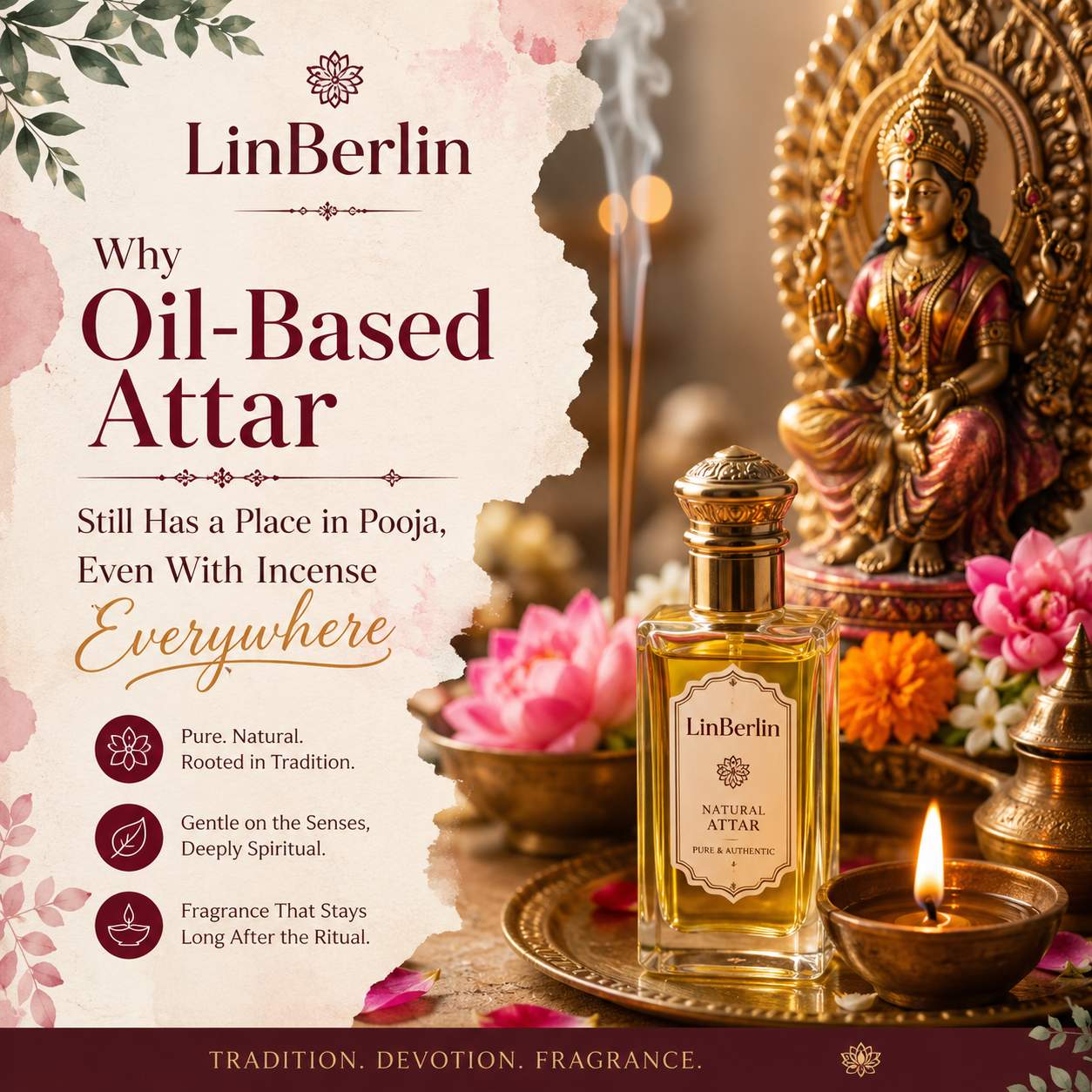
My grandmother never lit the incense stick first. She dabbed a drop of attar on her fingertip, touched it to the feet of the idol, and only then reached for the matchbox. I used to think it was habit. It wasn't — it was intention, and there's a difference between the two that most households have quietly forgotten.
Incense has taken over the pooja shelf almost by default. It's convenient, it's everywhere, and it does its job — filling a room with fragrance in under a minute. But attar was never meant to compete with that. It was meant to do something incense simply can't.
Smoke Fills a Room. Oil Marks a Moment.
Incense smoke spreads outward. It's designed to. The whole point is coverage — a stick burns for twenty, thirty minutes, and the scent moves through the air, settles into curtains, lingers in corners. That's genuinely useful for a puja room that needs to feel sanctified before guests arrive or before a longer aarti begins.
Attar doesn't work that way, and it isn't trying to. A drop applied to the idol, to a mala, to the corner of a cloth, stays put. It doesn't dissipate into the room — it concentrates in one place, close to the object of worship. So the fragrance becomes personal rather than ambient. You have to lean in to notice it. Some people find that more devotional than a room saturated with smoke; others simply find it more practical, since oil-based attar produces no ash, no residue, and no smoke that can irritate eyes or trigger a cough during a long ritual.
The truth is, most families use both — incense for the space, attar for the deity or the person — and there's nothing contradictory about that. They're solving different problems.
Over time, many households develop preferences for different attars depending on the ritual itself — lighter floral compositions for daily worship, festive celebrations and aarti, while sandalwood and woody blends are often preferred for quieter moments of prayer, meditation and reflection. Exploring a dedicated collection of Pooja Attars by LinBerlin can help devotees discover fragrances suited to different traditions and occasions, while creations such as DEVALAYA Pooja Attar & Meditation Attar are designed specifically for temple visits, meditation, chanting and personal spiritual practice where a softer, more contemplative fragrance feels most at home.
What Oil-Based Attar Actually Does During Daily Pooja
A few things happen with attar that don't happen with smoke-based fragrance, and they're worth naming plainly.
It lasts. A well-made natural attar, applied on a wick, a cotton wad tucked near the idol, or directly onto prasad cloth, can hold its scent for hours rather than minutes. It doesn't need reapplying every time someone walks past. And because it's oil-based rather than alcohol-based, it doesn't evaporate quickly in warm Indian households — it sits, slowly releasing, the way ghee-based diya oil burns slow rather than flaring up.
It's also safer indoors, particularly in smaller apartments or homes where elderly family members or infants are present. No open flame beyond the diya itself, no smoke accumulation, no risk of setting off a fire alarm in a closed kitchen-adjacent puja corner (this happens more often than people admit).
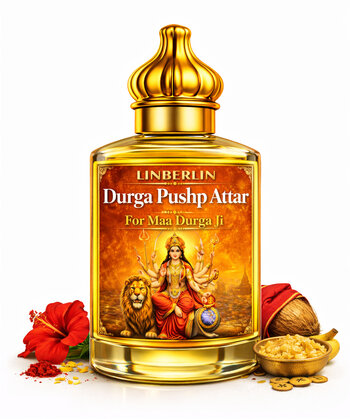
For daily rituals specifically — not the big festival days, but the ordinary Tuesday morning aarti — many households now reach for something like Durga Pushp attar for daily durga ma pooja, mainly because a floral-forward oil blend suits routine devotion better than a heavier, festival-only oud or musk. It's lighter, it doesn't overwhelm a small room, and it doesn't compete with the smell of fresh flowers already on the altar.
Why the Choice of Fragrance Still Carries Weight
There's a cultural memory built into attar that incense sticks, mass-manufactured and often synthetic, don't carry in the same way. Attar-making in India goes back centuries — steam-distilled florals, sandalwood-based oils, ittars pressed from actual petals rather than synthesized in a lab. When someone chooses a natural attar for their daily worship instead of a stick pulled off a supermarket shelf, they're — whether they think about it this way or not — continuing something older than either of them.
Or maybe that's overstating it. Realistically, most people just like how it smells and how long it lasts. Not everyone is thinking about heritage at 6 a.m. before work. And that's fine too — the ritual doesn't require philosophical justification to matter.
A Word on Skin, Since Attar Touches It Too
Here's the part most articles on this topic skip entirely: attar used in pooja doesn't stay on the idol. It ends up on hands, wrists, the base of the throat — because people apply it to themselves before or after the ritual, as a kind of personal blessing. And that's where a little skincare knowledge actually matters.
Moisturised skin holds fragrance longer than dry skin. This isn't folklore — oils and fragrance molecules bind more readily to skin that already has some lipid barrier intact, whereas dry, flaky skin lets scent evaporate faster and, in some cases, can absorb concentrated oils unevenly, leading to patchy irritation rather than a clean scent trail. If you're applying attar to your wrist right after washing hands for pooja, pat dry first rather than applying to damp skin — water dilutes the oil's grip and shortens how long it lasts.
Sensitive skin needs a slightly different approach. Natural attars are concentrated, and while they're free of the synthetic fixatives found in commercial perfumes, concentration itself can cause a reaction on skin that's already compromised — eczema-prone patches, freshly exfoliated skin, or areas recently treated with retinoids or strong actives. If you're using any prescription-strength skincare active, give it a few hours' gap before applying attar directly to the same patch of skin. It's a small precaution, but it prevents the stinging or redness people sometimes mistake for an allergy when it's really just an interaction between two strong ingredients on unprepared skin.
Pregnancy is another situation where caution is genuinely warranted, not just a disclaimer for the sake of one. Some floral and musk-based ittars contain compounds that certain women find aggravate nausea in the first trimester, and it's worth patch-testing on a small area — the inner elbow, not the wrist — before applying near the face or wearing it through a full pooja session.
Skin Types and Their Different Relationships With Attar
Oily skin tends to hold attar exceptionally well, sometimes too well — a single drop can read stronger by afternoon than it did in the morning, since skin oils mix with the attar and amplify certain notes. Dry skin loses scent faster and may need a light, fragrance-free moisturiser underneath to help the attar sit. Combination skin behaves unpredictably depending on where it's applied — forehead and nose tend to "eat" fragrance faster than cheeks or wrists.
None of this is complicated once you've noticed it a few times. But it does explain why two people using the same bottle of attar can report completely different experiences with how long it lasts.
Common Mistakes People Make With Pooja Attar
Applying too much, thinking more oil equals more devotion — it doesn't, and it usually just means a heavier scent that lingers uncomfortably on hands through the rest of the day. Storing the bottle near direct sunlight on a windowsill puja shelf, which degrades the top notes within weeks. And using the same bottle interchangeably for idol application and personal wear without checking whether the blend is meant for both — some heavier oud-based attars are traditionally reserved for the deity alone, not for daily personal wear.
Where This Leaves Things
Incense isn't going anywhere, and it shouldn't. It does something attar can't — filling a whole room in minutes. But attar does something incense can't either: it stays close, it lasts through the hours between one aarti and the next, and it carries a physical, applied intimacy that smoke never quite manages. For daily worship, where the ritual is quieter and more personal than a festival celebration, that closeness is often exactly what people are looking for, even if they've never put it into those words before.
One honest limitation worth naming: natural attar isn't a one-size-fits-all product, and what works beautifully for one household's daily pooja might feel too strong, too light, or simply unfamiliar to another. The best approach is testing a small amount first, on skin and on the idol area, before committing to it as a daily habit.