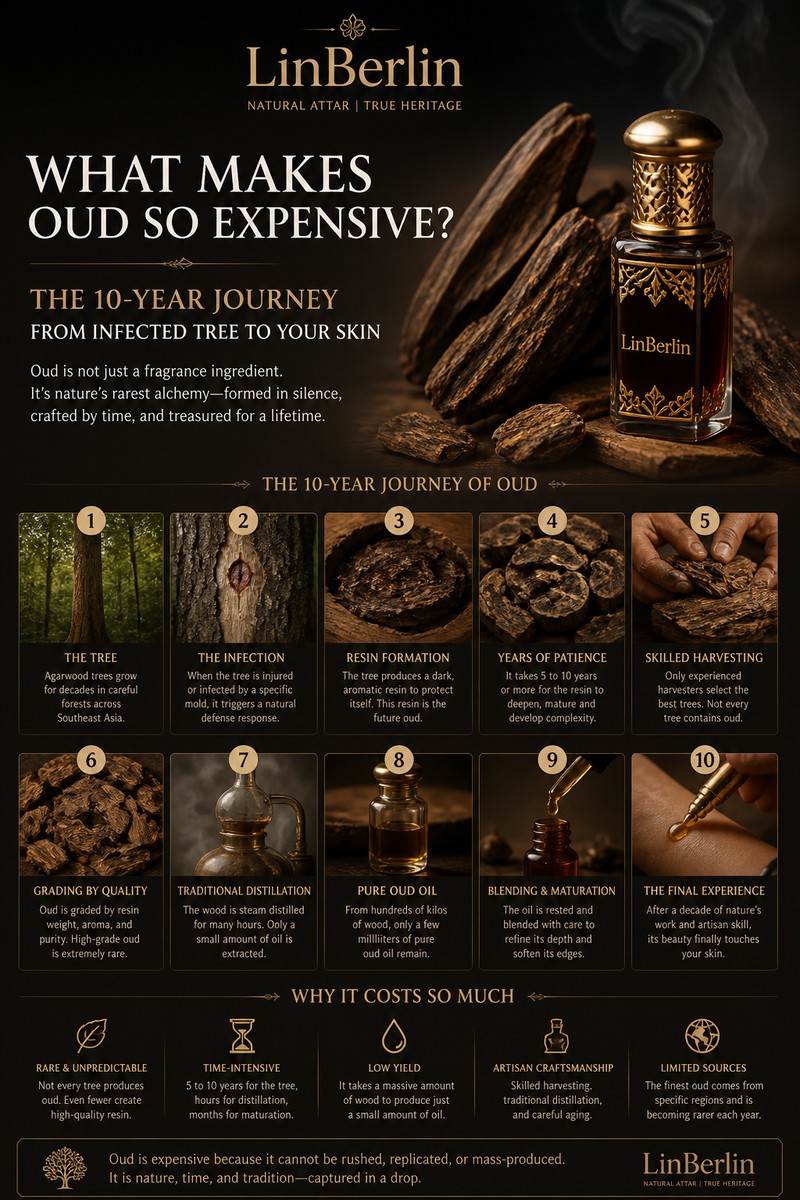
Discover why oud is so expensive through a detailed look at its 10-year formation, regional variations, harvesting challenges, and how true quality is recognised. What makes oud so expensive? The 10-year journey from infected tree to your skin
Resin darkens slowly inside a wounded tree somewhere in Assam, and no one watching it from the outside would guess it is becoming one of the most valued materials in perfumery. The scent isn’t there yet. The wood still looks ordinary. But deep inside, oud is forming—thick, complex, and unpredictable. By the time it reaches your skin, years later, it carries the weight of that quiet transformation. Understanding what makes oud so expensive begins not in a perfume bottle, but in that long, uncertain process hidden within living wood.
The origin and history
Long before modern perfumery, oud travelled along trade routes linking India, Southeast Asia, and the Middle East, carried as chips of resinous wood rather than refined oil. In ancient Assam and Bengal, Aquilaria trees were already known for producing this rare material, though not every tree yielded it. Only those infected by specific fungi would begin producing the dark resin that defines oud—and even then, the process could take years without guarantee.
By the time oud reached Arabian culture, it had become something deeply woven into daily life. It wasn’t reserved for special occasions alone. Homes were scented with it, garments were passed through its smoke, and it became part of hospitality itself. And yet, even then, supply remained inconsistent — no cultivation method could fully control how or when the resin would develop.
In Japan, oud took on a different role entirely. Through the tradition of Kōdō, or the “way of incense,” connoisseurs learned to appreciate subtle differences between woods from regions like Kyara (Vietnam) and Rakoku (Thailand). These distinctions weren’t marketing terms; they were sensory categories based on scent, density, and burn quality.
But here’s the thing, oud was never abundant. Historical texts describe it as rare even in periods when forests were far less depleted than they are today. That scarcity wasn’t created by demand alone—it was always part of its nature (and that hasn’t changed).
What makes it distinctive
Inside the Aquilaria tree, the story begins with stress. A wound, an infection, or environmental pressure triggers the tree’s defense mechanism. It produces a resin to protect itself, and over time, that resin saturates the wood. This is what becomes oud.
But not all resin is equal. The depth of aroma depends on how long the infection develops, the species of tree, and even the microclimate of the forest. And two trees growing side by side can produce entirely different profiles—one may smell sweet and balsamic, another dark and animalic.
Distillation adds another layer of complexity. Traditional hydro-distillation can take days, sometimes weeks, extracting oil slowly from the resinous wood. The yield is incredibly small. From kilos of wood, only a few grams of oil might emerge. So when you’re holding a tiny vial of oud, you’re holding something that has already passed through multiple stages of loss.
And then there is ageing — freshly distilled oud can smell sharp, almost chaotic, but over time it softens, deepens, and reveals layers that weren’t initially obvious. Some oils are aged for years before they are considered ready (this is where patience becomes part of the craft).
So why does one oud smell clean and leathery while another feels smoky and almost barn-like? That question comes up often, and the answer lies in origin, distillation style, and the maturity of the resin itself.
How to recognise, appreciate, or choose
The first thing most people notice is intensity, but that’s not always a sign of quality. High-quality oud doesn’t shout. It unfolds.
When you apply it, the opening may feel sharp or medicinal. That’s normal. Give it time. Within minutes, the scent begins to settle into something richer, often revealing sweetness, warmth, or a subtle animalic edge. If it feels flat or one-dimensional, it likely lacks depth.
Texture matters as much as scent. A good oud oil feels slightly viscous on the skin, not watery, and it lingers for hours without becoming harsh. And the way it evolves tells you more than the first impression ever could.
But many people wonder—how do you avoid synthetic or diluted versions? The truth is, it isn’t always easy. Some blends are designed to mimic oud using lab-created molecules, and while they can smell pleasant, they don’t carry the same evolution or depth.
Look for transparency. Where does the oud come from? Assam, Cambodia, Laos, and Vietnam all produce different profiles. Ask how it was distilled. And trust your nose over labels.
Honestly, even experienced collectors disagree on what makes an oud “better.” Some prefer the clean elegance of Cambodian oils, while others seek the raw intensity of Indian oud. There isn’t a single standard—and that’s part of what makes it so compelling.
LinBerlin's approach to this
At LinBerlin, oud isn’t treated as a trend ingredient. It’s approached with the same respect given to traditional attar-making methods, where the material itself leads the process.
The focus stays on sourcing small batches from regions known for consistent character, rather than chasing volume. Each oil is evaluated not just on strength, but on how it develops over time on skin. And blending, when it happens, is done carefully—so the oud isn’t masked, but supported.
There’s also an understanding that not every oud needs to be extreme. Some compositions are designed to be more approachable, especially for those new to natural perfumery, while still retaining the integrity of the material.
Closing
Some scents are built quickly, designed for immediate impact. Oud is the opposite. It asks for time, both in how it’s made and how it’s worn. And maybe that’s where its value really sits—not just in rarity, but in the patience it demands.
If you’ve only experienced oud in passing, try wearing it slowly, on your own skin, without rushing to judge it. You might find that what seemed unfamiliar at first begins to make sense in a way no description ever fully can.