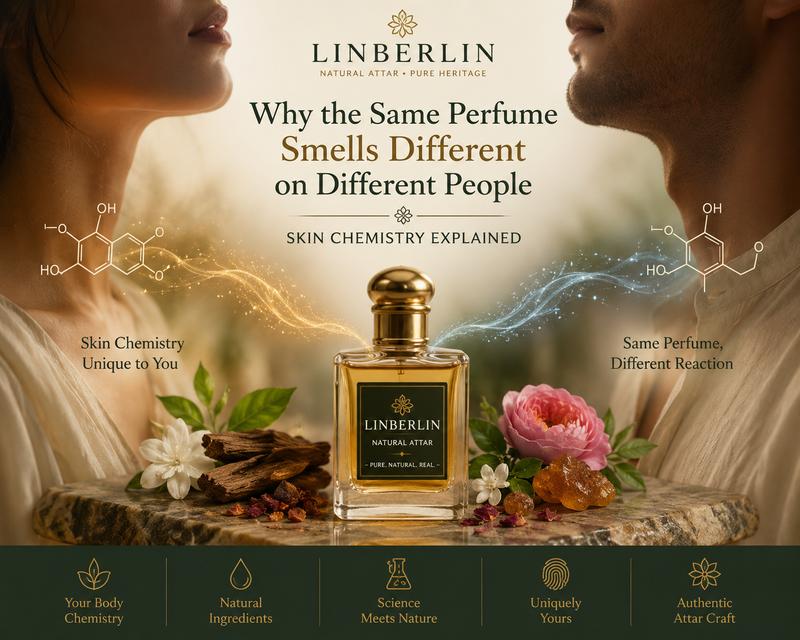
A trace of smoky oud can smell almost medicinal on one wrist and unexpectedly sweet on another standing beside it. Perfumers see this constantly during formulation testing, especially with naturals, yet many fragrance wearers still assume perfume behaves like fabric dye: spray it on, and everyone gets the same result.
That isn’t how scent works on human skin.
The same perfume smells different on different people because fragrance molecules interact with body heat, skin lipids, moisture levels, microbiota, and even subtle differences in skin surface acidity. A bright citrus built around limonene may sparkle for hours on one person but disappear quickly on someone whose skin runs warmer and drier. And animalic materials like natural oud or labdanum can become dramatically softer or harsher depending on how those aromatic compounds evaporate and oxidize on the skin.
Perfumery chemistry is full of variables, but the interesting part is that these differences are not random. There are real physiological reasons behind them, and understanding those mechanisms changes how you test, wear, and judge fragrance.
The science explained
A perfume is not a single smell. It’s a moving cloud of volatile organic compounds evaporating at different rates — and human skin acts like an active surface rather than a neutral canvas.
One major factor is sebum, the oily substance produced by sebaceous glands. Sebum contains triglycerides, wax esters, squalene, and free fatty acids, all of which interact differently with aromatic molecules. Richer skin oils can slow evaporation and hold onto heavier compounds longer. That’s partly why amber-heavy fragrances sometimes feel deeper and smoother on oily skin.
Skin temperature also matters more than most people realize. Heat increases molecular volatility, meaning top notes escape faster from warmer skin. Materials like bergamot oil, aldehydes, or certain green notes can bloom intensely for twenty minutes and then collapse quickly on someone with naturally warm skin. Cooler skin tends to release those same molecules more gradually.
And then there’s the microbiome. Human skin hosts bacteria such as Staphylococcus epidermidis and Cutibacterium acnes, and those microorganisms metabolize skin secretions into compounds with their own odors. That microbial activity changes the perceived character of fragrance. Musks, cumin-heavy accords, and indolic florals are especially sensitive to this interaction (jasmine is a classic example).
Oxidation plays a role too. Oxygen exposure changes fragrance molecules over time, especially naturals rich in terpenes. Linalool and limonene oxidize relatively easily, which can shift a scent from fresh and sparkling toward something flatter or sharper depending on environmental exposure and skin conditions.
People often ask whether skin pH alone explains everything. Not really. Human skin generally stays within a mildly acidic range around pH 4.7 to 5.7, and while that environment influences barrier function and microbial balance, researchers still debate how strongly pH itself changes perfume perception compared with oil content, heat, and evaporation dynamics. Honestly, fragrance chemistry is messy because several mechanisms happen at the same time.
Genetics enters the picture as well — though not always in the way social media claims. Variations in olfactory receptor genes influence how people perceive certain molecules. The aroma chemical Iso E Super is famously difficult for some people to smell consistently, while others experience it as soft cedar warmth radiating for hours.
So the perfume itself isn’t changing into a different formula. The interaction between volatile molecules, skin physiology, and human perception is changing the experience of that formula.
Why it matters for fragrance
Many people buy fragrance after smelling it on paper strips in stores, then feel disappointed later at home. The paper never had body heat, oils, moisture fluctuations, or bacteria affecting evaporation patterns. Testing on skin gives a far more accurate picture of the fragrance structure.
That’s why experienced perfumers and evaluators rarely judge a scent immediately. They watch how it develops over several hours instead. A composition may open with sharp citrus and aromatic lavender but settle into sandalwood, amber, and musk in completely different proportions depending on the wearer.
And concentration changes the experience too. Eau de parfum, extrait, and oil-based attars release aroma compounds differently because the carrier system controls volatility. Alcohol creates rapid lift and diffusion, while oils tend to stay closer to the skin and evolve more slowly.
Here’s the thing: skin chemistry also explains why fragrance recommendations online can feel unreliable. Someone describing a perfume as creamy vanilla may genuinely experience that profile, while another person gets dry smoke or bitter woods from the exact same blend. Both reactions can be real.
Climate affects perception in surprisingly dramatic ways. Humid weather amplifies projection because moisture slows evaporation and helps scent radiate outward. Dry winter air often compresses fragrance, muting top notes and emphasizing resins, woods, and musks. So a perfume that feels balanced in London during autumn might feel overpowering in Dubai during summer.
And application technique matters more than marketing suggests. Rubbing wrists together after applying fragrance increases friction and heat, which can disturb volatile top notes before they settle naturally. That effect is subtle, but with delicate natural citrus oils or green accords, it’s noticeable.
Some fragrance materials are particularly shape-shifting on skin. Natural oud contains hundreds of aromatic compounds produced during agarwood resin formation, including sesquiterpenes and chromones. Depending on skin warmth and oil levels, the same oud accord can smell leathery, smoky, sweet, medicinal, or almost fruity.
People often wonder why a perfume “disappears” on them while others can still smell it. Sometimes the issue is anosmia rather than performance. Repeated exposure can temporarily reduce sensitivity to certain molecules, especially musks and woody synthetics. But other people nearby may still smell the fragrance clearly.
Understanding these variables changes how you approach fragrance testing. One quick spray in a department store rarely tells the whole story.
What this means for attar specifically
Natural attars behave differently from most modern alcohol-based perfumes because the oil carrier changes evaporation speed and skin interaction. Traditional attars made with sandalwood bases or dense botanical oils develop gradually, often staying close to the body rather than projecting aggressively.
That slower evaporation curve matters because skin chemistry has more time to influence the scent profile. A rose attar rich in phenethyl alcohol and citronellol may feel velvety and warm on one wearer yet greener and sharper on another after several hours of oxidation and heat exposure.
But natural materials are also chemically more complex than many simplified synthetic accords. Real jasmine absolute contains indoles, benzyl acetate, linalool, methyl anthranilate, and many trace compounds that evolve differently depending on the wearer’s skin environment. That complexity is part of why natural attars often feel deeply personal.
Oil perfumery also interacts differently with moisture levels. Dry skin may absorb attar more quickly, softening projection but extending the intimate skin scent phase. Slightly moisturized skin usually allows smoother diffusion and better longevity.
And because attars are commonly applied at pulse points in smaller amounts, subtle shifts become easier to notice. A tiny increase in warmth from the neck or inner wrist can reshape the balance between floral, resinous, and woody facets over time.
There’s also a cultural dimension here (particularly in South Asian and Middle Eastern perfumery traditions). Attar has long been treated as something that merges with the wearer rather than sitting on top of the skin like a fixed product. The interaction itself is part of the experience.
LinBerlin's approach
LinBerlin works with the reality that fragrance will never smell identical on every person. Instead of designing oils that shout immediately and disappear fast, the brand focuses on layered natural materials that evolve slowly on skin over time.
That approach starts with ingredient quality — especially natural oud materials, botanical extracts, and carefully selected carrier oils that preserve aromatic depth rather than flattening it. Some compositions are intentionally tested across different skin types during development because a balanced attar should still feel coherent even as it shifts from person to person.
Realistically, natural perfumery will always contain variation. Crop conditions, extraction methods, storage, and skin chemistry all shape the final experience. LinBerlin embraces that variability instead of hiding it behind overly standardized scent profiles.
Closing
Two people can wear the same fragrance and walk away with entirely different impressions of it. That difference isn’t imagination, marketing psychology, or perfume snobbery. It comes from chemistry, biology, temperature, evaporation, and perception working together in ways that are surprisingly complex.
And that complexity is part of what makes perfume feel alive.
A well-made attar or fragrance doesn’t just release aroma into the air. It reacts with the wearer, changes through the day, and becomes slightly individual every time it touches skin. The truth is, perfumery would be far less interesting if every bottle smelled exactly the same on everyone.