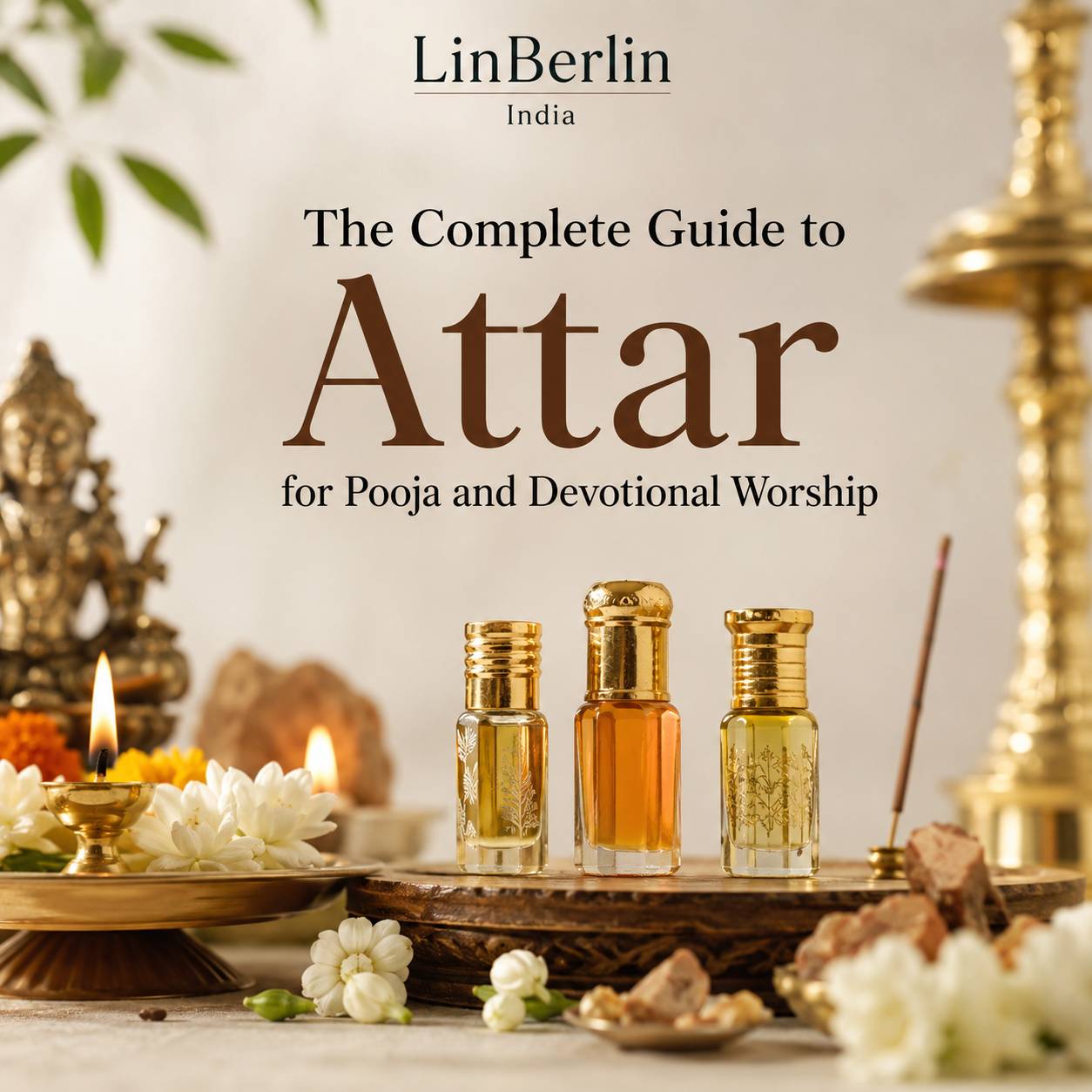
The scent that survives a summer havan is never the one you expected. A dozen agarbattis, camphor smoke, marigold, the faint sweetness of prasad — and somewhere underneath all of it, if the attar was chosen well, a single note that doesn't get lost. That's the real test of a devotional attar. Not how it smells from the bottle, but how it holds its own in a room already full of fragrance.
Most guides to puja attars talk about tradition and symbolism, which matters, but they skip the part that actually determines whether the fragrance works on the day: skin. Attar is worn, not just offered. It sits on wrists, on the nape of the neck, sometimes dabbed onto a deity's idol or a photograph before aarti. And skin — its temperature, its moisture, its oiliness — changes how every one of these fragrances behaves. So does the room. So does the season. Understanding that is, honestly, more useful than memorising which flower belongs to which god.
Why the Right Attar Changes How a Puja Feels
A devotional attar isn't decoration. It's meant to mark a shift — the moment daily routine gives way to something more deliberate. Real oud and sandalwood-based attars carry weight in a way synthetic incense sprays don't; they sit low and don't evaporate in the first ten minutes. That's part of why oil-based attars have stayed central to Indian devotional practice for centuries, even as spray perfumes took over everyday use.
But not every attar suits every deity, and this is where a lot of people get it wrong. A bright, sharp floral works beautifully for Durga Puja and falls completely flat for a quiet Shiva abhishekam. The mismatch isn't about right or wrong — it's about tone. Each puja carries its own emotional register, and the attar should sit inside that register rather than fight it.
Over time, many devotees discover that no single fragrance suits every ritual or every mood of worship. Floral compositions often feel at home during festive celebrations and Devi pujas, while sandalwood and woody blends are frequently preferred for quieter moments of prayer, meditation and reflection. Exploring a broader collection such as LinBerlin Pooja Attars allows devotees to find fragrances suited to different traditions and occasions, while creations such as DEVALAYA Pooja Attar & Meditation Attar were designed specifically for temple visits, meditation, chanting and personal spiritual practice where a softer, more contemplative fragrance feels most natural.
How Skin Actually Holds a Devotional Fragrance
Here's the thing most people never get told: attar doesn't perform the same way on every skin, and it has nothing to do with the quality of the oil. Dry skin burns through fragrance fast because there's less natural oil on the surface to bind the attar's molecules. Oily and combination skin, on the other hand, hold attar longer — sometimes twice as long — because the skin's own sebum acts like a slow-release layer underneath it.
This is why a Ganesh Pushp attar applied on freshly moisturised skin before a Tuesday puja will still be faintly present at dinner, while the same attar on dry, unmoisturised skin fades by afternoon. Moisture holds scent. It really is that simple, and yet it's the detail almost nobody mentions when they talk about "long-lasting" attars.
If you're applying attar before a lengthy puja — Navratri mornings, or a full Satyanarayan katha that runs for hours — a thin layer of an unscented or very mildly scented moisturiser on the pulse points beforehand will noticeably extend how long the fragrance stays present. Skip this step on dry winter skin and you'll likely be reapplying by the second hour of aarti.
For the Goddess: Durga and Lakshmi
Devi worship tends to call for florals with structure — not delicate, but confident. During Navratri and Durga Puja, a Durga Pushp attar for Durga Puja works well precisely because it doesn't try to be soft. It carries a fuller floral body, closer to how temple garlands smell after hours in the heat, rather than a clean, cut-flower freshness.
For Lakshmi puja — Diwali evenings especially — the mood shifts toward something warmer and more rounded. A Lakshmi Kamal attar for Maa Lakshmi puja built around lotus notes suits this beautifully, since lotus in Indian perfumery tends to read as gentle abundance rather than sharp sweetness. It's the kind of note that fills a room without announcing itself.
Ganpati and Hanuman Ji: Strength Before Anything Sweet
Ganesh Chaturthi calls for something that feels celebratory but grounded — not too heady, since the puja often stretches across visarjan processions and long, warm afternoons. A Ganesh Pushp attar for Ganpati Puja tends to hold up well here because floral attars of this kind are formulated to stay pleasant even in crowds and heat, rather than turning sharp or cloying.
Hanuman Ji puja, especially on Tuesdays and Saturdays, is a different register entirely. Devotees generally lean toward something bolder and more resinous. A Veer Sugandh attar for Hanuman Ji puja reflects that — it's built to feel assertive rather than gentle, which suits the energy most people bring to this particular worship.
Krishna's Corner: Shyam Baba, Laddu Gopal, and Radha Rani
This is arguably where devotional attar choice gets the most personal, because Krishna worship in Indian households often involves daily shringar — dressing and adorning an idol, not just an annual festival. For Shyam Baba worship, many households prefer a Shahi Darbar attar for Shyam Baba, something with a "royal court" character — warm, a little musky, unhurried.
Laddu Gopal shringar, on the other hand, tends to favour something lighter and sweeter, closer to how one imagines dressing a child-deity each morning. A Raj Shringar attar for Laddu Gopal is applied in small quantities, often on the idol's garments rather than skin, so a little goes further than you'd think.
And Radha Rani worship asks for something distinctly feminine and floral — soft, layered, never sharp. A Radha Shringar attar for Radha Rani puja is usually applied lightly at the base of the idol's neck or on flower offerings, since too much can overwhelm the smaller, more intimate scale most Radha Rani setups have at home.
Shiva, Rama, and the Discipline of Simplicity
Shiva worship rewards restraint. Sandalwood-forward attars remain the standard here for good reason — chandan has been used in abhishekam rituals for so long that any deviation tends to feel off. A Shiv Chandan attar for Mahadev puja works because it doesn't try to be more than sandalwood should be — cool, dry, a little austere.
Ram Navami and daily Ram Darbar worship call for something similarly composed but slightly warmer. A Ram Shringar attar for Shri Ram puja tends to lean into woody-floral territory, matching the dignified, orderly character most households associate with Ram Darbar.
The Navagraha Attars: Shani Dev and Surya Dev
Planetary worship has its own fragrance conventions, largely overlooked outside serious ritual circles. Shani Dev puja, observed on Saturdays, traditionally favours darker, heavier notes — black til, mustard oil associations run deep here, and attar choices tend to echo that gravity. A Shani Tatva attar for Shani Dev pooja is built around this heavier, earthier profile rather than anything floral or bright.
Surya Dev puja is almost the opposite. Morning Surya Namaskar rituals and Chhath Puja call for something that feels awake — citrus-adjacent or sharp floral notes that mirror sunrise rather than dusk. A Surya Pushp attar for Surya Dev puja is meant to be applied early, often before the sun is fully up, which is also when skin tends to hold fragrance best — cooler, less oily from the day's heat.
Vishnu Seva: The Quiet, Steady Attar
Vishnu worship — daily seva, Ekadashi observance, or larger temple-style pujas at home — usually calls for something understated. Not plain, but unhurried. A Vishnu Seva attar for Lord Vishnu puja tends to sit in woody, slightly sweet territory, designed to be present without pulling attention away from the ritual itself.
Applying Attar Correctly During a Puja
Most people apply attar the same way they'd apply perfume — a dab on each wrist and done. For devotional use, this isn't quite right. Attar meant to accompany hours of aarti or shringar should go on pulse points that stay covered from direct sun and heat: behind the ears, the inner elbow, the base of the throat. Direct sunlight and high heat break down natural oils faster, which shortens how long the fragrance lasts through a long ceremony.
Or, if the attar is meant for an idol rather than skin — as with many Laddu Gopal and Radha Rani shringar attars — a single drop on a cotton wick or directly onto garment fabric goes much further than dabbing it straight onto metal or stone, which can sometimes discolour delicate idol finishes over repeated use.
Skin Sensitivities Worth Knowing About
Real attar oils, even natural ones, aren't automatically risk-free. People with eczema, active breakouts, or recently exfoliated skin should avoid applying attar directly onto compromised areas — the concentrated oil can sting, and in some cases cause a mild reaction that has nothing to do with the attar's quality. Sandalwood and rose-based attars are generally gentler; heavier musk or oud blends carry a slightly higher chance of sensitivity for those with reactive skin.
And for anyone using strong actives — retinol, prescription acne treatments, recent chemical peels — it's worth applying attar somewhere other than the treated area entirely. Layering fragrance oil over freshly treated skin can cause irritation that has nothing to do with the fragrance itself and everything to do with a compromised skin barrier underneath.
Pregnant women, or anyone with a known history of fragrance allergies, should patch-test any new attar on the inner forearm at least a few hours before a long puja. It's a small step. Skipping it isn't usually a problem — but occasionally it is, and there's no way to know in advance which time that'll be.
A Few Common Mistakes
People over-apply, thinking more attar means longer-lasting fragrance. It doesn't — past a certain point, additional oil just sits on the surface and evaporates without adding real longevity. A single drop, worked in rather than rubbed hard, does more than three drops applied all at once.
People also store attar poorly — near heat, in direct sunlight, or with the cap loosely fitted — which shortens shelf life considerably. Real attar, kept properly, holds its character for years. Kept badly, it can turn flat within months.
Where This Leaves You
Realistically, there's no single "correct" attar for any deity — tradition offers strong guidance, not rigid rules, and personal and regional practice varies more than most guides admit. What matters more is understanding how the fragrance you choose will actually behave: on your skin, in your climate, across the length of your ritual. Start there, choose the note that matches the mood of the puja rather than just its name, and the rest tends to fall into place on its own.