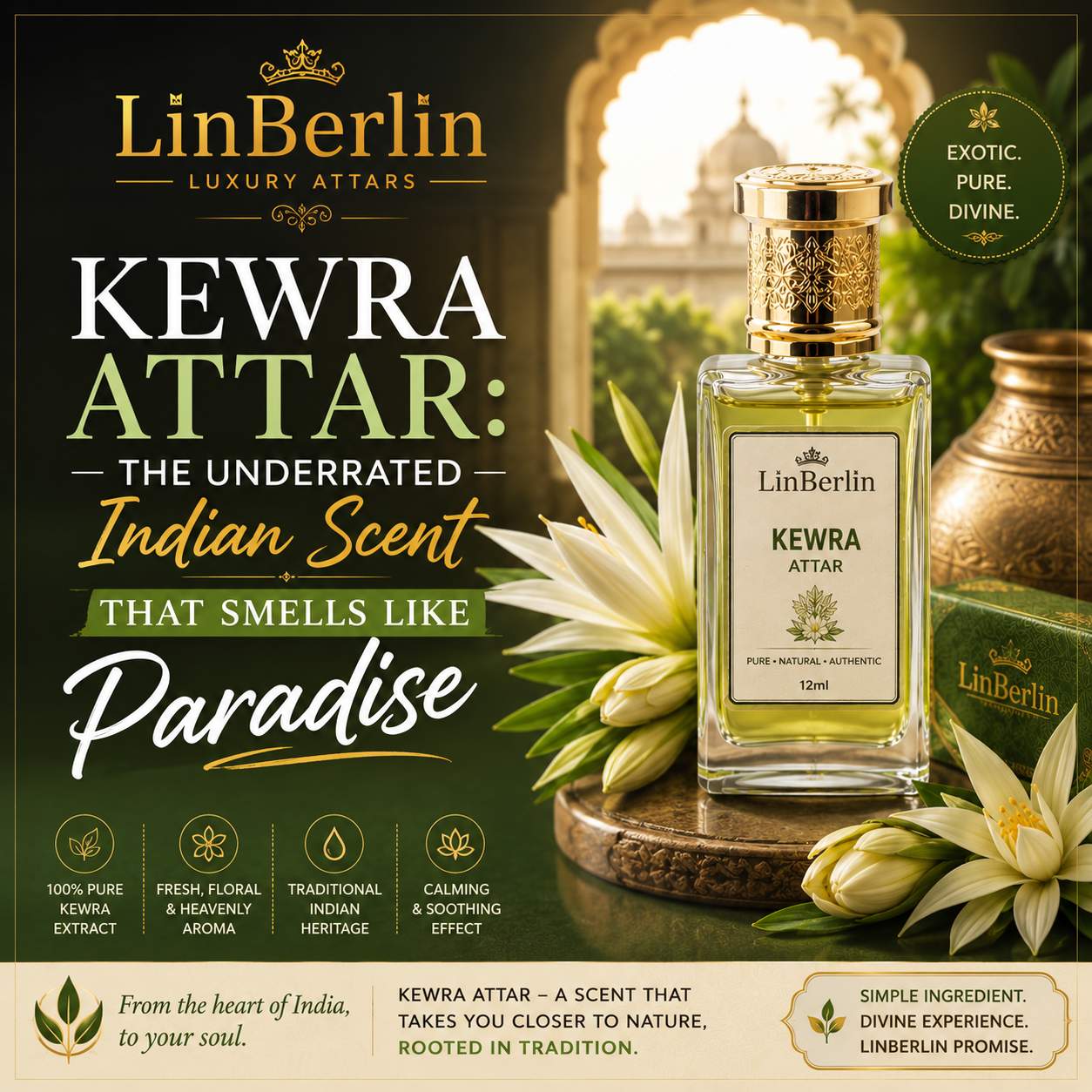
Kewra shows up in a biryani before it ever shows up in a perfume bottle for most people who grew up around it. That's the strange entry point most enthusiasts miss entirely — this is a scent most South Asians have been smelling their whole lives, folded into rice, drizzled over sweets at weddings, sprinkled at Eid gatherings, long before anyone thinks to wear it on skin. Which makes it one of the few attars where the "underrated" label is almost backwards. It's not unknown. It's just rarely been given the credit of being taken seriously as a fragrance in its own right, rather than a kitchen ingredient that happens to also smell nice on a wrist.
The flower itself comes from Pandanus odoratissimus, commonly called screw pine — not a pine at all, genetically, despite the name, but a spiky, tropical plant that grows along coastal regions of India, particularly Odisha, where the town of Ganjam has built centuries of distillation tradition around it. The flowers are tiny, cream-coloured, and almost aggressively fragrant even before distillation begins, which is part of why a small amount of kewra goes such a long way in both cooking and perfumery.
What kewra actually smells like, precisely
Green, honeyed, faintly medicinal at the very top — that's usually the first impression, and it can be a lot for someone expecting a straightforwardly sweet floral. Kewra doesn't behave like rose or jasmine. It's sharper on opening, almost herbaceous, with a quality some describe as similar to a ripe, slightly overripe fruit crossed with fresh-cut grass. That initial sharpness settles fairly quickly, though — within ten or fifteen minutes it softens into something rounder, sweeter, closer to what most people expect a tropical white floral to smell like. This is, honestly, part of why kewra gets underused outside South Asian contexts. The opening note can read as unfamiliar or even slightly off-putting to a nose trained entirely on rose, vanilla, and citrus. But that unfamiliarity is exactly what makes it worth paying attention to — it's a genuinely distinct olfactory experience in a market saturated with variations on the same handful of floral profiles.
Why the distillation method matters so much here
Traditional kewra attar is produced through the same deg-bhapka copper still process used for most classical Indian attars — flowers steeped in water, heated slowly, with the aromatic vapour captured into a sandalwood or liquid paraffin base rather than alcohol. This matters more for kewra than for some other florals, because the flower's aromatic compounds are genuinely delicate and heat-sensitive; rushed or overheated distillation can push the profile toward something sharper and less balanced than a properly slow, traditional process produces. The result, done well, is an attar that opens with that characteristic green sharpness and then genuinely develops over the course of wear — not just fading, but actually changing character as it warms against skin. That evolution is one of the clearer signs of quality with kewra specifically, since a poorly distilled or synthetically supplemented version tends to smell largely the same from the first minute to the last, without that slow unfolding real kewra oil goes through.
How kewra behaves differently across skin types
Here's where the beauty-writer half of this matters more than most kewra guides bother covering. Dry skin tends to lose kewra's sweeter, rounder mid-development faster than it would with a richer oil like sandalwood or oud — there's simply less natural moisture to hold the fragrance compounds through their full evolution, so the wearer sometimes only catches that initial sharp green opening before it fades, missing the softer, honeyed stage that makes kewra genuinely lovely. A light, unscented moisturiser underneath helps considerably here, giving the attar more surface to develop against rather than evaporating off dry skin too quickly. Oily and combination skin, by contrast, tends to hold onto kewra's full journey more reliably, extending both its green opening and its sweeter settling phase across several hours. This is one of the notes where oilier skin genuinely gets more out of a bottle than drier skin does, purely due to how the fragrance's own volatility interacts with skin's natural oil content. Sensitive skin generally tolerates kewra reasonably well, though — and this is worth being honest about — its intensity means overapplication is a real risk regardless of skin sensitivity. A little genuinely goes a long way, and applying it the way one might apply a heavier spray perfume can result in a scent that reads overwhelming rather than intriguing, particularly indoors or in warm weather. One or two dabs on pulse points is usually plenty.
A few situations that call for caution
Anyone with a documented history of floral fragrance sensitivity should patch test kewra specifically before full application — its concentrated, somewhat unusual compound profile means it's not automatically covered by "I've never reacted to florals before," since kewra's chemistry doesn't overlap neatly with rose or jasmine's more familiar irritant profiles. A small dab on the inner arm, twenty-four hours' wait, is the sensible approach for a first-time wear. Pregnancy caution applies here the same way it does with most concentrated essential oils — worth checking with a doctor before regular use, particularly given how commonly kewra shows up in both fragrance and food in South Asian households, which can mean higher cumulative exposure than someone unfamiliar with the ingredient might expect. And layering kewra directly over freshly applied retinol or other strong actives carries the same general caution as any concentrated oil-based fragrance — a twenty-to-thirty-minute gap after skincare has properly absorbed avoids most risk of mild stinging on temporarily more permeable skin.
Why kewra sits so deep in memory for so many people
There's something worth naming honestly here — kewra is, for a huge number of people, less a fragrance discovery and more a memory trigger. Wedding sweets, Eid mornings, a grandmother's kitchen. The scent-memory connection is genuinely well documented in how smell interacts with the brain's limbic system, more directly than any other sense, which is part of why a single note like kewra can transport someone decades back in an instant. There's a solid piece on exactly this mechanism in how fragrance actually affects mood, memory, and focus, worth reading if the science behind why kewra hits so differently for some people is something you're curious about. Realistically, this emotional weight is probably kewra's biggest advantage over more "universally pleasant" florals — it doesn't try to please everyone equally. For the people who grew up around it, wearing kewra attar is closer to wearing a memory than wearing a fragrance, and that's a genuinely rare quality in perfumery.
Where kewra pairs well
Kewra alone is distinctive enough to wear as a single note, but it also layers thoughtfully with deeper, quieter bases that let its green sweetness stand out rather than compete. Musk in particular tends to round kewra's sharper edges into something more wearable for longer stretches — there's a good exploration of that darker, more brooding musk category in deep, mysterious musk attars worth layering underneath something like kewra, worth a look if you want kewra to feel a little less exposed on its own. If you're building out a small festive rotation — kewra is genuinely at home during wedding season and Eid gatherings — there's a helpful roundup of affordable gifting perfumes that still feel like real luxury, useful if kewra is destined to become part of a gift alongside other seasonal fragrance picks rather than a solo purchase.
Where this leaves you
Kewra isn't a fragrance that asks to be liked immediately — it asks for a bit of patience through that first sharp minute before it settles into something genuinely lovely. For anyone tired of the same rotation of rose, oud, and vanilla, it's worth the adjustment. Apply less than you think you need, give it time to develop, and pay attention to what it stirs up. Chances are, if you grew up anywhere near South Asian kitchens or celebrations, it'll stir up more than you expect.