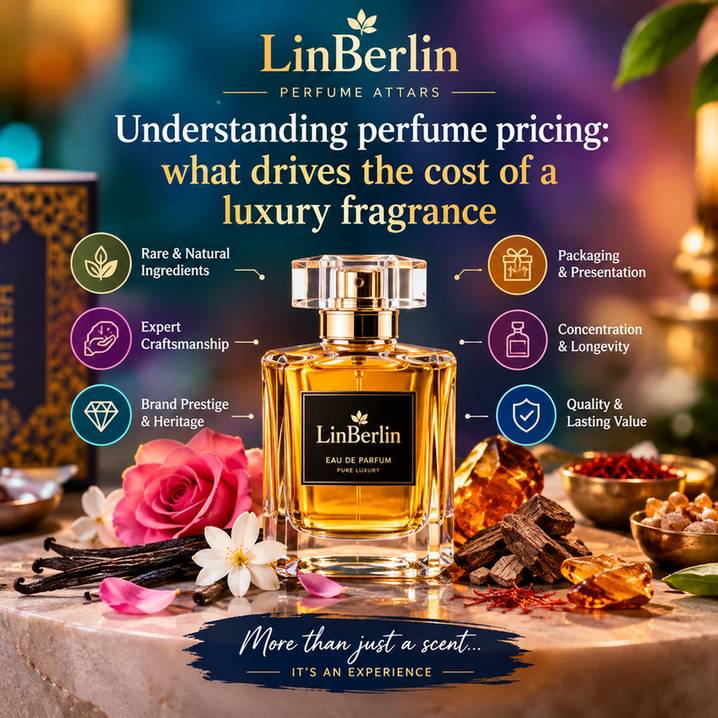
Understanding perfume pricing: what drives the cost of a luxury fragrance
The most expensive part of a luxury fragrance is often the part you can't smell. Heavy glass, a magnetic cap, a campaign shot somewhere with a coastline. Your hand registers the value of the bottle before your nose has said a word.
That isn't a scandal, exactly. It's just worth knowing before you spend, whether the purchase is for yourself or for someone you're trying to impress. So here is where the money actually goes, which costs are honest, and how to tell the difference when you're standing at a counter or staring at a product page.
What is actually in the bottle
Start with the oil itself, because this is where natural perfumery is genuinely expensive and no amount of clever marketing changes that.
A kilo of true rose oil takes several thousand kilos of petals, picked by hand in the early morning before the sun burns the scent off them. Jasmine is gathered at night. Oud comes from agarwood that has been infected and slowly transformed over years (wild supply is tightly restricted now, which pushes prices up every season). Genuine sandalwood comes from trees that need decades to mature, and the trade around it is regulated. None of this can be hurried, and none of it scales the way a factory line does.
Synthetic aroma molecules are a different story. They are cheaper, steadier from batch to batch, and some of them are beautifully made. Here's the thing: a high price does not prove a perfume is natural, and a low one does not prove it is poor. Realistically, you are paying for what the maker chose to put in, and you can only judge that if the brand tells you.
Musk is a good example of how murky this gets. Animal musk is long gone from legitimate perfumery, so what you smell today is plant-derived or synthetic, and the difference shows up in the bill. If you're curious how a natural-leaning musk behaves on skin, these musk-based attars that smell deep and mysterious are a fair place to compare scent depth against price.
Vanilla deserves a mention too. Real vanilla is labour-heavy, hand-pollinated and slowly cured, which is why it quietly raises the cost of any blend that leans on it. A softer pairing such as lavender and vanilla shows how much character a restrained, well-chosen ingredient list can carry.
Concentration, base and the question of what stretches the oil
A bottle of alcohol-based eau de parfum typically carries a modest share of fragrance oil, topped up with alcohol and water. That's why it feels light and sprays evenly. It's also why a lot of the volume you pay for evaporates within minutes.
An attar works differently. Traditional attars are concentrated oils, usually carried in a sandalwood base rather than alcohol, so the price per millilitre looks steep. But you apply a dab, not a cloud. Count the cost per wear instead and the picture shifts, sometimes dramatically. Sometimes. It depends how often you wear it and how forgiving your skin is, which I'll come back to.
Format matters as well, and not only for price. The same notes behave differently depending on how they're delivered, which is the whole argument behind rose oud as a daytime spray or an evening oil. A spray is easier to wear lightly. An oil stays closer to the skin and rewards patience.
Time, copper pots and the waiting nobody photographs
Traditional distillation is slow on purpose. In the Kannauj tradition, flowers or woods go into copper stills sealed with clay, and the vapour is led into receivers holding the base oil. It can run for many hours, and the result is often rested for weeks or months afterwards so the rough edges settle.
So you are paying for labour and for time (and for the person who knows by smell, not by timer, when a batch is ready). A perfume that skips the resting, or fills out the blend with cheaper material, can reach a shelf faster and a price tag lower. Whether it smells as good a year later is another matter.
The part that has nothing to do with scent
Glass, caps, boxes, ribbon. Advertising, retail margins, distribution, the rent on a prime shop floor. The truth is, in many mass-market luxury fragrances, a big share of the price sits here rather than in the liquid, and nobody can tell you the exact split. It's — well, it's not always a bad thing. A beautiful bottle is a real pleasure, and good packaging protects the oil from light and air.
But it does mean two bottles at the same price are not worth the same inside.
Why the same bottle behaves differently on different people
Here is something price tags never tell you. What you pay and what you get also depend on your skin.
Moisturised skin holds scent longer. Dry skin drinks fragrance up and lets it go quickly, so an expensive oil can seem to vanish by lunchtime on bare, thirsty skin. A thin layer of unscented moisturiser first gives the oil something to cling to. Oily skin tends to project more and can make top notes bloom and fade faster, so people with it often prefer a lighter hand and warmer, deeper notes. Sensitive skin needs the most care of all.
A few cautions are worth taking seriously:
- Patch test before wearing anything new. A small dab inside the elbow, then wait a day. Natural is not automatically gentle, and citrus oils such as bergamot can react badly with sun on the skin.
- Skip application on freshly exfoliated, sunburned or broken skin, and be careful if you use retinoids, strong acids or benzoyl peroxide, because those products can leave skin more reactive than usual.
- If you are pregnant, or have known fragrance allergies, ask your doctor before adding essential-oil-heavy products to your routine.
People often don't realise they have a reaction until they've layered things carelessly, usually a scented body lotion under a strong attar, and end up with redness or an itchy wrist they blame on the perfume. Keep the base layer plain.
Reading a price tag like someone who has been burned before
First, divide the price by the millilitres. A tiny, strong bottle and a large, diluted one are not comparable otherwise. Then look at what the brand says about its ingredients and base, and whether it explains how the scent is made at all. A brand that is proud of its process will usually say so. Return policies and sample sizes matter too, though that's a topic for another day.
A caveat, honestly given: no checklist replaces smelling the thing on your own skin. I can tell you what drives cost, but I can't tell you what you will love.
Gifts, budgets and quiet luxury
Price and thoughtfulness don't move together. If you are buying for someone, you can still get real quality without the top-shelf figure, and elegant gifts under ₹500 are a decent test of that idea. Students are a good example of a buyer who wants staying power without the price, and these picks under ₹300 for college students show how far a small budget can go.
Or spend more, once, on something you will wear for years. Both are reasonable.
The short version before you buy
Pay for ingredients, process and honest information, not for the glass and the glamour. Check the price per millilitre, patch test on your own skin, moisturise first, and ask for a sample when you can. The best-priced fragrance is the one you reach for again and again.