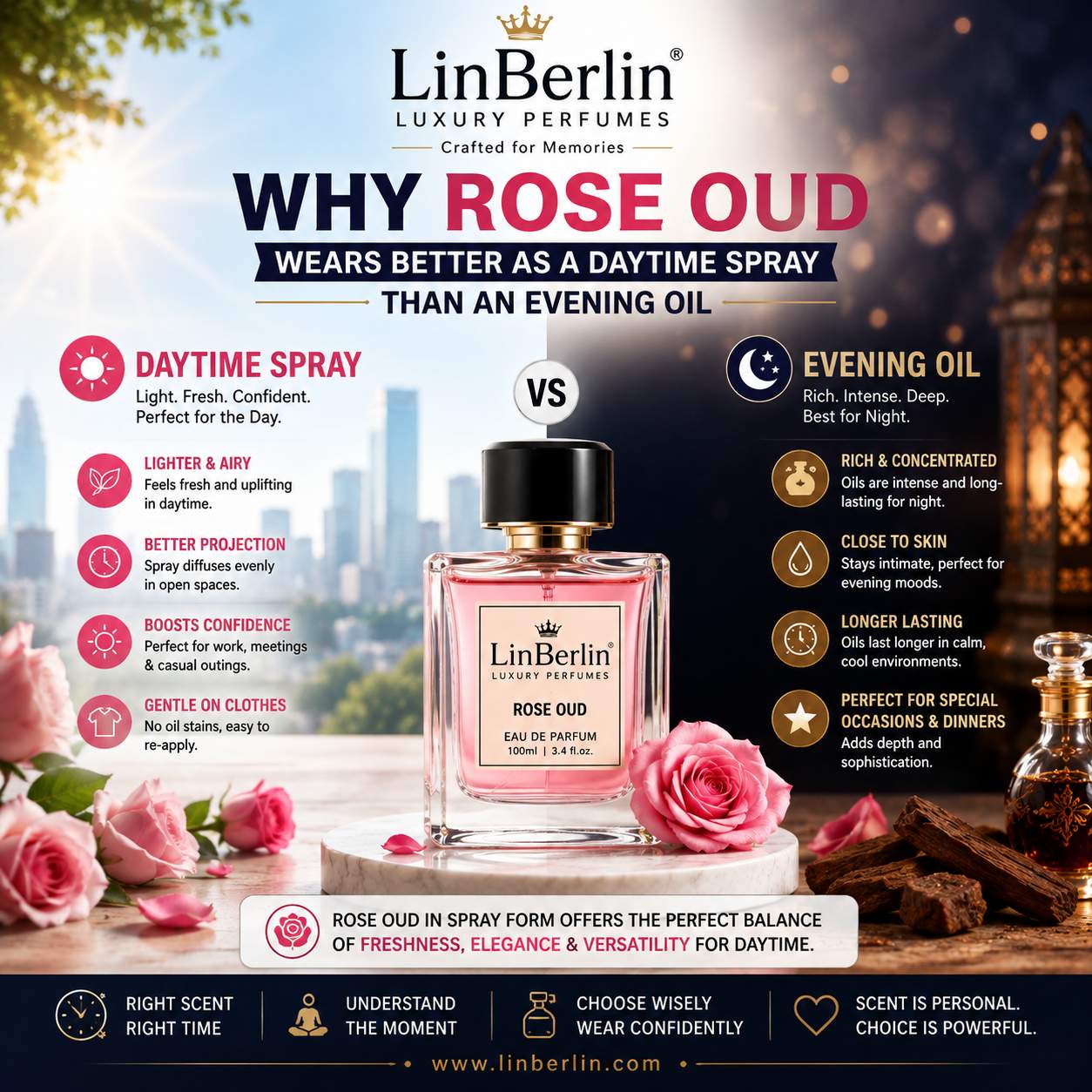
Most rose oud gets sold with candlelight in mind — dim lighting, dinner tables, the whole evening-luxury package. And there's a reason that pairing feels so automatic: rose oud is rich, it's layered, it reads expensive. But spend enough time actually watching how the same rose oud behaves on skin at 9am versus 9pm, and a different pattern shows up. The daytime version, worn light and sprayed rather than dabbed in oil, often performs better — not louder, better. Fewer people talk about this, mostly because the marketing around oud has trained everyone to think "heavy" automatically means "for later."
That's worth questioning, especially with rose oud specifically, because rose is a note that behaves differently depending on temperature, skin chemistry, and how concentrated the application is. So before assuming evening is the only correct context, it helps to understand what's actually happening chemically and practically when rose oud meets skin at different times of day.
What Makes Rose Oud Different From Other Oud Blends
Rose and oud aren't a natural pairing in the way people assume. Oud on its own is dark, resinous, sometimes animalic depending on the grade — and rose is bright, slightly green, a little sweet. Put them together and you get tension rather than harmony, which is exactly what makes the combination interesting. The rose softens oud's rawer edges. The oud gives rose a backbone it doesn't have on its own, since rose alone can read thin or one-note after the first twenty minutes.
That tension is also why rose oud gets misjudged so often. Worn too heavy, the oud dominates and the rose disappears into something murky. Worn light, the balance actually shows — and this is where daytime wear starts to make more sense than people expect.
Why Oil Application Pushes Rose Oud Toward "Evening Only"
Attar oil sits close to the skin and builds warmth over hours. That's the whole appeal of oil-based perfumery — it's slow, it's intimate, it develops rather than announces itself. But that slow build works against rose oud specifically, because as oud warms on skin through the day, its deeper resinous facets intensify while the rose note — lighter, more volatile — tends to fade earlier in comparison. By late afternoon, an oil application often leans much heavier toward oud than it started, and that shift is exactly what gives rose oud its "nighttime" reputation. It's not that rose oud is inherently an evening scent. It's that oil application, worn across a full day, naturally drifts that direction on its own.
A spray format changes this equation. Alcohol-based or lighter carrier sprays diffuse faster and don't build the same slow-burning warmth that oil does. The rose stays present longer relative to the oud because the whole composition isn't sinking into skin oils and re-warming itself hour after hour. It's — well, it's a bit more complicated than just "spray equals lighter," because skin type still plays a role here too. But broadly, spray formats hold the rose-oud balance in a more even place across a workday than oil does.
How Skin Type Changes This Further
This is the part that rarely gets explained properly in fragrance guides, and it matters more with rose oud than with simpler compositions. Oily or well-moisturized skin holds fragrance molecules longer and lets them develop more fully — which sounds like an advantage, and often is, but with rose oud it also means the oud facets get more fuel to intensify across the day. Someone with naturally oily skin wearing rose oud oil by midday might already be smelling something closer to a pure oud than a rose oud.
Drier skin, by contrast, lets fragrance fade faster and thinner overall. On dry skin, a light spray application of rose oud can actually read as underwhelming by early afternoon, simply because there's less natural oil to anchor the scent molecules against. If that's your skin type and you want rose oud to last through a full office day, a thin layer of unscented, non-comedogenic moisturizer applied first — before the spray, not layered over it — genuinely extends how long the composition holds its balance.
And this is where caution matters too, since it's easy to assume "more moisturizer means more longevity" and start layering fragrance over active skincare without thinking it through. Applying rose oud, or any concentrated fragrance, directly over fresh retinoid application or recently exfoliated skin can increase irritation risk — not because oud itself is harsh, but because a compromised skin barrier reacts more strongly to almost anything placed on it. If you're using strong actives in your morning routine, it's safer to apply fragrance to clothing or pulse points that weren't part of that routine, rather than directly over treated skin.
Choosing Between Rose Oud Variations
Rose oud isn't a single fixed formula across the fragrance world, and comparing rose oud against other oud styles — arabian, black, white — helps clarify why the rose version specifically suits lighter daytime wear better than most. If you're newer to oud altogether and unsure how rose oud fits against the more common starting points, there's a genuinely useful beginner's comparison of arabian, black, and rose oud as starting points, which explains where rose oud sits on the intensity spectrum relative to the darker, heavier oud styles most people picture first.
For those who want to explore how rose interacts with a lighter oud style specifically — closer to what daytime wear is aiming for — there's also a piece on how rose behaves paired with white oud rather than the darker traditional variety, worth reading if the rose-oud combination interests you but the classic dark-oud version still feels a bit heavy for your taste.
Why Rose Oud Costs What It Does
The truth is, a lot of buyers hesitate on rose oud purely because of price, without understanding what's actually driving that cost. Genuine oud oil isn't a synthetic shortcut — it comes from a slow, resource-intensive process involving infected agarwood trees and years of maturation before the oil is even usable. Understanding that background changes how the price reads; it stops looking like markup and starts looking like the actual cost of a genuinely rare material. There's a detailed breakdown of exactly why oud carries the price it does, from tree to finished attar oil, which is worth reading before assuming a rose oud perfume is overpriced relative to simpler florals.
When Evening Oil Still Wins
None of this means the oil version has no place — that would be an unfair conclusion to draw. For a dinner, an event, anything where you're staying in one climate-controlled space for a few hours rather than moving through heat, traffic, and a full workday, oil-based rose oud does exactly what oil does best: it develops slowly, it stays close to skin, and by the second or third hour it often smells more complete than it did at first application. Daytime spray wear trades that slow development for consistency and lighter projection — a fair trade for an office, a less obvious one for a candlelit dinner.
Realistically, the "right" format depends on where you're going and how long you'll be there, not on some fixed rule that oud belongs to nighttime. If you're specifically after something reliable for office hours, LinBerlin's rose oud perfume, Ruby, is built as a spray specifically for that kind of consistent, all-day wear rather than the slow-build evening format oil delivers.
If your budget leans lighter and you mainly need something dependable for a work or college routine rather than a statement evening scent, it's also worth browsing affordable office and college perfumes under ₹500 that genuinely hold up through a full day before committing to a full-priced oud composition — not every daytime scent needs to be rose oud, even if rose oud happens to be a strong option once you understand how to wear it.
The Simple Takeaway
Rose oud isn't naturally an evening-only fragrance. It just behaves like one when worn as a slow-building oil across a full day, letting the oud overtake the rose by afternoon. Switch to a lighter spray format for daytime, pay attention to your own skin type and moisture level, and the rose-oud balance holds far more evenly than most people expect — leaving the oil format for evenings where that slower, warmer development actually works in your favor.