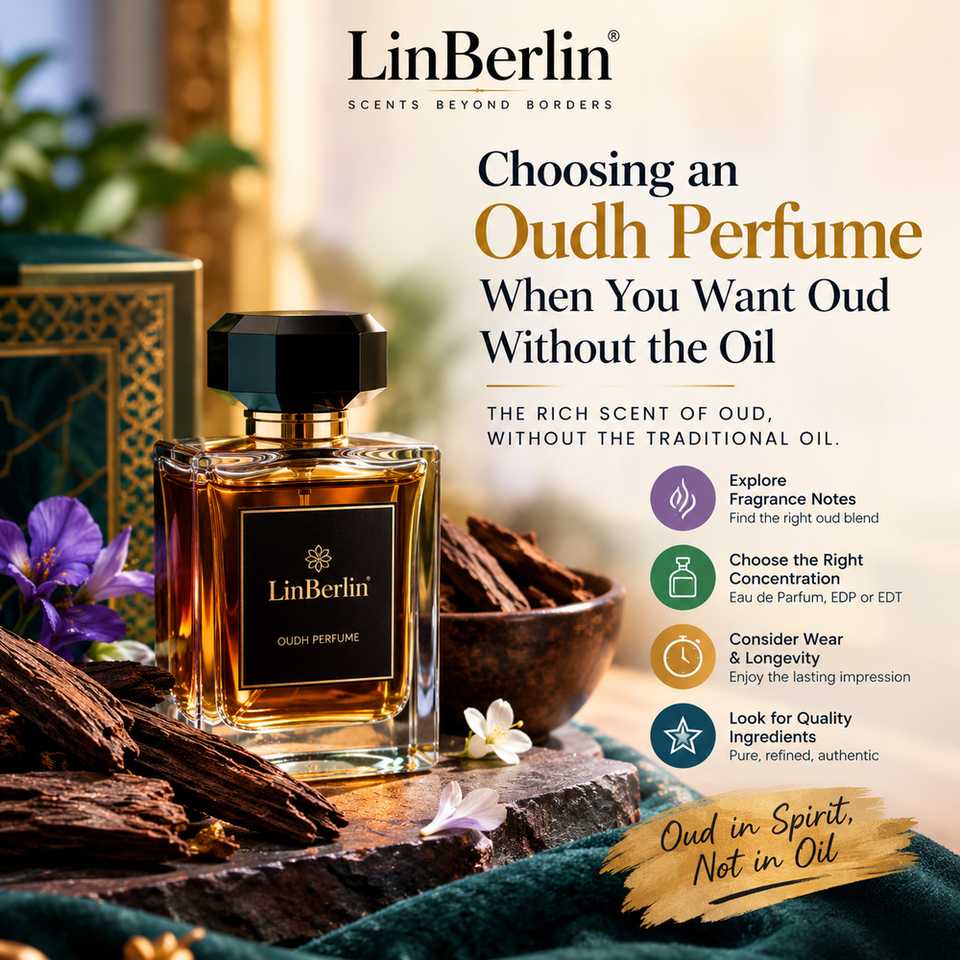
Most fragrance complaints that reach me have nothing to do with scent. They're about texture. Someone loved the smell, wore it twice, and then noticed a faint shine along the jawline or a stubborn ring on a kurta collar — and quietly stopped reaching for the bottle.
That's usually the real story behind the phrase "I want oud, but not the oil."
It's a reasonable thing to want, and it's also one of the most misunderstood requests in perfumery. Because "oil" can mean four different things depending on who's saying it, and until you work out which one you mean, you'll keep buying the wrong bottle. So let's untangle it properly, from the skin outward.
What people actually mean when they say "no oil"
In my experience there are three separate complaints hiding under one sentence, and they need three different solutions.
The first is about feel. Some attars sit on the skin with real weight — a slow, slightly tacky film that takes twenty minutes to settle. If you have oily or acne-prone skin, or you live somewhere humid (much of India qualifies for at least four months a year), that film registers as greasy long before it registers as luxurious.
The second complaint is about staining. Heavy oil-based attars, especially resinous dark ones, can leave marks on pale fabric. This is not a flaw in the attar. It's chemistry meeting cotton.
And the third — this is the one people rarely say out loud — is really about intensity. They don't mind oil. They mind smelling like a bonfire of medicine cabinets for nine hours. What they want is Oudh that behaves, not oud that announces.
Work out which of those three is yours before you shop. The rest of this guide gets much easier after that.
Your skin decides more than the bottle does
Here's the thing nobody tells beginners: the same 3ml of attar performs completely differently on two people, and the variable is skin, not quality.
Dry skin is porous and thirsty. It absorbs fragrance fast and lets go of it fast, which is why dry-skinned people often complain that expensive attar "disappears" in two hours. It didn't disappear. It sank. Applying to well-moisturised skin — a plain, unscented cream or a little jojoba or almond oil as a base — gives the aromatic molecules something to cling to, and easily adds a few hours of wear. This is the single most useful trick in oil perfumery and it costs nothing.
Oily skin does the opposite. It holds scent longer, projects more warmly, and pushes the top notes up faster because of surface heat. If you have oily skin and keep finding attars "too much," you probably aren't wearing too much — you're wearing the wrong concentration. Half a dab is a legitimate dose.
Combination skin is where most people actually live, and it's why the same attar can smell balanced on your wrist and overwhelming behind the ear. Test both. Seriously, test both.
Mature skin tends to run drier and slightly less acidic, which softens sharp top notes and flatters resins, amber, and woods. It's a lovely match for oud, honestly. Sensitive skin is its own conversation, and we'll get there.
The layering mistakes that cause most reactions
Nine times out of ten, when someone tells me an attar "broke them out" or stung, the attar wasn't the problem. The sequence was.
Fragrance on freshly exfoliated skin is the classic error. If you've used an AHA, a BHA, retinol, or benzoyl peroxide on an area, your barrier is temporarily more permeable — that's the point of those actives — and anything aromatic applied on top will be absorbed faster and felt more sharply. Wrists and inner elbows are usually safe because nobody puts retinol there. The neck is not safe, because plenty of people do.
Freshly shaved skin, same problem. So is skin straight out of a hot shower, where the pores are open and the barrier is softened. Wait. Dry off, moisturise, let it settle for five minutes, then apply.
And then there's sunlight. Certain naturals — citrus oils in particular, bergamot being the usual culprit — can cause photosensitivity, leaving temporary dark patches where they met UV. Oud itself isn't the risk here, but many oud blends carry a citrus opening, so a daytime application on the back of the hand isn't ideal if you're about to spend three hours outdoors.
One more, quietly: don't rub. Rubbing wrists together crushes the top notes and generates heat, which speeds evaporation. Press instead.
If you'd rather it never touched your skin at all
This is a completely valid choice, and it's underrated.
Attar on fabric lasts dramatically longer than attar on skin — sometimes days rather than hours — because there's no body heat driving it off and no skin chemistry altering it. The scent also stays truer to what you smelled in the bottle. For anyone with genuinely reactive skin, fabric application isn't a compromise; it's arguably the more faithful way to wear oud.
The obvious worry is staining, which is why it matters to choose blends formulated with that in mind. LinBerlin's fabric-safe amber oudh is a good example of a blend you can put on a shirt cuff without holding your breath. Test on an inside seam first anyway — pale silk and raw linen are unpredictable, and a rule that works for cotton won't always hold.
Scarves, the inside of a collar, a jacket lining, the hem of a dupatta. All better than hair, which is drier than people assume and doesn't love repeated oil application near the scalp.
Reading the label without getting confused
The naming around oud is genuinely messy, and beginners lose money to it.
Pure oud oil — dehn al oud, distilled from infected agarwood — is thick, expensive, and frequently barnyard-sharp for the first ten minutes. If that's what you tried and disliked, don't write off the whole category. Most oud you'll enjoy wearing is a composition: oud sitting inside rose, amber, saffron, musk, or sandalwood, where those materials round off its edges.
Spelling causes its own confusion. "Oud," "oudh," "aoud" — mostly transliteration differences rather than different materials, though the marketing around each has drifted apart over time. If you've wondered whether black oudh and black oud are actually different things, the short answer is: usually not, but the blends sold under each name can be.
Lighter interpretations exist too, and they're the sensible entry point for anyone in a warm climate. A light oudh attar for hot weather gives you the woody signature without the density that makes heavy oud feel claustrophobic at 38°C.
A short checklist before you buy
- Ask what the oud is blended with. Rose and saffron soften it; leather and labdanum amplify it. This one question tells you more than any note pyramid.
- Buy the smallest size first. 3ml is enough to learn your own chemistry.
- Patch test on the inner forearm and leave it a full 24 hours — not 10 minutes.
- Wear it through a whole day before judging. Oud's first fifteen minutes are rarely representative.
If you want somewhere sensible to start, our luxury oud perfume is built to be wearable rather than punishing, which is exactly what a first oud should be. And if you eventually want something with more force behind it, the range of stronger, longer-lasting oud fragrances is there when your nose is ready for it.
When to be genuinely careful
An honest limitation, because this matters more than a sale: natural does not mean hypoallergenic. Naturals contain dozens of aromatic compounds, and some of the most common allergens in perfumery — linalool, eugenol, limonene — are natural constituents, not synthetic additives. A person can react to a pure attar and be perfectly fine with a synthetic one.
If you have eczema, psoriasis, rosacea, or broken skin anywhere near the application area, keep fragrance off it entirely and use fabric instead. If you have a known allergy to a botanical family, ask for the full ingredient breakdown before buying rather than after.
Pregnancy is a common question and the honest answer is that evidence is thin either way. Many people find their sense of smell changes so drastically in the first trimester that heavy resins become unbearable regardless. Lighter application, fabric rather than skin, and a word with your doctor if you're unsure — that's the reasonable position, and anyone promising you certainty is overreaching.
Children's skin is thinner and more permeable. Don't apply concentrated attar to it.
Where to go from here
Start with one small bottle of a blended oud rather than a pure oil. Moisturise first if your skin runs dry, use half what you think you need if it runs oily, and give yourself a week of wearing it before deciding anything. If your skin objects at any point, move the same attar to your collar and scarf — you lose almost nothing, and you keep the scent you liked.
Oud rewards patience more than most materials. It's worth learning slowly.