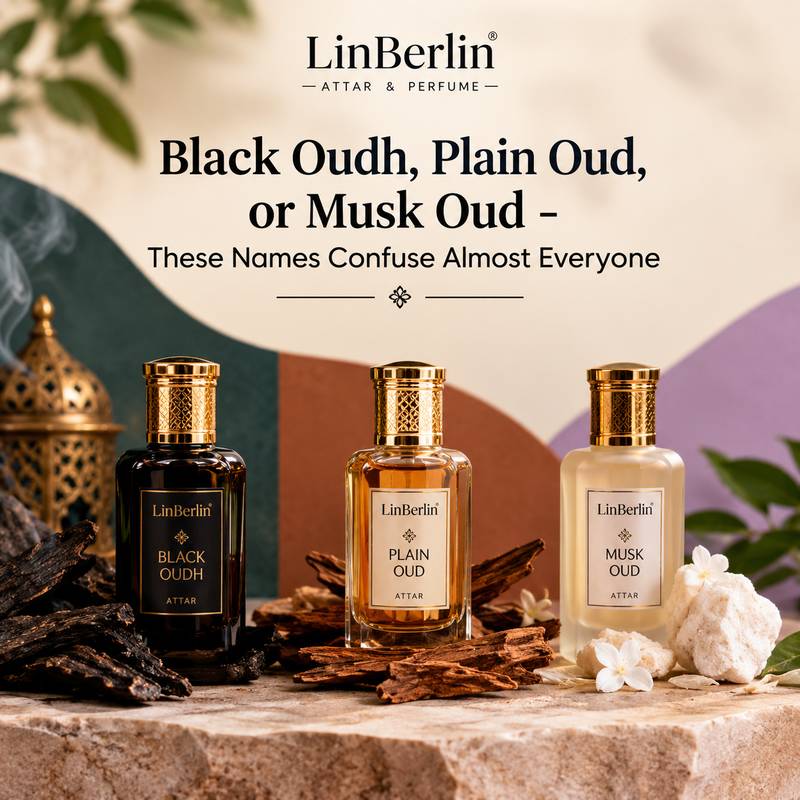
A customer once wrote to LinBerlin asking for "the black musk oud, not the plain black one, but the dark one that's also musky." We read that sentence four times before we understood what she actually wanted. She wasn't confused about fragrance. She was confused about names — and honestly, the industry hasn't done buyers any favors here.
Oud terminology gets thrown around loosely across markets, packaging, and even by sellers who should know better. Black oudh, plain oud, musk oud — three names that sound like variations on a theme but actually describe three fairly distinct experiences on skin. If you've ever stood at a counter or scrolled a product page trying to figure out which one will actually smell like what you imagine, this is for you.
Where the Confusion Actually Begins
Most of it traces back to how oud is processed and blended, not to any single agreed-upon naming system. Raw oud oil itself varies wildly depending on the tree species, region, and how the wood was aged before distillation. So when a brand adds the word "black," they might mean a deeper, more matured oud. Or they might just mean the bottle is dark. There's no universal rulebook, and that's the honest truth of it.
Musk adds another layer entirely. Some musk oud blends lean animalic and warm, others go powdery and clean — and the ratio of musk to oud changes the entire personality of the scent. A brand's "musk oud" could smell nothing like another brand's version. Realistically, the only way to know is to understand what each term means at the ingredient level, then check what a specific brand is actually offering.
Black Oudh (Oud e Zulmat): The Deep, Resinous End of the Spectrum
Black oudh usually refers to a darker, more matured, and often more intense oud profile — think aged wood, leather, and a smoky depth that develops rather than announces itself. LinBerlin's black oudh attar (Oud e Zulmat) sits at this heavier end. It's not a scent that opens loud. It builds, quietly, over the first twenty minutes on skin, and that slow reveal is part of what people mistake for weakness when it's actually just how dense oud behaves.
People sometimes ask if black oudh is a completely different raw material from regular oud. It isn't, really — it's more a matter of maturation, distillation method, and sometimes wood origin, all of which push the scent toward something darker and more grounded. One of our fragrance guides goes deeper into this exact question, and if you're curious whether "black oudh" is really its own product or just a naming variation, it's worth a read before you buy.
Plain Oud Attar: Unblended, Unapologetic, Occasionally Misunderstood
Plain oud is exactly what it sounds like — oud without the sweetness of amber, the animalic warmth of musk, or floral rounding. It's the rawest expression a brand can offer, and it's not for everyone. Some people smell it for the first time and recoil slightly. That reaction is normal. Genuine oud can be sharp, medicinal, even a little barnyard-adjacent before it settles.
LinBerlin's oud attar is built for buyers who want that unfiltered character — collectors, mostly, or people who've already worn blended ouds and want to understand the base note they've been smelling all along. It rewards patience. Give it an hour on skin before deciding you don't like it.
There's a quieter side to plain oud too, one that doesn't get talked about as much: how it behaves at night, away from crowds, when there's nothing competing with it. We wrote about that mood specifically — how a dark oud reads when it's paired with tobacco and quieter, velvet-toned notes — and it's a useful reference if plain oud is the direction you're leaning.
Musk Oud (Oud e Mishk): Where the Sharp Edges Get Softened
Musk oud takes that raw, sometimes intimidating oud character and rounds it off. The musk doesn't hide the oud — a good blend never does that — but it cushions the sharper top notes and adds a skin-warm, slightly sweet undertone that reads as more approachable. This is usually the entry point for people who want to like oud but found the pure version too much.
Our musk oud attar (Oud e Mishk) is a good example of this balance — dark enough to still feel like oud, soft enough to wear to dinner without announcing yourself from across the room. And this is where black oudh and musk sometimes get confused with each other, since both can smell "dark" to an untrained nose. But they're built differently. One is intensity through depth, the other is intensity softened by warmth. If you want the fuller picture on how these two actually interact when layered or compared side by side, this piece on how black oudh and musk share a certain nighttime warmth is genuinely useful.
A Quick Side-by-Side, For the Skimmers
| Attar | Character | Best For |
|---|---|---|
| Black Oudh (Oud e Zulmat) | Deep, resinous, slow-building | Evening wear, experienced oud lovers |
| Plain Oud | Raw, sharp, unblended | Collectors, layering base, oud purists |
| Musk Oud (Oud e Mishk) | Warm, softened, skin-close | First-time oud buyers, daily wear |
None of these categories are rigid, by the way. A brand's "plain oud" might be softer than another brand's "musk oud" depending on sourcing. So use this table as a starting compass, not gospel.
How These Actually Wear, Skin Type by Skin Type
Here's the thing nobody tells you at the counter: oud attars don't perform the same way on every skin, and it has almost nothing to do with the fragrance itself. It's about your skin's moisture level and pH.
Dry skin burns through top notes faster and often makes attars — especially oud-heavy ones — smell sharper and thinner than intended, because there's less oil on the surface to slow evaporation. Oily or well-moisturised skin, on the other hand, holds onto attar oils longer and rounds out the sharper edges naturally. So if you've applied plain oud on dry skin and thought it smelled harsh, that might not be the attar's fault at all.
Combination skin sits in between and tends to show the truest, most balanced version of a blend — which is honestly why we recommend testing new attars on the inner wrist rather than clothing, where oil transfer varies too much to judge fairly.
Layering With Skincare Without Working Against Yourself
A well-moisturised base does more for attar longevity than almost any application trick. Apply a light, unscented moisturiser or a plain carrier oil to pulse points first, then the attar — the oil-in-oil environment holds the fragrance molecules closer to skin and slows the rate they evaporate. It's a small step. It makes a real difference, though, especially in dry climates or air-conditioned offices.
Caution matters here too, and it would be dishonest to skip it. If you're using active skincare ingredients — retinoids, AHAs, benzoyl peroxide, anything that thins or sensitises the skin barrier — applying strong attars, particularly oud-forward ones, directly over freshly treated skin can cause stinging or irritation that has nothing to do with an allergy. Wait until actives have fully absorbed, or apply attar to a different pulse point that day. Pregnant readers, and anyone with a history of fragrance sensitivity or skin conditions like eczema, should patch test on a small area first and give it 24 hours before wearing an attar more broadly. This isn't a formality — genuine sensitivities to musk compounds and concentrated oud do exist, and they're not always predictable from ingredient lists alone.
Choosing One As a Gift, Without Overthinking It
If you're buying for someone whose fragrance taste you don't fully know, musk oud is the safer bet — it reads as sophisticated without being polarising, and most people find it wearable rather than overwhelming. Black oudh works well as a gift for someone who already wears oud confidently and wants something with more presence. Plain oud, honestly, is a gift you give someone who's already told you they love raw oud. It's not really a surprise-gift category.
One more angle worth considering: if the person you're buying for already owns an amber or musk fragrance, pairing knowledge helps. We've covered how amber and musk sit together in a blend, and it's a decent way to guess what they'd enjoy in an oud direction too.
A Few Questions People Actually Ask
Is black oudh stronger than musk oud? Not necessarily stronger — more concentrated in a different direction. Black oudh's intensity comes from depth and resin; musk oud's comes from warmth and sillage. They project differently rather than one simply overpowering the other.
Can I wear plain oud daily? You can, but it's an acquired habit for most people. It tends to suit evenings, formal settings, or quieter environments better than a busy morning commute.
Do these attars expire? Natural attars generally have a long shelf life if kept away from direct light and heat, though the top notes can mellow slightly over a year or two. This is a minor point we won't fully unpack here — storage conditions vary too much between homes to give one universal number.
So which one should you actually buy? If in doubt, start with musk oud. It gives you the character of oud without the learning curve, and it's the one blend on this list that rarely gets returned for smelling "too much." Black oudh and plain oud are worth exploring once you know your own tolerance for depth and rawness — and at that point, you'll probably already know which one you're reaching for.